Ten years ago, the world spent more building fossil fuel supply than building electricity systems. A decade on, that relationship has inverted completely. “Now, it is exactly the opposite,” said Dr Fatih Birol, Executive Director, International Energy Agency (IEA), describing the reversal at the agency’s World Energy Investment 2025 launch.
Global energy investment reached USD 3.3 trillion in 2025, with USD 2.2 trillion flowing to clean energy against USD 1.1 trillion to fossil fuels. That two-to-one ratio has held for at least three consecutive years, according to IEA data.
For institutional investors with Asia energy exposure, the aggregate number conceals the more useful story. Inside the region, that capital has split into two entirely different trades, and treating them as one is starting to cost money.
The Two Speeds Inside One Region
Japan and Korea now send 92% of their energy investment to clean technologies. That compares with a global average of 66%, according to the IEA’s most recent country-level data. Both economies import almost all their fossil fuels.
That is why the incentive to build clean capacity arrived earlier there than almost anywhere else in Asia.
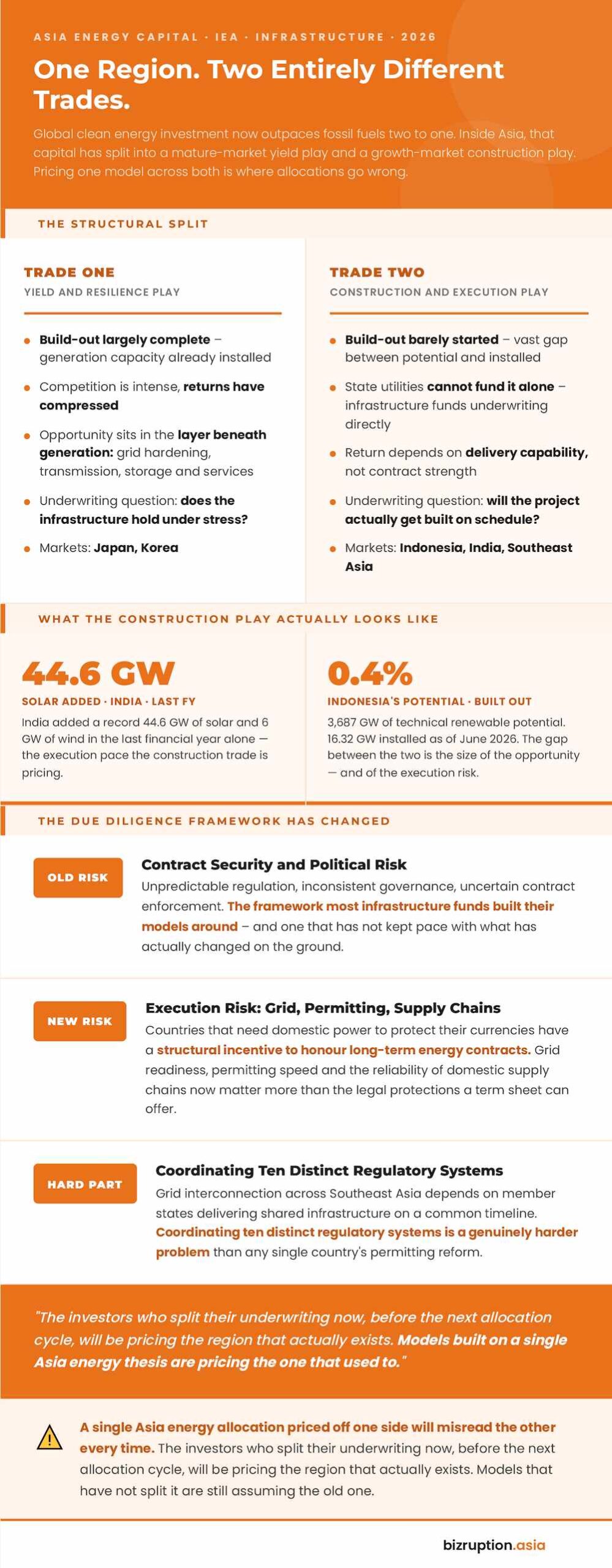
Competition in these markets is intense, permitting is established and returns have compressed accordingly. What remains attractive is the layer beneath generation: grid hardening, transmission and the storage and services infrastructure that keeps an already-built system resilient.
Southeast Asia is running a different race entirely. Fossil fuel investment in the region fell from USD 70 billion in 2015 to USD 50 billion in 2025, a 29% decline. Clean energy investment rose from USD 30 billion to USD 47 billion over the same decade, up 57%.
That is not a mature market maturing further. It is a growth market still being built, and the two should not sit in the same allocation model.
Where the Real Opportunity Sits
Indonesia illustrates the gap most starkly. The country’s Energy and Mineral Resources Ministry puts its renewable technical potential at 3,687 gigawatts. Installed renewable capacity, as of June 2026, stood at just 16.32 gigawatts, a little over 0.4% of what the resource base could theoretically support.
None of this technical potential converts into a portfolio position on its own. A gap this size, between what the resource base could support and what is actually built, cannot close from one balance sheet.
Indonesia’s state utility, PLN, cannot fund it alone. That is precisely why infrastructure funds and family offices are underwriting projects directly, rather than waiting for state capital to close it.
India shows what closing that gap looks like in practice. “We are on track,” said Pralhad Joshi, India’s Minister for New and Renewable Energy. His Ministry confirmed 283.46 gigawatts of total non-fossil capacity installed as of 31 March 2026, already past the halfway mark toward the country’s 500-gigawatt 2030 target.
By this month, that milestone had advanced further still. Non-fossil capacity climbed to 300.5 gigawatts as of 31 July 2026 – up from the 283.46 gigawatts recorded four months earlier – crossing 60% of the 2030 target. India added a record 44.6 gigawatts of solar and 6 gigawatts of wind in the last financial year alone.
The pattern holds across the region’s import-dependent economies.
Every gigawatt of domestic renewable capacity is not only a climate commitment. It is a subtraction from a fuel import bill that currency and fiscal shocks have made harder to ignore since the Strait of Hormuz closure.
The Diligence Question Has Changed
Growth-market infrastructure in Asia has long been underwritten as a political risk story: unpredictable regulation, inconsistent governance, uncertain contract enforcement.
That framework has not kept pace with what has actually changed on the ground.
Countries that need reliable domestic power to protect their currencies and fiscal positions have a structural incentive to honour long-term energy contracts, not break them. The risk has not disappeared. It has moved.
“The nature of risk is shifting from contract security to execution,” said Rahul Agrawal, Managing Director, Energy Infrastructure, Actis, in a signed column published 10 August 2026. Grid readiness, permitting speed and the reliability of domestic supply chains now matter more than the legal protections a term sheet can offer.
That is a different due-diligence exercise than the one most infrastructure funds built their models around. It rewards investors who can assess whether a project will actually get built on schedule, not just whether the contract looks defensible on paper.
Not every part of that story is settled. Grid interconnection across Southeast Asia depends on member states delivering shared infrastructure on a common timeline. Coordinating 10 distinct regulatory systems is a genuinely harder problem than any single country’s permitting reform.
Execution risk has not been eliminated. It has simply replaced a different kind of risk that investors were already pricing.
What This Means for Capital Deployment
The two trades require different underwriting entirely. One is a yield and resilience play, competing on grid and storage assets where the generation build-out is largely finished.
The other is a construction and execution play, where the return depends on delivery capability, not on the strength of the paperwork.
A single Asia energy allocation priced off one side will misread the other every time. The investors who split their underwriting now, before the next allocation cycle, will be pricing the region that actually exists. Their models still assume the old one.
References:
- Global Energy Investment Set to Rise to USD 3.3 Trillion in 2025 Amid Economic Uncertainty and Energy Security Concerns – IEA, June 2025
- Executive Summary – World Energy Investment 2025 – IEA
- Southeast Asia – World Energy Investment 2025 – IEA
- Japan and Korea – World Energy Investment 2025 – IEA
- Indonesia Has 3,687 GW Renewable Energy Potential: Ministry – ANTARA News
- India Reaches 300 GW Renewable Energy Capacity, 60% of 2030 Target – Economic Times Energy
- India Achieves Record 55.29 GW Non-Fossil Energy Capacity in FY26 – Economic Times Energy
- India on Track to Achieve 2030 Clean Energy Target – Carbon Copy
- What the Reallocation of Global Energy Capital Means for Asia – Rahul Agrawal, The Business Times