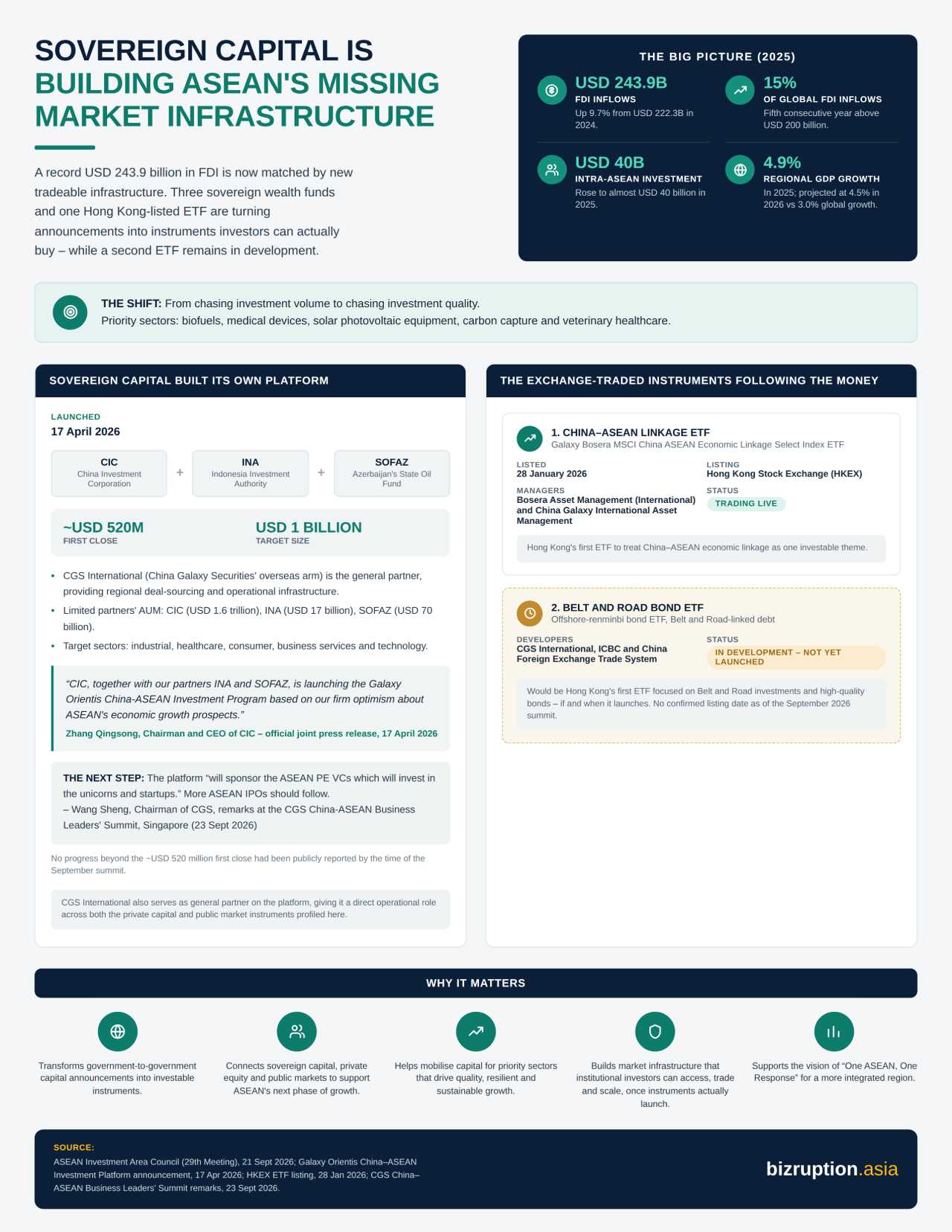
ASEAN trade ministers closed the 29th ASEAN Investment Area Council Meeting in Pasay City on 21 September 2026 with a record figure. Foreign direct investment reached USD 243.9 billion in 2025, up 9.7% from USD 222.3 billion in 2024. It marks a fifth consecutive year above USD 200 billion and 15% of global FDI inflows.
The headline number is not the story. Behind it sit three sovereign wealth funds, one Hong Kong-listed exchange-traded fund and a second bond ETF still in development. Together they begin to build channels through which institutional investors can access China-ASEAN growth: direct private-equity deployment on one side, listed equity exposure on the other.
For fund managers, the infrastructure question now matters more than the inflow figure itself.
The Number Behind the Number
Intra-ASEAN investment rose to almost USD 40 billion in 2025, Philippine Trade Undersecretary Ceferino Rodolfo confirmed at the meeting. Regional GDP grew 4.9% in 2025 and is projected at 4.5% in 2026, against 3.0% global growth, according to the ministers’ joint statement.
Merchandise trade expanded 13.7% to USD 4.4 trillion; services trade grew 7.5% to USD 1.4 trillion. The ministers reframed the mandate explicitly: from chasing investment volume to chasing investment quality. Priority sectors named include biofuels, medical devices, solar photovoltaic equipment, carbon capture and veterinary healthcare.
Philippine Trade Secretary Cristina Roque, this year’s ASEAN chair, addressed that shift at a press briefing in Manila on 19 September 2026. The reframing “creates both pressure and opportunity for ASEAN,” she told reporters, calling the region “one of the brightest economic powerhouses on Earth.”
That ambition needs a delivery mechanism. Three sovereign funds and two ETFs launched this year are the closest thing ASEAN capital markets have to one.
Sovereign Capital Built Its Own Platform
China Investment Corporation, Indonesia Investment Authority and Azerbaijan’s State Oil Fund jointly established the Galaxy Orientis China-ASEAN Investment Platform on 17 April 2026. It reached a first close of approximately USD 520 million against a USD 1 billion target.
CGS International, the overseas arm of China Galaxy Securities, serves as general partner, providing regional deal-sourcing and operational infrastructure. The platform’s limited partners are not small. CIC reported USD1.57 trillion in total assets at end-2024; INA and SOFAZ bring additional sovereign capital and regional networks to the platform. Target sectors span industrial, healthcare, consumer, business services and technology.
“CIC, together with our partners INA and SOFAZ, is launching the Galaxy Orientis China-ASEAN Investment Program based on our firm optimism about ASEAN’s economic growth prospects,” said Zhang Qingsong, Chairman and CEO of CIC, in an official joint press release issued by the three sovereign funds on 17 April 2026.
The platform was announced with a USD520 million first close and a USD1 billion target.
The Exchange-Traded Instruments Following the Money
Private capital is one channel. Public markets are the other. The Galaxy Bosera MSCI China ASEAN Economic Linkage Select Index ETF listed on the Hong Kong Stock Exchange on 28 January 2026. Bosera Asset Management (International) and China Galaxy International Asset Management co-manage it.
The fund tracks the MSCI China ASEAN Economic Linkage Select Index. It combines Hong Kong-listed southbound stocks with high ASEAN economic exposure and stocks in the MSCI AC ASEAN Index with high exposure to Hong Kong and China. The two components are reset to 65% and 35%, respectively, at each rebalance. The ASEAN component covers Singapore, Indonesia, Malaysia, the Philippines and Thailand; it does not include Vietnam.
“China-ASEAN collaboration has entered a new era,” said Zhang Dong, President of Bosera Asset Management, in remarks at the ETF’s listing ceremony on the Hong Kong Stock Exchange on 28 January 2026.
A second instrument is still being built. CGS International, the Industrial and Commercial Bank of China and the China Foreign Exchange Trade System are developing it jointly.
The target is the first offshore-renminbi bond ETF focused on Belt and Road-linked debt, not yet launched. CGS International Group CEO Carol Fong confirmed the plan in comments reported by IFR at the September summit.
“China-ASEAN flows are already happening,” Fong told IFR. The opportunity now, she said, is to make them “more transparent, more investible, more scalable.”
What the Plumbing Means for Everyone Else
A policy layer sits beneath the financial-instrument layer, and it is not yet finished either. ASEAN and China signed the Free Trade Area 3.0 Upgrade Protocol in Kuala Lumpur on 28 October 2025. The protocol expands cooperation across nine areas, including digital and green economy, supply-chain connectivity, competition and consumer protection, and support for micro, small and medium-sized enterprises.
Seven ASEAN member states had completed domestic ratification procedures by August 2026. China had not. Once China finishes its own process, the protocol takes effect within 60 days. Both sides are targeting the November 2026 ASEAN-China Summit to mark it in force.
Record FDI, a sovereign-backed private equity platform, two exchange-traded funds and an unratified trade upgrade are not four separate developments. They form a single pattern: ASEAN’s capital-markets plumbing catching up to its trade and investment volume.
That matters directly for cost of capital and liquidity. It determines whether institutional investors can buy diversified, tradeable exposure to the region, rather than negotiating bilateral access deal by deal through government channels alone.
The Close
The test for whether this becomes durable infrastructure rather than a cluster of announcements is threefold. Does CAIP reach its full USD 1 billion target. Does the Belt and Road bond ETF actually launch. Do trading volumes in the Galaxy Bosera ETF show sustained investor demand rather than novelty interest.
ASEAN is plainly attracting record capital. Whether the market infrastructure to access that growth efficiently, at scale, has caught up to the capital itself is the open question. Every allocator with regional exposure now has to answer it for their own portfolio.
References:
- ASEAN Enjoys Investors’ Trust, Logs USD 243.9 Billion FDI – Tribune (Philippines), 20 September 2026
- ASEAN Shoots for Quality Investments – Philstar.com, 21 September 2026
- ASEAN Shifts Investment Push Toward High-Value, Innovation-Driven Industries – Philippine Canadian Inquirer, 20 September 2026
- ASEAN Seeks to Attract High-Value, Innovation-Driven Investments – BERNAMA, 19 September 2026
- Three Sovereign Funds Anchor Newly Launched Galaxy Orientis China-ASEAN Investment Platform – CGS International Securities Pte. Ltd., 17 April 2026
- Establishment of Galaxy Orientis China-ASEAN Investment Platform – Allen & Gledhill
- Hong Kong Unveils First Equity ETF Targeting Premium China, ASEAN Assets – Asia News Network, 29 January 2026
- MSCI China ASEAN Economic Linkage Select Index – MSCI
- China-ASEAN Market Activity Set to Grow – IFR, September 2026
- CGS International Convenes China-ASEAN Business Leaders Summit to Deepen Capital Connectivity Across the Corridor – CGS International Securities Pte. Ltd., 23 September 2026
- China and Southeast Asian Nations Sign Upgraded Free Trade Agreement – JURIST, 29 October 2025
- China, ASEAN Sign Free Trade Area 3.0 Upgrade Protocol – Global Times, 28 October 2025
- Seven ASEAN States Complete Steps Towards ACFTA 3.0 Launch – The Nation Thailand, 3 August 2026
- ASEAN Attracts Record FDI in 2025 Amid a Shifting Global Investment Landscape – ASEAN Investment
- Three Sovereign Funds Anchor Newly Launched Galaxy Orientis China–ASEAN Investment Platform – Indonesia Investment Authority
- Galaxy Bosera MSCI China ASEAN Economic Linkage Select Index ETF – Hong Kong Exchanges and Clearing
- MSCI China ASEAN Economic Linkage Select Index- MSCI
- Middle Eastern Borrowers Revisit Asia – International Financing Review / LSEG