The 2026 Philippine CEO Survey, conducted by Isla Lipana & Co./PwC Philippines with the Management Association of the Philippines, surveyed 176 CEOs and senior business leaders across industries in the Philippines. Some 83% expressed confidence in their industry’s 12-month outlook and 81% expect revenue growth.
The same respondents cited regulatory uncertainty and climate change at 93% each, geopolitical conflict at 92%, technology disruption at 85%, and supply-chain constraints and skills shortages at 84% each.
That is not a contradiction. A company can see opportunity in the Philippine economy while recognising the operating environment has become harder to read. The more useful question is what happens when these risks stop arriving one at a time.
The Risks Stopped Arriving One at a Time
Corporate risk management typically sorts exposure into categories: geopolitical, financial, operational, cyber, supply chain, regulatory, climate, technology, talent. Each gets its own owner and its own line in the annual report. Actual disruptions rarely respect those categories.
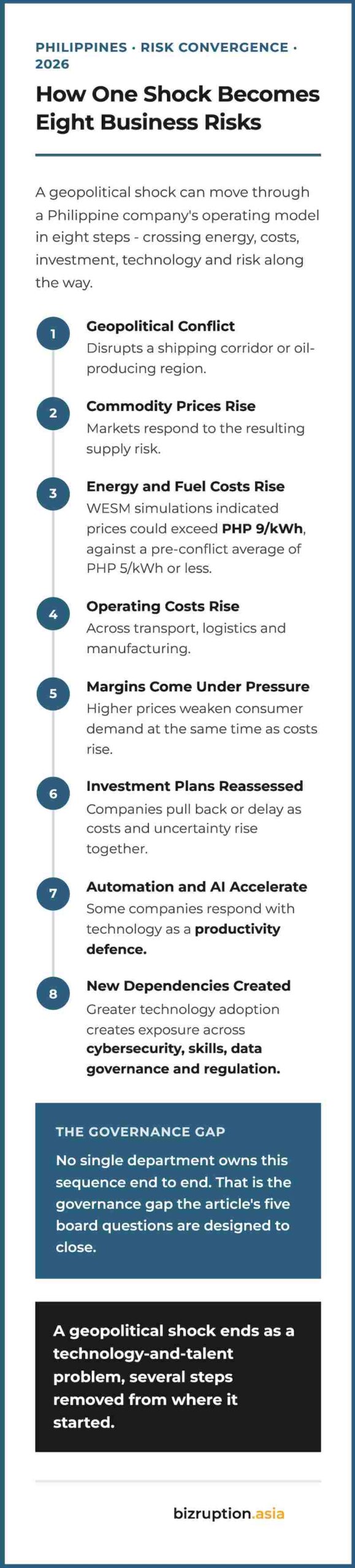
A geopolitical conflict raises oil prices. Higher oil prices raise electricity, transport and logistics costs. Higher operating costs compress margins and consumer demand. Slower demand pushes companies toward automation to protect productivity, which deepens dependence on AI, cloud infrastructure and the cybersecurity, data governance and skills base that dependence requires.
A geopolitical shock ends as a technology-and-talent problem, several steps removed from where it started.
The World Bank’s August 2026 assessment identifies two compounding shocks weighing on the economy: policy uncertainty and a surge in global energy prices. The Bank held its 2026 growth forecast at 3.7%, down from 4.4% in 2025. Headline inflation averaged 4.8% in the first half, driven largely by energy costs.
Energy Is Where the Chain Starts
The clearest evidence of convergence sits in the energy system, because the Philippines is a net importer of petroleum products and remains exposed to global fuel markets.
After hostilities involving the United States, Israel and Iran began on 28 February 2026, the Strait of Hormuz, a critical corridor for global oil shipments, was closed to shipping. On 24 March 2026, President Ferdinand Marcos Jr declared a state of national energy emergency under Executive Order No. 110.
Initial Independent Electricity Market Operator of the Philippines (IEMOP) simulations indicated that the Wholesale Electricity Spot Market (WESM) supply could exceed PHP9/kWh, compared with pre-conflict average WESM prices of PHP5/kWh or less.
For energy-intensive businesses, a WESM price spike can feed into procurement and tariff costs, depending on their supply contracts and exposure to spot-market pricing. It is an input-cost risk that can move faster than annual budgeting cycles can absorb.
The World Bank’s June 2026 financing package for Philippine energy and water security linked affordable, reliable electricity directly to business growth and investment, while highlighting reduced exposure to global fossil-fuel price shocks as a resilience priority.
The IMF’s 2026 assessment of Asia’s exposure to the same shock found the effects running through inflation, external balances and narrower monetary policy space, with knock-on disruption to fertiliser and petrochemical supply chains.
Its Philippines Article IV consultation separately named heightened geopolitical tension a downside risk precisely because it generates commodity volatility that reaches confidence, investment, tourism, trade and supply chains simultaneously, and can quickly move beyond the government-affairs function that first identifies it.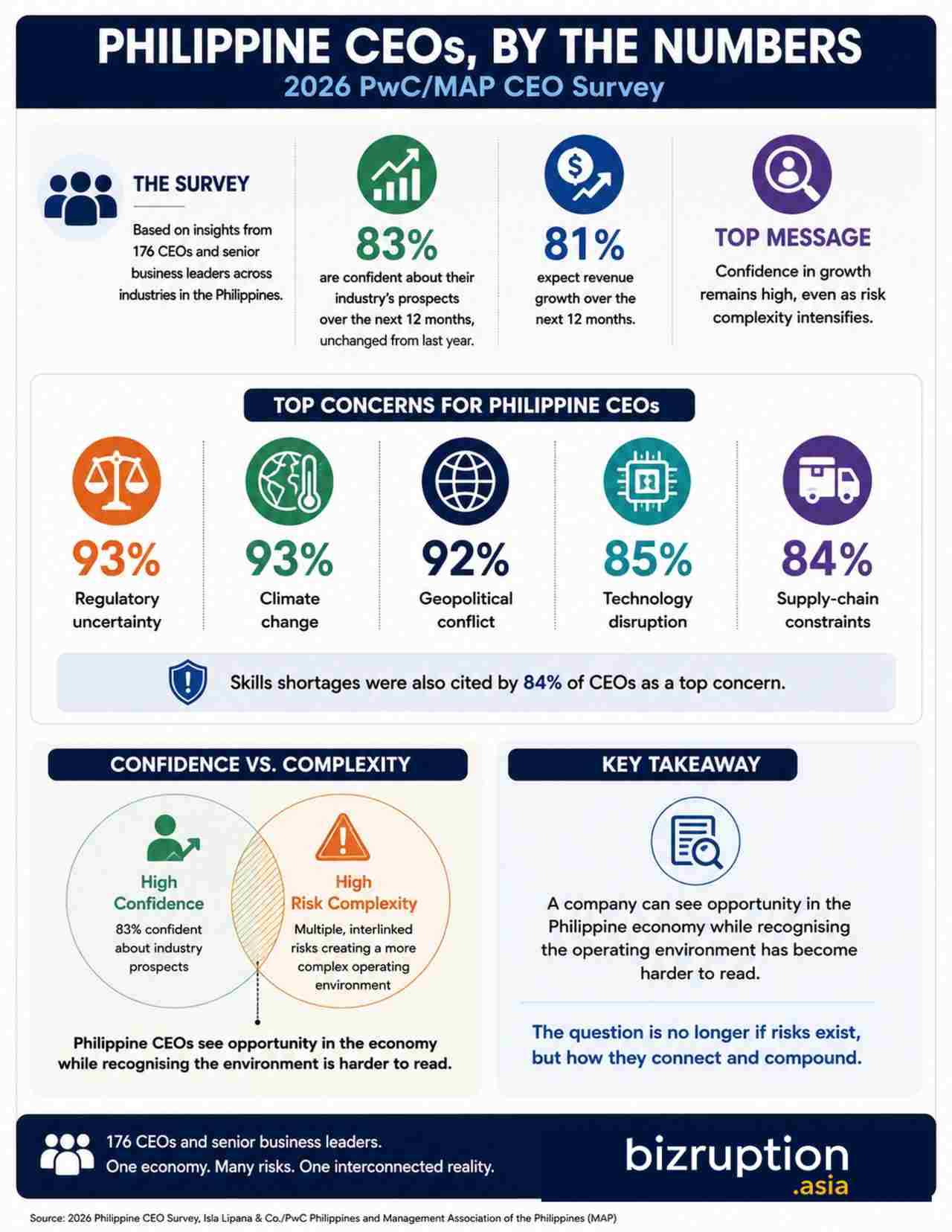
AI Adoption Is Compressing Several Risks Into One
More than eight in 10 surveyed CEOs have incorporated AI into their strategic or business plans, up from 68% a year earlier, and 79% have begun implementing AI initiatives. Read against the same survey’s 85% concern about technology disruption, 84% about skills shortages and 82% about cyber risk, AI adoption is not one more item on the risk register. It is the mechanism connecting several existing ones.
AI adoption requires specialist skills. Meeting that gap increases dependence on external providers and platforms. Platform dependence raises cybersecurity and data-governance exposure, which intersects directly with regulatory compliance, a concern already topping the survey at 93%.
In July 2026, President Marcos signed Executive Order 119, updating government data classification and establishing a risk-based data residency framework for government data, against a backdrop of expanding cloud and AI infrastructure. The 2026 Strategic Investment Priority Plan identifies cybersecurity, artificial intelligence and data science among its priority activities.
Meeting rising compute demand also raises electricity consumption, looping the chain back to the energy exposure above. The IMF has separately warned that AI and cloud dependency can create concentration risk, where an outage or breach at a single critical provider affects multiple institutions at once.
The Philippines is expanding its AI infrastructure regardless: its AI+ Infrastructure Masterplan 2026–2033 targets a 30-fold expansion in AI data-centre capacity, from a 50MW baseline to 1.5GW by 2033.
The binding constraint on all of this may increasingly be execution rather than capital. Skills shortages sit at 84% in the same survey, and the IMF’s Philippines assessment identifies skills development as central to digitalisation, including the exposure this creates for the country’s outsourcing sector.
The constraint is organisational: whether a company can recognise an interconnected risk quickly enough to act before the chain reaction it triggers has run its course.
Five Questions Replace the Old Risk Register
The shift for boards is from listing risks independently to interrogating how they interact. Five questions can reveal what a conventional risk matrix may miss:
- Where are the critical dependencies across energy, suppliers, cloud, data, logistics, geography, financing and talent?
- Which risks amplify each other when two or three materialise together?
- What happens to unit economics under simultaneous stress from energy prices, currency movement, supply disruption and higher financing costs?
- Where is transformation creating new dependencies, particularly through AI and cloud?
- Which investments improve growth and resilience at the same time, rather than trading one for the other?
None of this replaces conventional risk management. It reorganises it around connections a category-based register cannot see.
Where the Convergence Becomes an Advantage
The Philippines is not short of policy momentum to work with. Digital infrastructure, AI, renewable energy, semiconductor investment and the Luzon Economic Corridor all sit inside the same growth agenda the government has set out.
Companies that understand interconnected risk can do more than limit exposure. The same visibility that helps them prepare for compounding shocks can also improve how quickly they identify and act on opportunities.
The Philippines is not facing one defining business risk. It is facing an environment in which geopolitics, energy, technology and talent increasingly move together. The question for management is no longer simply which risks are biggest. It is which risks amplify each other, and what happens when several land at once.
References:
- Philippine CEOs Still Confident Despite Risks – BusinessWorld / Metrobank Wealth Insights
- PH Reaches Upper-Middle-Income Status, Bolder Reforms Critical for More Inclusive Growth – World Bank
- World Bank Group Backs Philippines’ Push for Energy and Water Security – World Bank
- DOE Enforces Emergency Measures to Keep Power Stable, Protect Consumers From Price Spikes – Department of Energy Philippines
- Asia’s Economic Resilience Is Being Tested by the Energy Shock – IMF
- Philippines 2025 Article IV Consultation – IMF eLibrary
- How Central Banks Can Contain Financial Stability Risks as AI Accelerates Change – IMF
- The Philippines Is Building a Digital Economy for Economic Growth – Presidential Communications Office
- President Marcos Signs EO 119, Unlocking Digital Infrastructure Growth and Strengthening Philippine Data Security – Philippine Information Agency
- Philippines Launches AI+ Infrastructure Masterplan 2026-2033 – Philippine News Agency
- World Bank Lowers Philippines Growth Outlook – Philippine Star
- ERC Suspends Electricity Trading as Prices Set to Surge – BusinessWorld
- Leading with Confidence, Reinventing Tomorrow: 2026 Philippine CEO Survey – PwC Philippines and the Management Association of the Philippines