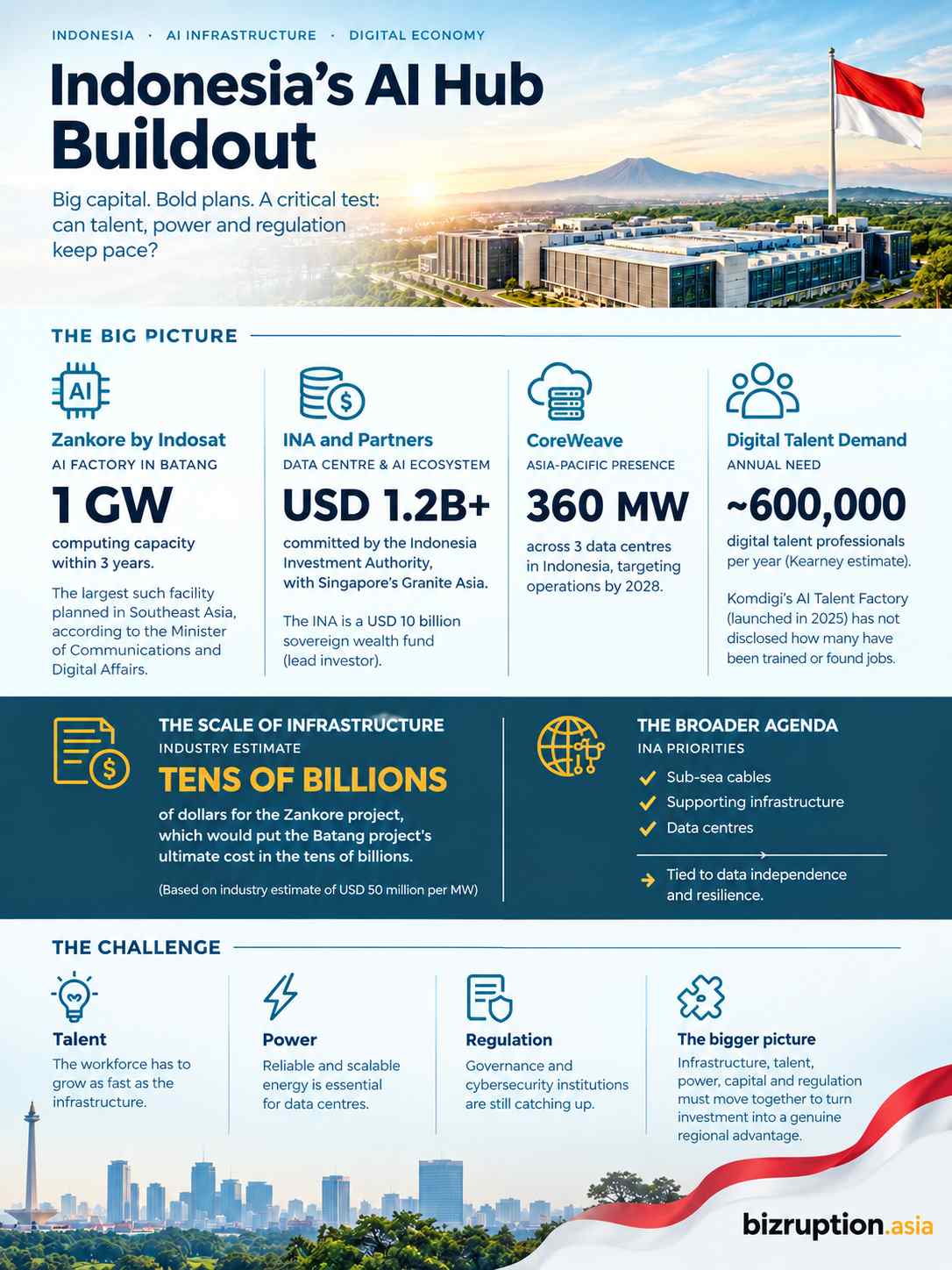
Indosat Ooredoo Hutchison, Ooredoo Group, Nokia and Nvidia announced Zankore by Indosat on 10 August 2026. The AI Factory in Batang, Central Java, is designed to reach one gigawatt of computing capacity within three years. Communications and Digital Affairs Minister Meutya Hafid called it the largest such facility planned in Southeast Asia.
It is one signal among several. The Indonesia Investment Authority, the country’s USD 10 billion sovereign wealth fund, is a lead investor. Alongside Singapore’s Granite Asia, it has committed more than USD 1.2 billion to Indonesia’s data centre and AI ecosystem.
CoreWeave has chosen Indonesia for its first Asia-Pacific data-centre presence: three facilities totalling 360 megawatts, targeting operations by 2028. Scale alone does not make a hub.
The Constraint Isn’t Capital
The capital is arriving faster than the workforce to use it. Consultancy Kearney estimates Indonesia’s digital talent demand at around 600,000 professionals a year. Komdigi’s own AI Talent Factory programme, launched in 2025, has not disclosed how many participants it has trained, or how many have found jobs.
The government is not treating this as a real-estate story. Indonesia Investment Authority’s Chief Investment Officer, Christopher Ganis, has named sub-sea cables and supporting infrastructure alongside data centres as priorities. Officials tie that explicitly to data independence and resilience.
Zankore’s own economics illustrate the scale required. Industry estimates put end-to-end AI infrastructure investment at around USD 50 million per megawatt. That would put the Batang project’s ultimate cost in the tens of billions of dollars.
That is the case for optimism. It is also the case for caution. Connectivity, power, talent, capital and regulation all have to move together for infrastructure to become genuine regional advantage rather than a collection of announcements.
This main analysis on Indonesia’s cybersecurity governance gap, “The Governance Behind Indonesia’s Digital Opportunity,” makes the same point from the risk side. The institutions meant to govern this investment are still catching up to it.
The infrastructure case and the governance case are not separate stories. They are the same story, told from opposite ends.
What Indonesia Has That Its Neighbours Don’t
None of this guarantees Indonesia converts scale into regional leadership. Vietnam, Malaysia and Singapore are each building their own version of the same pitch, with their own power grids, talent pipelines and regulatory offers.
What Indonesia has that its neighbours cannot easily match is domestic demand. Its market is large enough that infrastructure built for its own digital economy can also serve the region. Sahabat-AI, the open-source Indonesian-language model set to run on Zankore’s capacity, is a bet on exactly that domestic base.
The right question for investors is not whether Indonesia is building. It plainly is, at a pace few ASEAN peers can match. It is whether the harder inputs, trained people, reliable power, coordinated regulation, arrive on the same timeline as the capital. Indonesia has answered the capital question.
The rest of the answer is still being written.
References:
- Indonesia Unveils 1 GW AI Factory Plan Backed by Indosat, Ooredoo, Nokia and Nvidia – TechApple Global
- Indonesia: 1GW AI Factory to Strengthen Regional AI Hub Ambitions – OpenGov Asia
- INA Positions Indonesia For AI Era With ‘Pick-And-Shovel’ Infrastructure Bet – Indonesia Investment Authority
- Indonesia Sovereign Wealth Fund INA Targets Data Centres, AI in Healthcare, Renewables – Digital Watch Observatory
- Indonesia and Indosat Collaborate on an AI Supply Chain – Indonesia Business Post
- Indonesia’s Komdigi Expands AI Talent Factory Programme – Asia Business Outlook
- Indonesia’s AI Factory Ambition Faces Investment and Ecosystem-Readiness Constraints – AFU.id