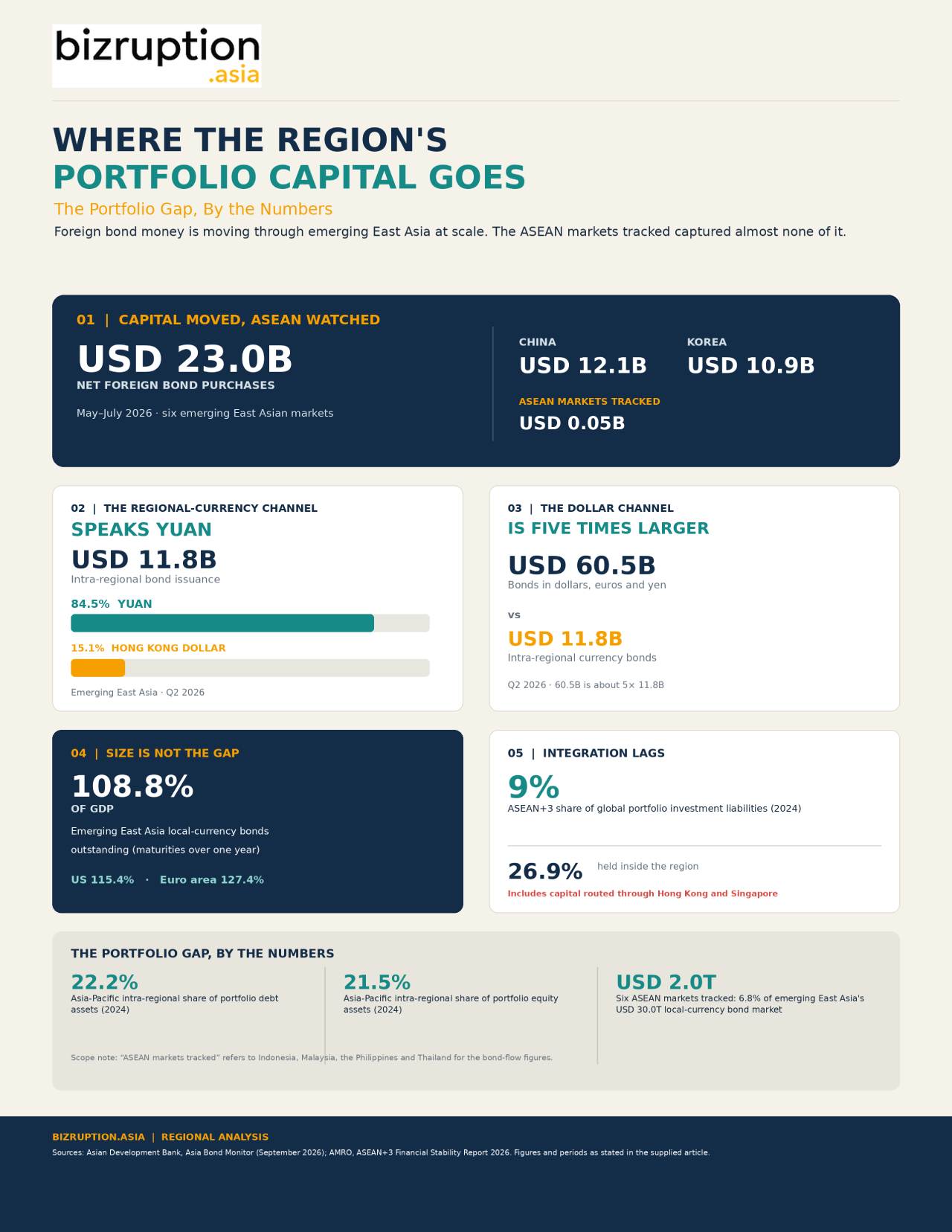
The Asian Development Bank (ADB) reports USD 23.0 billion of net foreign purchases across six emerging East Asian local-currency bond markets from May to July 2026. China received USD 12.1 billion and Korea USD 10.9 billion. The ASEAN markets covered by the data – Indonesia, Malaysia, the Philippines and Thailand – received combined net inflows of USD 0.05 billion.
In equities, capital moved in the other direction. Between 01 June and 31 August, foreign investors withdrew USD 68.1 billion from the six emerging East Asian equity markets covered by ADB’s data. Korea and China accounted for almost all of it. The four ASEAN markets in the dataset – Indonesia, the Philippines, Thailand and Vietnam – recorded combined net outflows of about USD 1.3 billion.
Capital is moving through emerging East Asia – ADB’s term for ASEAN plus China, Hong Kong and Korea – at scale. But in this three-month bond snapshot, the ASEAN markets captured almost none of the net inflow. For a fund manager, that is an exit-liquidity question. For a CFO, it is a funding-currency question.
The ASEAN+3 Macroeconomic Research Office (AMRO) frames the wider gap in its ASEAN+3 Financial Stability Report 2026, released on 5 October. ASEAN+3 means ASEAN plus China, Hong Kong, Japan and Korea.
The grouping accounts for roughly 30% of global trade but only 9% of global portfolio investment liabilities, based on 2024 data. The constraint is not economic size. It is financial plumbing.
Portfolio Integration Lags Every Other Link
Only 26.9% of ASEAN+3’s portfolio investment liabilities in 2024 were held by investors inside the region, according to AMRO. That sits far below the region’s intra-regional trade and direct-investment links.
Even that figure flatters the region. Hong Kong and Singapore intermediate substantial amounts of capital originating outside ASEAN+3. Part of the 26.9% therefore reflects global money routed through regional financial centres, rather than savings generated and allocated within the region.
ADB reaches the same conclusion on a wider base. Across its 50 Asia-Pacific regional members, financial integration remains the weakest dimension and trails the European Union plus the United Kingdom. In 2024, 22.2% of portfolio debt assets and 21.5% of equity assets were invested within the region.
Those shares edged higher during the year, but ADB’s broader integration indicators show that intra-regional financial links have declined since 2021.
Foreign direct investment builds a plant that may remain for decades. Portfolio money buys shares and bonds that can be sold in a day. A region rich in the first and thin in the second has patient production capital but shallower regional markets through which to price, finance and exit that investment.
The factory half of the headline has a basis. AMRO links ASEAN+3’s direct-investment integration to production and investment ties between ASEAN and the Plus-3 economies – China, Hong Kong, Japan and Korea. Within ASEAN itself, intra-ASEAN investment accounted for about 14% of FDI inflows in 2024.
Regional-Currency Funding Is Largely a Yuan Channel
ADB classifies debt as intra-regional issuance when an issuer borrows in the currency of another emerging East Asian economy. Total intra-regional debt issuance reached USD 17.0 billion in the second quarter of 2026. Excluding bills and other instruments with maturities of one year or less, issuance amounted to USD 11.8 billion.
The Chinese yuan accounted for 84.5% of total intra-regional issuance and the Hong Kong dollar another 15.1%. ASEAN issuers borrowed in another regional currency only through yuan and Hong Kong dollar-denominated instruments. Across emerging East Asia, 79.6% of intra-regional issuance had maturities of five years or less.
The measure needs careful reading. Hong Kong issuers supplied 76.2% of total intra-regional debt issuance during the quarter. The number therefore captures the offshore yuan market and Hong Kong’s role as an intermediary more than it demonstrates broad ASEAN-to-ASEAN lending.
For an ASEAN treasurer, borrowing in another regional currency effectively meant borrowing in yuan or Hong Kong dollars that quarter. The external-currency channel was considerably larger. Excluding instruments with maturities of one year or less, emerging East Asian issuers sold USD 60.5 billion of bonds denominated in US dollars, euros and yen; about five times the comparable USD 11.8 billion regional-currency total.
Size is not the obstacle. Emerging East Asia’s local-currency bonds outstanding, excluding securities with maturities of one year or less, reached USD 30.0 trillion in June 2026. That was equivalent to 108.8% of GDP, compared with 115.4% in the United States and 127.4% in the euro area.
China accounted for 85.2% of that total. The six ASEAN markets covered by ADB accounted for USD 2.0 trillion or 6.8%.
Europe’s Passport Waited 30 Years for Its Pipes
Europe introduced the Undertakings for Collective Investment in Transferable Securities framework, better known as UCITS, in 1985. Its pan-European securities-settlement platform, TARGET2-Securities, began operating in June 2015.
The fund passport initially received a lukewarm market response, which European authorities attributed partly to the absence of standardised frameworks for a single cross-border market.
ADB’s 2022 study on collective investment scheme transactions in ASEAN+3 was written by Satoru Yamadera of the Cross-Border Settlement Infrastructure Forum secretariat and Ki Hoon Ro of the Korea Securities Depository. They wrote that Europe viewed settlement “not as back-office plumbing but as one of the crucial game changers.”
ASEAN’s passport, the ASEAN Collective Investment Schemes Framework, was launched on 25 August 2014 by regulators in Malaysia, Singapore and Thailand.
The ASEAN Capital Markets Forum maintains a register of qualifying schemes. As retrieved on 13 October 2026, the register identified at least five home-approved funds that had not yet been offered across borders. The latest home approval among those funds was dated 15 November 2021.
Distribution points in the same direction. At the end of 2020, approximately 92% of foreign funds offered in Singapore, measured by number of funds, were domiciled in Luxembourg or Ireland.
Settlement infrastructure also lagged. At the end of 2020, only three ASEAN+3 economies surveyed by ADB – Indonesia, Japan and Korea – linked their fund-processing or securities-depository systems to central banks for delivery-versus-payment settlement.
Delivery versus payment links the transfer of securities to the corresponding cash payment, reducing the risk that one side performs while the other fails.
The ASEAN Capital Markets Forum began implementing initiatives under its Action Plan 2026-2030 at its 44th Chairs’ Meeting in the Philippines on 26 March 2026. It reported progress on the ASEAN Collective Investment Schemes Framework.
Other integration measures included ASEAN Diamonds, a proposed selection of well-governed regional companies, alongside studies of cross-listings, depositary receipts and ASEAN indices.
Francis Ed. Lim, chair of the ASEAN Capital Markets Forum in 2026 and chairperson of the Securities and Exchange Commission Philippines, said on 31 January that the forum was pursuing initiatives that “accelerate the integration of ASEAN’s financial ecosystems.”
AMRO includes the ASEAN Collective Investment Schemes Framework among regional initiatives that have yet to generate sufficient commercial scale. Product-based mechanisms may widen formal market access, but they do not by themselves resolve fragmented tax treatment, thin secondary-market liquidity, inconsistent investor protections or mismatched settlement cycles.
Even the Benchmark Leaks Savings to the US
Europe is an imperfect yardstick. The European Central Bank reported on 7 May 2026 that euro-area financial integration had improved markedly since late 2022. Equity integration, however, had declined. Cross-border equity investment within the euro area was stagnating, while a significant portion of equity investment continued to flow outside the European Union.
Christine Lagarde, President of the European Central Bank, described the problem at the 34th European Banking Congress in Frankfurt on 22 November 2024. Capital, she said, is either “trapped within national borders or leaves for the United States.”
Enrico Letta, the former Prime Minister of Italy, estimated that approximately EUR 300 billion of European household savings was diverted abroad each year, primarily to the United States. He made the estimate in his April 2024 report to the European Council.
Asia shows the same directional pull. AMRO finds that the United States is the largest outward portfolio-investment destination for almost every major ASEAN+3 economy when the data are assessed on an ultimate-investor basis.
European parity is therefore not the right target. The test is whether regional channels provide the settlement infrastructure, hedging instruments and domestic institutional-investor base required to make retaining capital within the region commercially rational.
ADB’s recommendations point in the same direction: strengthen the regional institutional-investor base, expand hedging instruments and promote regulatory harmonisation.
Vietnam shows why infrastructure still matters. Foreign investors were net sellers of Vietnamese equities between 1 June and 31 August. ADB reports that margin calls and forced selling associated with elevated margin lending exacerbated a sharp market correction in July. FTSE Russell’s reclassification of Vietnam from Frontier to Secondary Emerging market status became effective on 21 September 2026.
At a seminar on 2 June, the chairwoman of Vietnam’s State Securities Commission said the country’s central counterparty clearing mechanism was expected to become operational in the first quarter of 2027.
The ASEAN Capital Markets Forum’s current action plan runs to 2030. Until the pipes arrive, allocators should price the integration gap into their exit-liquidity assumptions. Treasurers should audit how much regional-currency funding depends on a single regional currency.
References:
- ASEAN+3 Financial Stability Report 2026 – ASEAN+3 Macroeconomic Research Office, October 2026
- Chapter 3: Advancing ASEAN+3 Financial Market Integration – ASEAN+3 Macroeconomic Research Office, October 2026
- Asia Bond Monitor, September 2026 – Asian Development Bank
- Asian Economic Integration Report 2026 – Asian Development Bank
- Collective Investment Scheme Transactions in ASEAN+3 – Asian Development Bank, September 2022
- ASEAN Investment Report 2025 – ASEAN Secretariat and UN Trade and Development
- ASEAN Collective Investment Schemes Register – ASEAN Capital Markets Forum
- Facilitating Cross-Border Offers of Collective Investment Schemes – Monetary Authority of Singapore, 25 August 2014
- ACMF Sets 2026 Priorities in Motion at 44th Chairs’ Meeting – Financial Services Authority of Indonesia, 26 March 2026
- ACMF Action Plan 2026–2030 – ASEAN Capital Markets Forum
- Philippines Pushes ASEAN Market Integration – Daily Tribune, 31 January 2026
- Euro-Area Financial Integration Improves Despite Persistent Fragmentation – European Central Bank, 7 May 2026
- Follow the Money: Channelling Savings into Investment and Innovation – Christine Lagarde, European Central Bank, 22 November 2024
- Much More Than a Market – Enrico Letta, Report to the European Council, April 2024
- TARGET2-Securities Successfully Launched – European Central Bank, 22 June 2015
- FTSE Russell Confirms Vietnam’s Reclassification – FTSE Russell, 7 April 2026
- Securities Watchdog Plans Legal Overhaul to Boost Foreign Investor Access – Viet Nam News, 3 June 2026