*Photo: World Bank Group
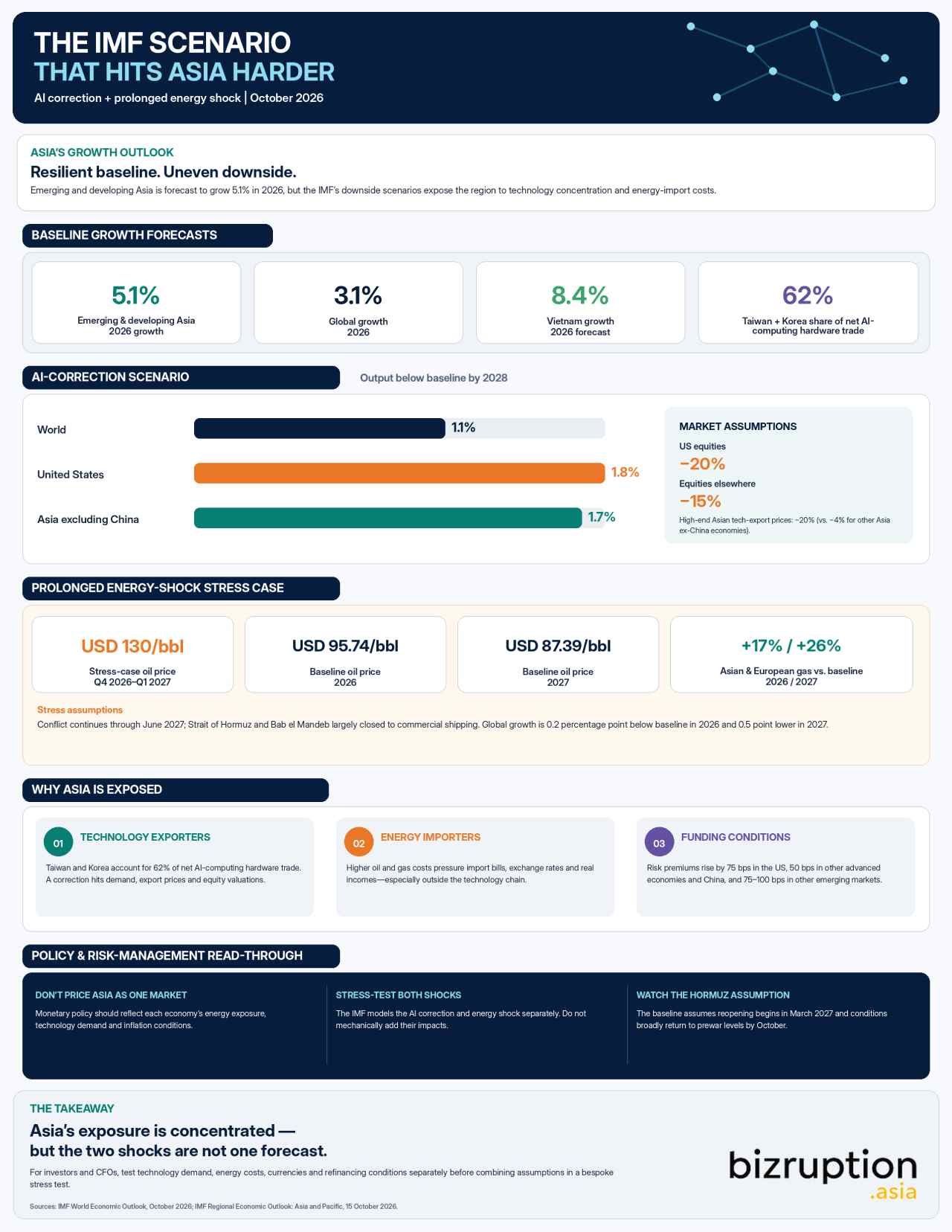
The IMF’s October World Economic Outlook, released during its Bangkok meetings in October 2026, forecasts emerging and developing Asia growth of 5.1% in 2026. That is 0.1 percentage point above its July estimate and two points above projected global growth of 3.1%.
Technology demand explains much of the resilience. But the IMF’s downside scenarios show Asia is exposed to two distinct risks: an AI investment correction and a prolonged energy shock.
For fund managers, the correction hits technology exporters while the oil shock hits energy importers outside the technology chain. For CFOs, the risks arrive through demand, energy costs, exchange rates and funding conditions.
Much of the Upside Surprise Came From the Technology Chain
The IMF’s July update attributed much of the positive first-quarter surprise to technology. Taiwan Province of China, Korea, Thailand and Malaysia – the IMF’s four largest net exporters of AI-related hardware – beat its April growth forecasts by an average 4.4 percentage points at annualised rates.
Korea grew at an annualised 7.5%, against the IMF’s April forecast of 1.8%, despite its dependence on imported Middle Eastern energy. Vietnam’s 2026 forecast rose from 7.5% in July to 8.4% in October, supported by stronger technology exports and domestic demand.
Supply is concentrated. Taiwan and Korea account for 62% of net trade in AI-related computing hardware. Kristalina Georgieva, the IMF Managing Director, warned in Bangkok that dependence on a single growth engine is “like we stand on one leg.”
The Correction Lands Where the Chips Are Made
In the IMF’s AI-correction scenario, expected productivity gains fail to materialise. Technology investment falls, US equities decline 20% in 2026 and equities elsewhere drop 15%.
Corporate risk premiums rise by 75 basis points in the United States, 50 basis points in other advanced economies and China, and 75-100 basis points in other emerging markets. Higher risk premiums raise refinancing costs for companies and governments.
By 2028, global output is 1.1% below baseline and US output is 1.8% lower. Asia excluding China is 1.7% below baseline. China benefits initially from a weaker US dollar; other regions face weaker external demand and tighter financial conditions.
The direct investment unwind reduces global output by as much as 0.4%. Financial tightening, lower consumption and bond-market spillovers deepen the total global loss to 1.1%.
Asian losses concentrate in high-end technology exporters. Their export prices fall 20%, against 4% for other economies in Asia excluding China. The IMF’s Asia-Pacific outlook says an AI correction could weigh disproportionately on Asia because of its central role in the technology production chain.
On 13 October, the Korea Composite Stock Price Index (Kospi) closed 5.46% lower. Samsung Electronics fell 7.39% and SK Hynix declined 10.09%. One session is not the IMF’s correction scenario, but it showed how quickly concentrated technology exposure can transmit through markets.
Energy Importers Outside the Chain Face the War’s Costs
The IMF says energy importers with limited technology-chain exposure face higher import costs, exchange-rate pressure and weaker real incomes. Its baseline assumes petroleum prices of USD 95.74 a barrel in 2026 and USD 87.39 in 2027.
Gulf crude exports averaged 16.7 million barrels a day in September, equivalent to 88% of prewar levels. Global oil reserves were being depleted by about 2.7 million barrels a day, approaching levels that could trigger nonlinear price adjustments.
The IMF’s stress case assumes conflict continues through June 2027, with the Strait of Hormuz and Bab el Mandeb largely closed to commercial shipping. Oil reaches USD 130 a barrel from the fourth quarter of 2026 through the first quarter of 2027.
Asian and European gas benchmarks run 17% above baseline in 2026 and 26% higher in 2027. Global growth falls 0.2 percentage point below baseline in 2026 and 0.5 point in 2027.
The IMF’s Policy Advice Splits Economies by Exposure
The IMF’s monetary guidance divides economies by energy exposure, technology demand and inflation conditions. The case for tightening is stronger where technology demand is lifting activity and prices, especially when inflation is already above target.
For energy importers, central banks may look through an initial fuel-price shock if it is temporary and inflation expectations remain anchored. But nominal rates may still need to rise to preserve the real policy stance.
Where energy importers face weaker growth outside the technology chain, eventual easing may be justified if underlying inflation recedes. The IMF says any easing should be gradual and data-dependent.
Silvana Tenreyro, the IMF’s Economic Counsellor and Director of Research, told reporters: “The outlook is highly uneven.” A single regional view on rates therefore risks mispricing Asia’s divergent exposures.
The Case the IMF Does Not Publish
The IMF’s baseline assumes the Strait of Hormuz begins reopening in March 2027 and conditions broadly return to prewar levels by October. It models the extended energy shock and AI correction separately; it does not publish a combined case.
The risks are nevertheless connected. The IMF warns that energy-market disruption could endanger the AI-led impetus because AI infrastructure and operations are energy intensive. Ayhan Kose, the World Bank’s Deputy Chief Economist, warned that “resilience today is not a guarantee for resilience tomorrow.”
Allocators should construct the combined stress test themselves. The IMF uses separate models for the energy shock and the AI correction, so their effects should not be mechanically added. But testing Asian exposures against USD 130 oil and a 15% non-US equity decline is prudent before early 2027 tests the Hormuz assumption.
References:
- World Economic Outlook, October 2026: Resilience Under Strain, Urgent Choices – International Monetary Fund, 13 October 2026
- Chapter 1: Global Prospects and Policies – International Monetary Fund, October 2026
- Statistical Appendix Table A, World Economic Outlook – International Monetary Fund, October 2026
- World Economic Outlook Update: Global Economy in Crosscurrents of War and Technology – International Monetary Fund, July 2026
- Regional Economic Outlook: Asia and Pacific – International Monetary Fund, 15 October 2026
- International Monetary and Financial Committee Press Briefing – International Monetary Fund, 17 October 2026
- World Economic Outlook Press Briefing Transcript – International Monetary Fund, 13 October 2026
- Seoul Shares Fall More Than 5% in Technology Sell-Off – Yonhap News Agency, 13 October 2026
- IMF and World Bank Meetings Leave Developing Countries With More Questions Than Answers – Reuters, 18 October 2026