Indonesia’s markets are sending a mixed message. On 12 November, the Jakarta Composite Index rose 2.66%, while the rupiah weakened to a record low. The moves came amid a stronger US dollar, concerns over MSCI’s proposed reclassification of Indonesia and uncertainty about the country’s political and economic direction.
Neither movement alone proves a shift in investor confidence. Together, however, they point to a more consequential question: can Indonesia sustain the flow of capital needed to finance its ambitions when the risks attached to that capital are becoming harder to price?
Growth is not the same as investability
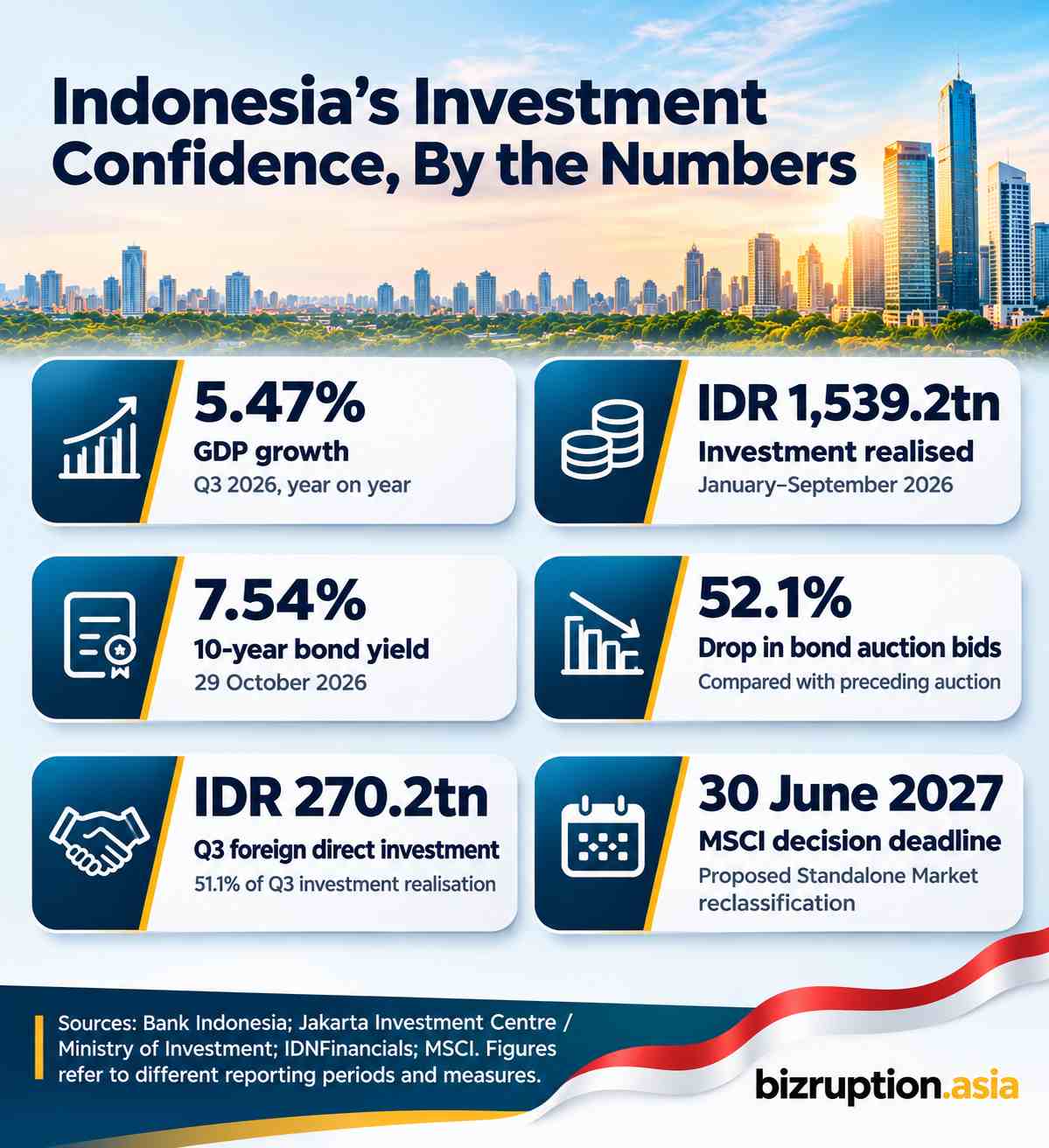
The economic case remains substantial. GDP grew 5.47% year on year in the third quarter of 2026. Investment realisation reached IDR 1,539.2tn in the first nine months, up 7.3% from a year earlier.
But these figures measure economic activity and capital deployed, not the willingness of international investors to buy Indonesian securities or the returns they can ultimately realise. Foreign direct investment – tied to businesses and projects over longer periods – behaves differently from portfolio capital, which can be withdrawn more quickly when risk perceptions change.
That distinction matters as Indonesia pursues an ambitious development agenda. Danantara is expected to help mobilise capital for strategic projects. Its ability to do so will depend not only on the projects it identifies, but on whether investors trust the governance, financing structures and accountability surrounding them.
The IMF’s January 2026 assessment welcomed Indonesia’s resilience but called for robust governance and accountability around Danantara. Its concern was that poorly controlled quasi-fiscal activities and contingent liabilities could create vulnerabilities. The issue is not that such liabilities have already materialised; it is that investors need clarity about where risks sit and who ultimately bears them.
The cost of a weaker rupiah
Currency weakness is more than a translation problem for foreign investors. A weaker rupiah raises the local cost of imported equipment and foreign-currency debt servicing. For infrastructure and industrial projects that rely on imported inputs, it can erode margins and alter project economics. Companies earning in rupiah but borrowing in dollars face a similar mismatch.
The pressure extends to the public balance sheet. Higher yields increase the cost of new government borrowing and refinancing, although they do not immediately reprice all outstanding fixed-rate debt. Indonesia’s 10-year government bond yield reached 7.54% on 29 October, its highest level in nearly four years.
If elevated yields persist, debt servicing can take a larger share of future revenue, narrowing the room for infrastructure and other development spending. Higher financing costs can also make private projects less viable, particularly those dependent on regulated prices, government contracts or long payback periods.
Transparency is part of the financing infrastructure
MSCI’s proposed reclassification has put market accessibility under scrutiny. Its 15 October consultation raised concerns about opaque shareholding structures, suspected coordinated trading and the effectiveness of enforcement. MSCI has invited feedback until 30 April 2027, with a decision expected by 30 June. A move to Standalone Market status is a proposal, not a completed downgrade.
The distinction between market size and market accessibility is crucial. Indonesia can have large listed companies and attractive valuations yet still fall short of the transparency and investability standards expected by international institutions.
A reclassification could prompt passive funds tracking emerging-market benchmarks to adjust their holdings. Active managers would retain discretion, but a narrower benchmark investor base could weigh on liquidity and valuations. For companies seeking equity financing, fewer institutional buyers can make capital raising harder and reduce the pool of potential buyers at exit.
Market transparency is therefore not simply a regulatory concern. It is part of the infrastructure that allows companies to access capital and investors to realise returns.
What the growth agenda requires
Indonesia’s domestic market, industrial opportunities and infrastructure needs remain compelling. But growth potential and investment confidence are not interchangeable. Investors will not necessarily follow strong growth forecasts if they cannot assess the rules governing their investments, the cost of financing or the conditions under which they can exit.
For Danantara, the test is whether it can mobilise private and foreign capital through transparent structures, credible oversight and commercially intelligible risk-sharing. For private investors, currency exposure, borrowing costs, regulatory implementation and exit liquidity need to be assessed together, not as separate variables.
Indonesia does not need to choose between growth and investor confidence. Sustaining the former will depend partly on restoring the conditions that support the latter. The opportunity remains substantial. The question is whether the investment environment can give capital enough predictability to stay.
The decisive measure is not how much capital Indonesia attracts at entry, but whether it can create the conditions for that capital to remain productive and deliver sustainable returns.
References:
- Indonesia’s Economy Grows 5.47% in Third Quarter of 2026 – Bank Indonesia, November 2026
- Indonesia Maintains Positive Investment Realisation in Q3 2026 – Jakarta Investment Centre, 3 November 2026
- Indonesian Bond Yields Hit 7.54% as Interest Waned – IDNFinancials, 29 October 2026
- Investors Cold on RI Bonds Since MSCI Warning – The Jakarta Post, 28 October 2026
- MSCI Launches a Consultation on a Proposal to Reclassify Indonesia from Emerging Market to Standalone Market Status – MSCI, 15 October 2026
- IMF Executive Board Concludes 2025 Article IV Consultation with Indonesia – International Monetary Fund, 21 January 2026
- Market Update 13 November 2026 – J Trust Bank, 13 November 2026
- Indonesia’s Investment Realisation Reaches IDR 1,539.2 Trillion Through September – State Secretariat of the Republic of Indonesia, 19 October 2026