Thailand’s Cabinet approved a THB 15.5 billion national disaster insurance scheme on 15 September 2026. By 26 September, Bangkok had declared all 50 districts disaster-affected. The scheme was not due to take effect until 1 October. The flood did not wait.
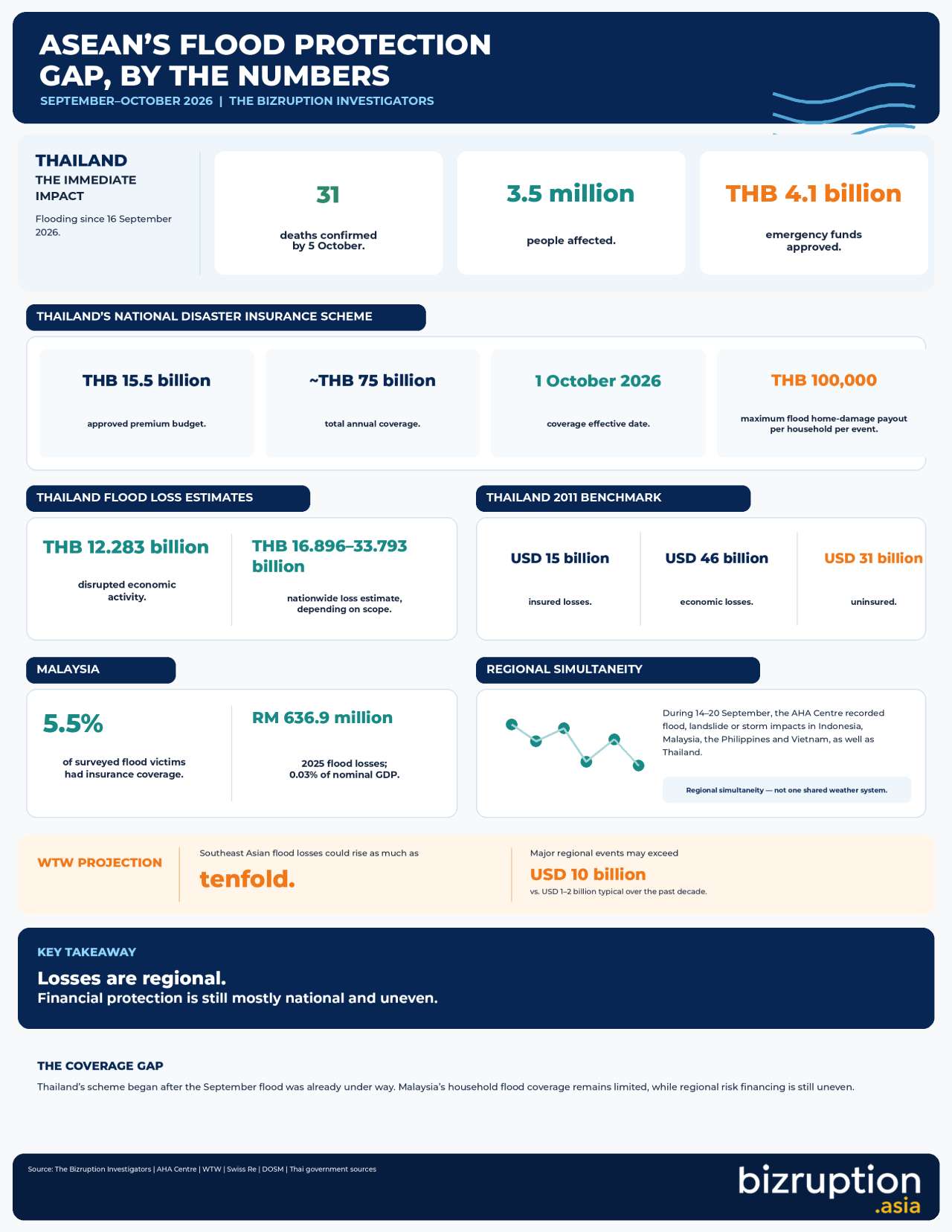
By 5 October, Thailand’s Interior Ministry had confirmed 31 deaths across eight provinces. More than 3.5 million people remained affected nationwide, according to the Department of Disaster Prevention and Mitigation. The government approved more than THB 4.1 billion in emergency recovery funds.
That was roughly a quarter of the scheme’s THB 15.5 billion annual premium budget – not a quarter of its approximately THB 75 billion in total annual coverage.
Thailand is not an isolated case. During 14-20 September, when Thailand’s nationwide flood episode also began, the AHA Centre recorded flood, landslide or storm impacts in Indonesia, Malaysia, the Philippines and Vietnam. The records establish regional simultaneity, not a single shared weather system.
Each government is confronting catastrophe-financing arrangements built for losses that are becoming larger and more interconnected.
The Scheme That Missed Its Own Launch Window
Thailand’s government-funded scheme covers roughly 30 million homes against floods, windstorms and earthquakes. For flood damage, it provides an initial THB 10,000 and up to THB 90,000 more, capped at THB 100,000 per household per event. The Department of Disaster Prevention and Mitigation receives and disburses the budget, while the Office of Insurance Commission and Thai General Insurance Association select participating insurers.
The design uses public funds to purchase private insurance, transferring a defined layer of household catastrophe risk rather than relying only on post-event relief. That changes the state’s financing model and has direct implications for capacity, reinsurance and pricing across Thailand’s non-life sector. But coverage began only after the September flood event was under way.
Early loss estimates diverge because they use different periods and scopes. The University of the Thai Chamber of Commerce estimated THB 12.283 billion in disrupted economic activity from 25-29 September, equal to 0.066% of annual GDP; it excluded property, vehicle, inventory and agricultural damage.
A separate Rangsit University assessment put nationwide losses for 24-27 September at THB 16.896 billion-THB 33.793 billion, with Bangkok at THB 10.586 billion in its moderate scenario. “The flooding is expected to shave 0.3 percentage points off this year’s GDP growth,” said Associate Professor Aat Pisanwanich of Rangsit University’s Faculty of Economics, in Reuters on 28 September 2026.
Thailand’s 2011 floods set the benchmark for an uncovered loss. Swiss Re recorded insured losses of USD 15 billion against total economic losses of USD 46 billion, leaving USD 31 billion uninsured. In 2025, Thailand’s non-life direct premiums were THB 293.118 billion against GDP of THB 18.97 trillion, equivalent to approximately 1.5%.
The Coverage Question Nobody Has Closed Since 2011
The 2011 protection gap was not purely a penetration problem. Following southern Thailand’s late-2025 floods, Wotton Kearney revisited structural weaknesses first exposed in 2011. Many commercial policies paired broad direct property cover with contingent business interruption extensions written on a limited-perils basis.
Ian Johnston, managing partner for Thailand at Wotton Kearney, and his co-authors wrote on 8 December 2025 that those extensions covered “only fire, lightning and explosion.”
Flood losses at suppliers’ or customers’ premises therefore often did not trigger those contingent business interruption (CBI) extensions. Prevention-of-access disputes turned on whether the wording required physical damage to nearby property or extended to obstruction or interference. Many such extensions also capped indemnity at thirty days, while floodwaters in some locations in 2011 persisted for more than 90.
Wotton Kearney’s analysis was direct: the 2025 event revived coverage problems first exposed in 2011. For a commercial policyholder today, the questions remain. Does the CBI extension name flood as a covered peril? Does prevention-of-access wording extend beyond physical damage? Is the indemnity period long enough for a flood that does not recede in 30 days?
The Same September, Four Other Markets
Thailand’s flooding did not happen in isolation. The AHA Centre’s update for 14-20 September recorded floods and landslides in North Sumatra, West Sumatra and Aceh; impacts in Perak and Kuala Lumpur; flooding in Nueva Ecija; and floods or landslides across six Vietnamese localities.
These events overlapped with the national Thai flood episode that began on 16 September, but the source does not identify them as one weather system.
Malaysia’s exposure illustrates a different version of the same gap. Department of Statistics Malaysia case studies – not a census of all 2025 flood victims – found that only 5.5% of surveyed victims had insurance coverage. That leaves most household exposure outside formal risk transfer.
Total 2025 flood losses were RM 636.9 million, equivalent to 0.03% of nominal GDP. Public assets and infrastructure accounted for RM 380.2 million, the largest component, underscoring that the protection gap extends beyond households.
Each market is solving its own version of the problem on its own schedule. SEADRIF provides a regional platform and sovereign disaster-risk products, but its insurance results remain concentrated in Lao PDR; it does not yet pool household or corporate flood losses across these five markets.
What the Modelling Already Shows
Willis Towers Watson’s (WTW)Natural Catastrophe Review 2026 warned that flood losses in Southeast Asia could rise as much as tenfold. Its early indications suggest major regional events could exceed USD 10 billion, versus the USD 1 billion-USD 2 billion range typical over the past decade.
Losses “now propagate in more complex ways than our historical data or models were designed for,” said Christopher Au, head of WTW’s APAC Climate Risk Centre, in Green Central Banking on 16 February 2026. He identified urban expansion, rising asset values and interconnected systems as compounding drivers alongside climate change.
Aon’s 2026 Climate and Catastrophe Insight separately identified severe South and Southeast Asian flood losses as evidence of significant underinsurance.
That is the structural read beneath September’s headlines. Thailand built a national household scheme, but coverage started after the flood began. Unlike Thailand, Malaysia has no government-funded disaster insurance programme automatically covering households nationwide.
Flood cover remains largely optional, while the government provides post-disaster assistance. Indonesia, the Philippines and Vietnam faced separate flood events while the region’s sovereign risk-financing architecture remained limited in reach. Loss modelling is moving faster than coverage.
The Question for the Next Renewal Cycle
For insurers, reinsurers and corporate risk officers with ASEAN exposure, the test is not whether another flood comes. It plainly will. The test is whether catastrophe programmes, CBI wordings and national schemes still being built one market at a time can absorb that kind of loss.
In September, the AHA Centre recorded flood-related events across all five markets; financial protection remained mostly national and uneven.
References:
- Thailand Approves National Disaster Insurance System – Government Public Relations Department, 15 September 2026
- Launch of Nationwide Disaster Insurance Programme – Thailand Public Relations Department, 30 September 2026
- Bangkok Declares All 50 Districts Flood Disaster Areas – The Nation Thailand, 26 September 2026
- Death Toll From Thailand Floods Rises to 31 – Reuters, 5 October 2026
- Weekly Disaster Update, 14–20 September 2026 – AHA Centre
- Weekly Disaster Update, 21–27 September 2026 – AHA Centre
- UTCC Forecasts THB 12.3 Billion in Flood Losses – The Nation Thailand, 27 September 2026
- Rangsit University Estimates Thai Flood Losses – The Nation Thailand, 27 September 2026
- A Decade On: Thailand’s 2011 Floods – Swiss Re Institute, 30 September 2021
- Thailand Floods 2025: Coverage Lessons From 2011 – Wotton Kearney, 8 December 2025
- Special Report on the Impact of Floods in Malaysia 2025 – Department of Statistics Malaysia
- Natural Catastrophe Review January 2026 – WTW
- Insurers’ Climate Repricing and Asia’s Protection Gap – Green Central Banking, 16 February 2026
- 2026 Climate and Catastrophe Insight – Aon
- SEADRIF Implementation Report – World Bank, 30 January 2026