On 13 November 2026, Singapore’s Cyber Security Agency (CSA) reported that the monthly average of reported cyber incidents since September was three times the January-August average. Some involved compromised third-party suppliers.
Two incidents earlier in the year show how disruption can spread. A cyberattack on Japanese food distributor Nichirei in July affected its logistics operations, which serve about 5,000 clients. KFC Japan suspended mobile orders and delivery.
In September, a cybersecurity incident temporarily halted container terminal operations at Malaysia’s Port of Tanjung Pelepas (PTP), which handled more than 14 million TEU in 2025.
The incident starts at the supplier. Your business still has to deal with it
A supplier does not need access to your systems to disrupt your business. If a logistics provider cannot move goods, deliveries may stop. If a payment provider goes offline, transactions may be delayed. If a supplier holding essential data is compromised, work may have to pause while records are checked.
A cyber incident can expose information as well as interrupt services. The concern here is what happens when a supplier can no longer provide a service your business depends on, even if your own systems remain untouched.
The distinction is important. In April 2025, DBS said its own systems were not compromised in a ransomware incident at printing vendor Toppan Next Tech. Nevertheless, the bank halted printing jobs with the vendor. The technical problem was outside the bank; the business response was not.
Your Most Important Supplier May Not Be Your Biggest
Supplier risk should not be judged by contract value alone. A relatively small technology provider could support a system essential to production, payments or customer orders. If it fails, the business impact could be far greater than the supplier’s annual fees suggest.
There may also be hidden dependencies. Two suppliers might appear to offer separate services but rely on the same cloud platform or technology provider. One incident could affect both, leaving the company without the backup it thought it had.
The Basel Committee’s third-party risk principles for the banking sector, published in December 2025, emphasise assessing suppliers according to the importance of the services they support and the potential consequences of failure. For business leaders, the question is simple: which parts of the operation could stop if a particular supplier went offline?
The Financial Damage Can Continue After Systems Return
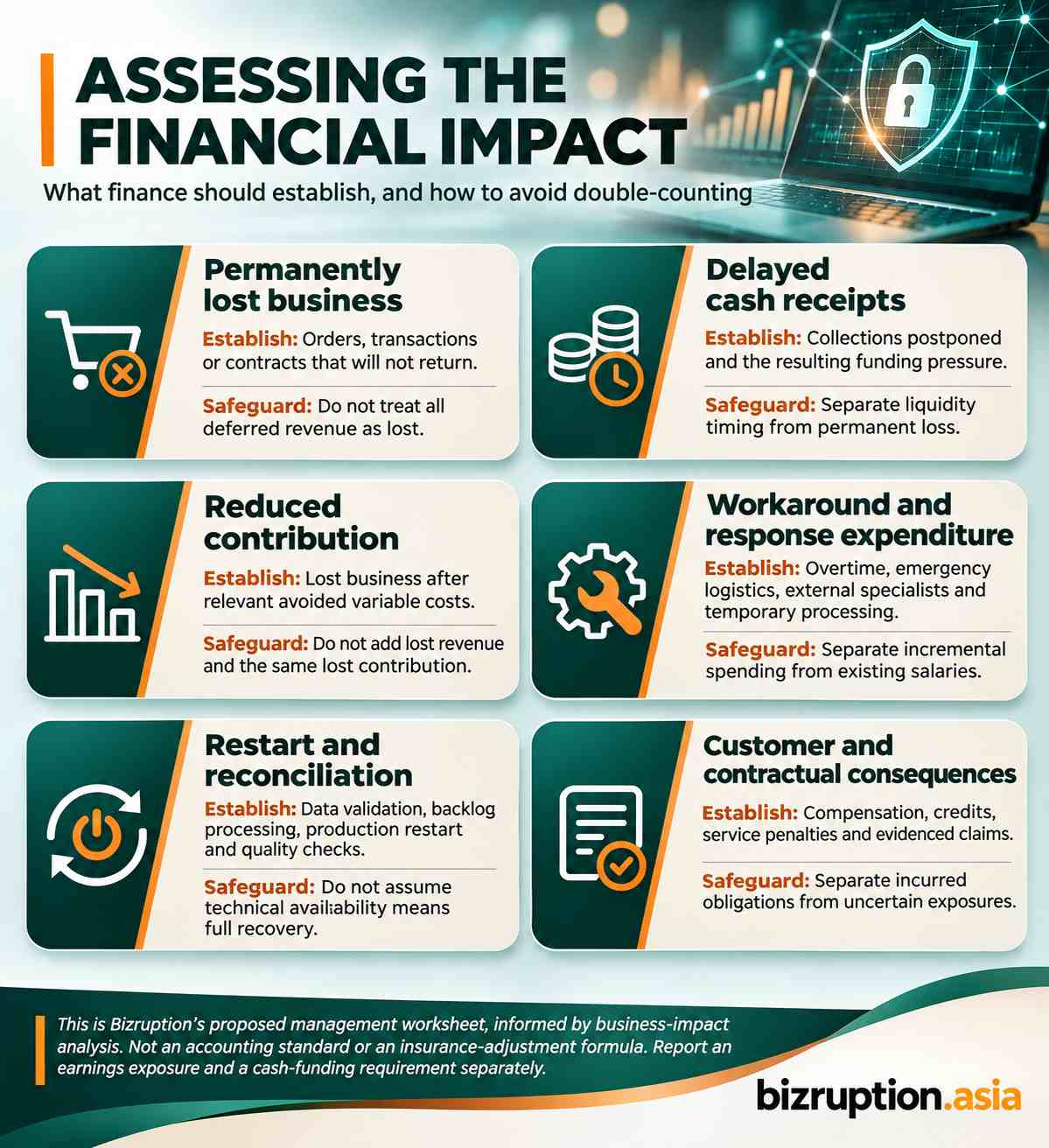
A supplier restoring its systems does not mean your business has recovered. Delayed orders still need to be fulfilled, payments reconciled, backlogs cleared and customers dealt with. Additional costs may arise from emergency transport, overtime, external specialists or temporary arrangements.
Finance teams need to distinguish between sales that are permanently lost and orders that are merely delayed. A delayed order may still be fulfilled later, although the delay could affect cash flow or contractual commitments.
They must also avoid counting the same loss twice. For a permanently lost sale, calculate the lost contribution by subtracting costs the business no longer incurs from the forgone revenue. Do not then add that figure again as a separate loss.
CFOs should assess two different figures: the likely impact on earnings and the cash needed to keep the business operating during the disruption. One measures the financial damage; the other measures the immediate funding pressure.
Finance and operations should model the financial impact of a one-day outage, a multi-day disruption and a prolonged recovery, including lost sales, additional costs and cash-flow pressure. This helps management decide what backup arrangements are worth funding.
A Contract Does Not Guarantee Recovery
Contracts may require suppliers to meet recovery commitments and provide compensation if they fail. But a right to claim damages does not provide replacement staff, working systems, clean data or an alternative provider when operations are disrupted.
Insurance is not an automatic solution either. Whether a policy covers losses caused by a supplier’s incident depends on its wording, including the suppliers and types of disruption covered.
Bank Negara Malaysia’s Business Continuity Management Policy Document requires financial institutions within its scope to align key suppliers’ recovery arrangements with their own, involve suppliers in recovery testing and provide appropriate audit and records access.
These requirements recognise an important distinction: contractual protection may help recover financial losses later, but it does not keep a business running during an incident.
Recovery Is a Business Decision, Not Just an IT Responsibility
Each critical service should have a named business owner responsible for confirming when normal operations can resume. IT teams determine when systems can be safely reconnected; the business owner checks that services, data and outstanding work are back in order.
Operations determines how essential services continue, Finance assesses losses and cash requirements, and senior management resolves competing priorities and approves temporary arrangements. A supplier saying its systems are back online does not necessarily mean your business has recovered.
A Backup Plan Must Work When It Is Needed
Having another supplier on a contract list is not necessarily a recovery plan. Switching providers may take weeks, and an alternative may not have the capacity to take over immediately.
Businesses need to test whether alternative arrangements can actually support essential operations. This includes checking access to data, staff readiness and whether the alternative can handle the required workload.
The Monetary Authority of Singapore’s business continuity guidelines and BNM’s policy both emphasise planning and testing arrangements for disruption involving third parties.
Fund the Recovery Before the Incident
Boards and senior management should know which supplier failures could cause the greatest damage, who is authorised to coordinate recovery and whether the company has funded and tested alternatives.
Before renewing a critical supplier contract, they should be able to answer a practical question: if this provider became unavailable tomorrow, how would the business continue serving customers, and how much would it cost?
Responsibility for causing an incident may take months to settle. Responsibility for keeping the business operating cannot.
References:
- Advisory on Recent Uptick in Reported Cyber Incidents – Cyber Security Agency of Singapore, 13 November 2026
- Nichirei Getting Back Online After Cyberattack Hit KFC Supplies – The Japan Times, 16 July 2026
- Cyber Attack Disrupts Operations at Malaysia’s Port of Tanjung Pelepas – Lloyd’s List, 11 September 2026
- DBS Made Aware of Ransomware Attack at Printing Vendor Toppan’s Systems – DBS, 7 April 2025
- Guidelines on Business Continuity Management – Monetary Authority of Singapore, June 2022
- MAS Strengthens Financial Institutions’ Business Continuity to Address Evolving Threats – Monetary Authority of Singapore, 6 June 2022
- Business Continuity Management Policy Document – Bank Negara Malaysia, 19 December 2022
- Principles for the Sound Management of Third-Party Risk – Basel Committee on Banking Supervision, 10 December 2025