
An enterprise AI contract is not an account of what artificial intelligence costs, delivers or exposes. Until finance, technology and risk teams reconcile those things, the return on investment remains an assertion.
The AI bill is spread across model APIs, cloud services, software subscriptions with embedded features, developer tools and infrastructure. The FinOps Foundation’s 2026 guidance says 98% of surveyed practitioners now manage AI spending, against 31% two years earlier. AI has entered financial management, but cost visibility, allocation and value measurement remain difficult.
Employees’ use of unapproved tools is not the whole issue. Management may be looking at an incomplete picture. A blanket ban can discard useful capability; ignoring unofficial use conceals costs and data flows.
Three ledgers, one decision
Bizruption proposes an audit built around spend, value and exposure. This is Bizruption’s proposed framework, informed by FinOps cost-allocation practice and NIST’s voluntary generative AI risk profile.
The spend ledger records subscriptions, API consumption, embedded charges and operating costs. The value ledger records accepted outputs, end-to-end task time, quality and realised benefit. The exposure ledger records data, permissions, provider terms, system dependencies and accountable owners.
Consider a legal team using an unofficial AI drafting tool because its approved alternative is slower or less suited to the task. The tool may produce an acceptable first draft faster, but the value ledger must account for lawyer review and correction.
The exposure ledger must establish whether client information can be processed under the provider’s terms. The decision may be to approve a suitably contracted version, redesign the workflow or discontinue its use.
Shadow AI means use outside required organisational approval, inventory or monitoring. It is not synonymous with decentralised purchasing: a department can own an approved tool. Nor is it confined to free personal accounts. An approved application used with unauthorised data or an AI feature activated without assessment inside existing software, can also fall outside organisational controls.
Reconcile before cutting
No single source reveals the full inventory. Expense records miss free or unreimbursed use; shared cloud accounts obscure ownership; software licences do not prove meaningful use. Network monitoring may not reveal what information was submitted, while monitoring itself needs privacy safeguards.
Staff interviews can expose workflow needs that are not met but require corroboration. Each material use needs business and technical owners, a workflow, provider, billing model, renewal date and data classification. Finance must separate approved expenditure from newly identified spend and potentially avoidable future outlay.
Do not count a cloud-marketplace charge and its underlying supplier invoice twice. Risk is not another cost line.
Measure the finished task
The relevant unit is not the prompt or token. It is an acceptable business outcome. FinOps guidance distinguishes resource consumption from measures such as cost per successful outcome.
For selected workflows, compare three baselines: no AI, the approved tool and the capability employees use outside the approved route. Measure the whole task, including preparation, prompting, verification, correction and downstream review. Count failed attempts and rework; define the quality threshold before testing. Use approved environments and anonymised or synthetic inputs.
A 2025 study in The Quarterly Journal of Economics found that a generative AI assistant increased issues resolved per hour by 15% on average among 5,172 customer-support agents, with substantial variation by experience. This is evidence about customer support, not a productivity forecast for legal, engineering or marketing teams in Southeast Asia.
If a shadow tool outperforms the approved alternative, it may expose a weakness in the organisation’s deployment. The response is to assess the tool and understand why employees chose it, not to tolerate uncontrolled use.
A saved hour is not a saved dollar
Time released is not automatically payroll saved, revenue earned or capacity productively redeployed. Finance should separate cash expenditure avoided, capacity released, incremental contribution and quality improvement. Only the first is an immediate cash saving; the others require evidence.
Calculate returns against the workflow’s incremental cost over the same period as the benefits. Include licences, consumption, integration, training, redesign, security, administration, verification and rework where attributable. Do not count one saved hour as both labour savings and extra output. Keep estimated productivity value separate from cash savings.
DBS offers a regional example of governed deployment, though not a shadow-AI case. The Singapore bank reported deploying more than 2,000 AI models across over 430 use cases; its data analytics and AI/ML initiatives generated approximately S$1bn in economic value in 2025. It also described a generative AI framework with reusable components and governance guardrails.
The figure is DBS’s own measure, not an independently comparable ROI calculation. The example shows the operating structures that accompany deployment at scale.
Risk does not follow the price tag
A free service can receive sensitive information; an expensive system may perform a low-risk task. Management needs to know what data enters each system, how the provider retains or uses it, where processing occurs, which sub-processors are involved and what connected systems it can access. A tool able to take actions presents a different risk from one that only drafts suggestions.
The legal position depends on jurisdiction and data. Singapore’s Personal Data Protection Act governs relevant personal-data handling; PDPC guidance issued in July 2026 clarifies its application to generative AI. Indonesia’s Law No. 27 of 2022 addresses lawful processing, security, breach notification and overseas transfers.
These regimes are not interchangeable, and neither makes every unapproved use automatically unlawful. Governance frameworks do not replace legislation.
Decide by workflow, not vendor
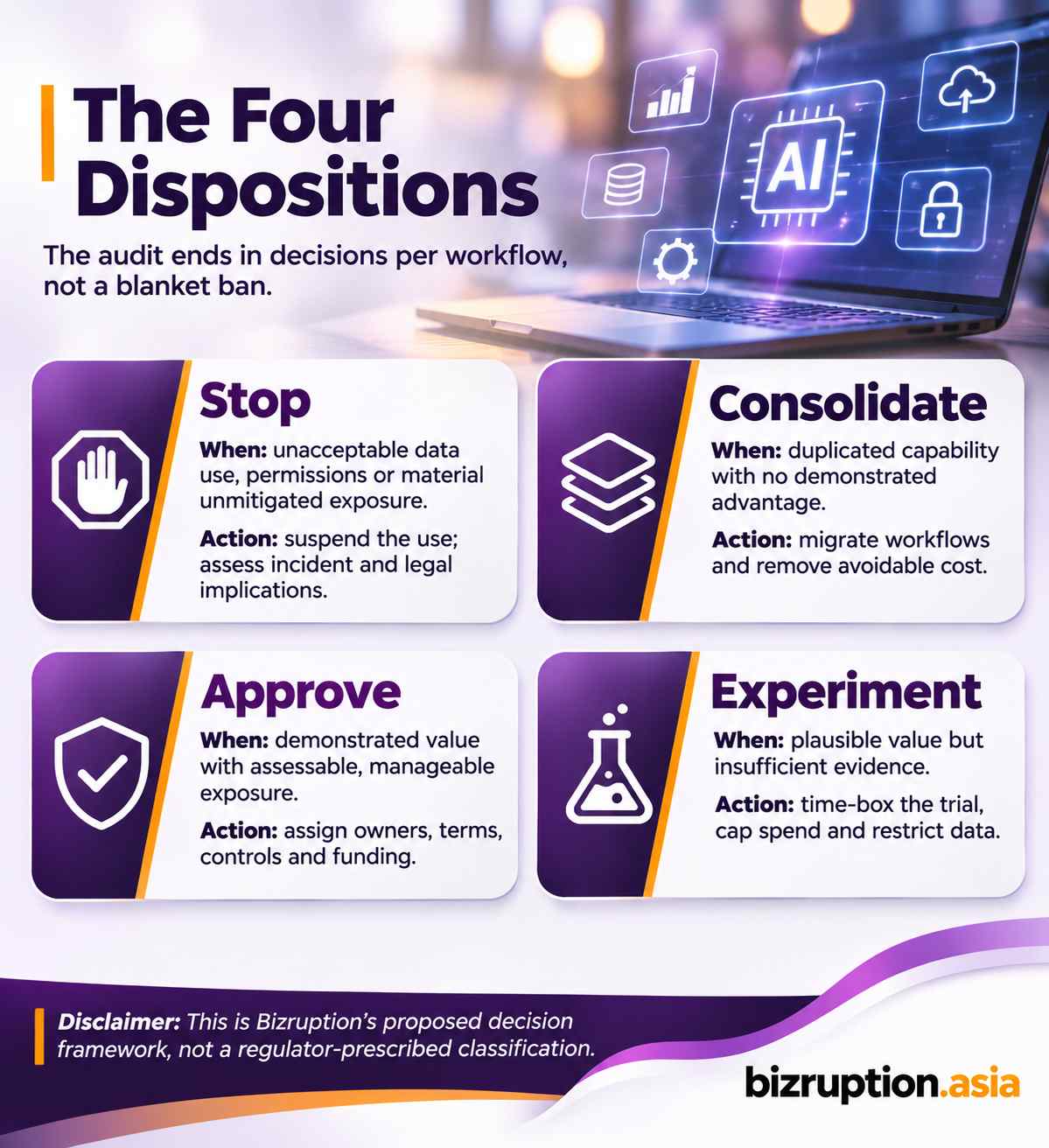
The audit should produce four decisions: stop usage with unacceptable data practices or unmitigated exposure; consolidate duplicated tools without demonstrated advantage; approve usage that deliver value under manageable controls; and time-limit experiments where value remains unproven, with spending caps and restricted data.
Governance must also be practical – slow approval processes encourage workarounds. Fast requests, clear data rules and controlled trials matter.
The first number management should demand is the share of identified AI expenditure without an accountable owner. Then it should ask what accepted output that spending buys, what benefit has reached the business and what data exposure accompanies it.
Until those questions can be answered together, a company may know what it has purchased. It does not yet know what its AI investment is worth.
References:
- FinOps for AI Overview – FinOps Foundation, updated 28 October 2026
- Unit Economics – FinOps Framework Capability, FinOps Foundation
- Generative AI at Work – Brynjolfsson, Li and Raymond, NBER Working Paper 31161 (published in The Quarterly Journal of Economics, 2025)
- Artificial Intelligence Risk Management Framework: Generative Artificial Intelligence Profile – NIST, 26 July 2024
- NIST AI 600-1: Generative Artificial Intelligence Profile, full report – NIST, July 2024
- Advisory Guidelines on Use of Personal Data in Generative AI – Personal Data Protection Commission Singapore, 20 July 2026
- Singapore’s Approach to AI Governance – Personal Data Protection Commission Singapore
- Law No. 27 of 2022 on Personal Data Protection – Indonesia, official BPK legal database
- Law No. 27 of 2022 – full statutory text (Articles 20, 35, 46 and 56)