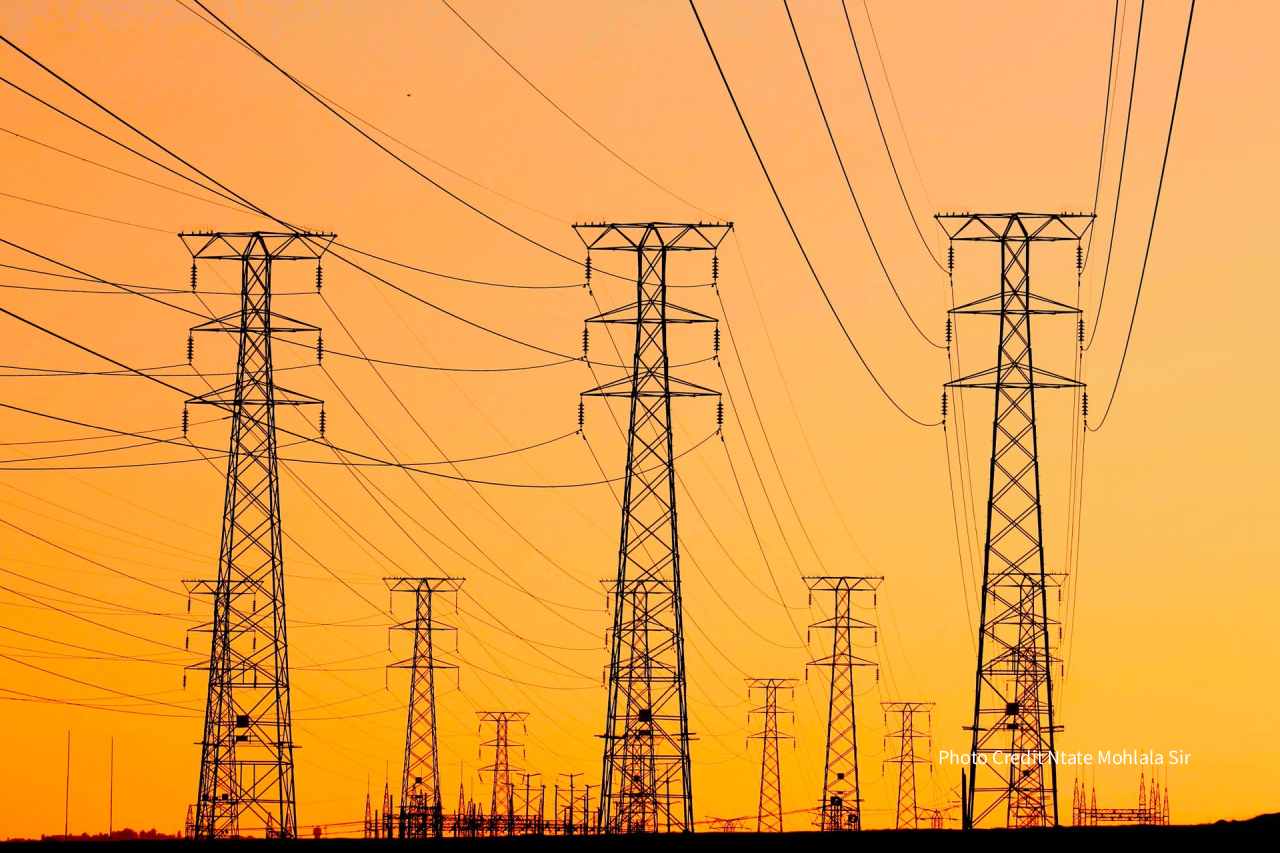
The Great Bifurcation established that risk in growth-market Asia has moved from contract security to execution. That leaves a harder question unanswered: what does an investor actually check to tell a project that will get built from one that will not.
A term sheet cannot settle that question. It sits in transmission queues, manufacturer registries and utility balance sheets, most of it public before a single dollar commits.
Three variables answer it, and none require access an outside investor lacks.
Grid Readiness Comes First
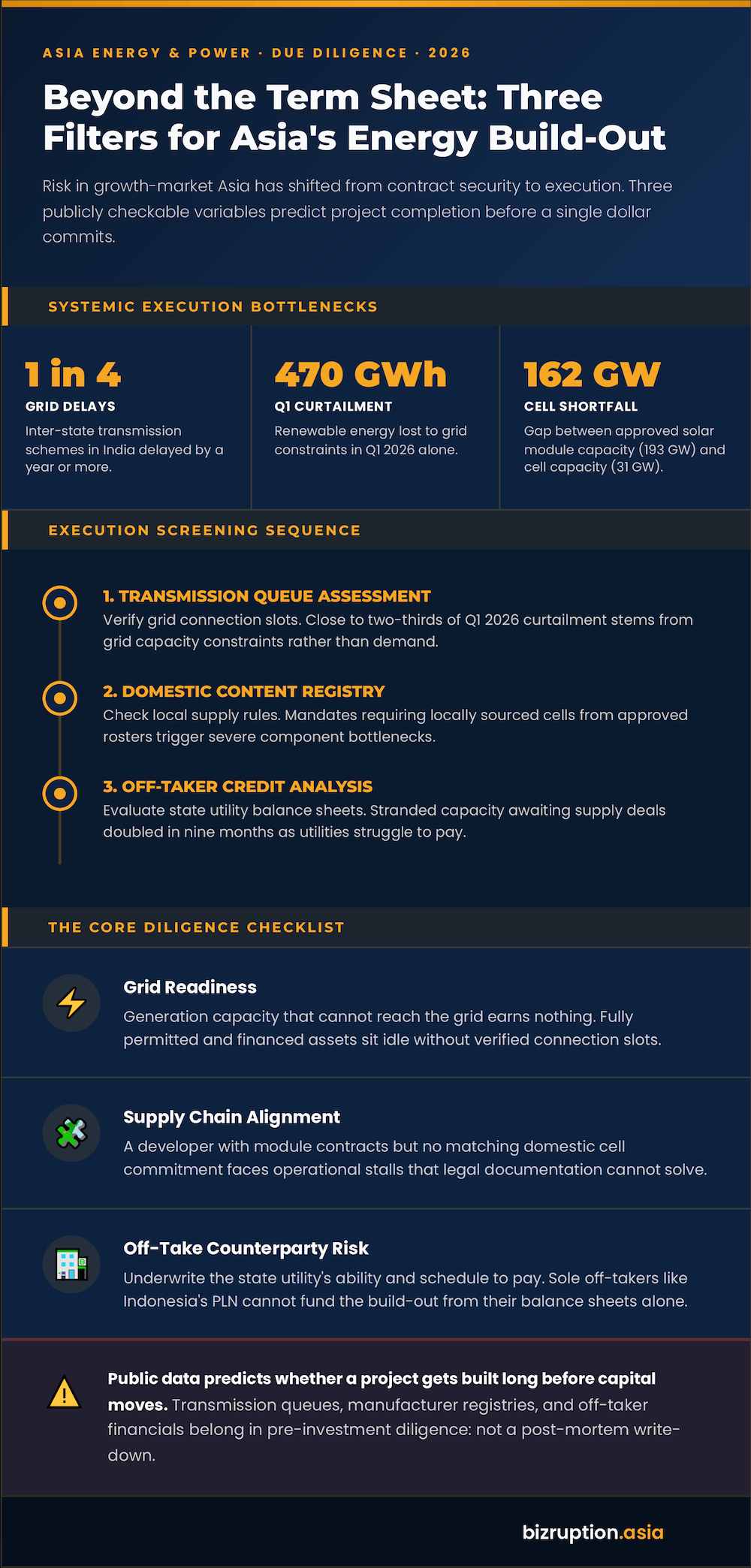
Generation capacity that cannot reach the grid earns nothing. In India, roughly one in four inter-state transmission schemes now faces a delay of a year or more. That is Ember’s finding, from its May 2026 analysis of the country’s renewable build-out.
The country lost 470 gigawatt-hours of renewable power to curtailment in the first quarter of 2026 alone. Close to two-thirds of that was attributable to grid constraints rather than demand. A project can be fully permitted and fully financed and still sit idle for want of a connection slot.
The Supply Chain Test
Domestic content rules are becoming a second filter. India’s approved roster of solar module manufacturers now covers roughly 193 gigawatts of capacity. The approved list for the solar cells those modules actually require covers only about 31 gigawatts.
From June 2026, projects under India’s domestic content mandate must source cells from that shorter roster. A developer with a module supply contract but no matching cell commitment is exposed to a bottleneck that legal documentation will not solve.
Who Actually Owns the Off-Take Risk
The third variable is the counterparty buying the power. Indonesia’s state utility, PLN, cannot fund the country’s renewable build-out from its own balance sheet, which is precisely why private capital is underwriting generation directly. The same question applies wherever a state utility is the sole legal off-taker: can it pay, and on what schedule.
“Energy transition is not just about building solar and wind capacity,” the Sustainable Project Developers Association told Reuters in August 2025. The letter, addressed to India’s renewable energy ministry, warned that stranded capacity awaiting supply deals had doubled in nine months.
That warning generalises well beyond India. A project with grid access, a matched supply chain and a creditworthy off-taker is a fundamentally different underwriting proposition. The same generation figure, without any of the three, is a different asset entirely, whatever the brochure says.
None of these checks require inside information. Transmission queue data, domestic content thresholds and off-taker financial statements are public or obtainable well before capital moves. That is exactly why they belong in diligence, not in a post-mortem.
The screen does not eliminate execution risk. It prices that risk correctly before the capital moves. The alternative is discovering it after the ribbon-cutting photo, when the only options left are a write-down or a renegotiation.
References:
- Transmission Gaps Are Beginning to Constrain India’s Rapid Renewables Integration – Ember
- India Loses 300 GWh Renewable Power in Q1 2026 as Transmission Delays Threaten 2030 Clean Energy Target – Down To Earth
- India’s ALMM List-II Solar Rules Expose Domestic Cell Shortage, Threaten Standalone Module Makers – Down To Earth
- Unlocking Solar Manufacturing Potential with Solar PV Modules – CEEW
- India’s Stranded Renewable Projects Double to Over 50 GW, Documents Show – Reuters