The Asia Pacific Loan Market Association held its first Dubai conference in January 2026, drawing roughly 300 attendees, nearly half from outside the region. Asian banks had extended more than USD 17 billion to Gulf borrowers in 2025, a record and roughly triple the 2024 total. The Gulf expansion came as Asia-Pacific syndicated lending outside Japan entered one of its weakest periods in more than a decade.
Home markets were shrinking. The Gulf was absorbing the capital instead. That trajectory lasted barely five weeks. After the United States and Israel struck Iran on 28 February 2026, Asian lenders did more than reassess Gulf exposure. New deal discussions and Asian-balance-sheet participation slowed sharply.
The Freeze Had Names Attached
By the time APLMA members regrouped in Hong Kong in March, the market conversation had inverted. HSBC Holdings and Standard Chartered, two of Asia’s largest loan arrangers, told some Middle East clients that transactions drawing on Asian balance sheets would need to pause.
A major Singapore bank shelved its 2026 Middle East expansion plans and redirected its Hong Kong team towards South Korea and Australia.
One major Chinese bank went further, restricting a drawdown on a bilateral facility involving the Abu Dhabi government. People familiar with the matter described the move as rare. Hong Kong-based bankers at multiple institutions were required to provide daily updates to headquarters on regional loan exposure.
Taiwanese banks, previously among the most aggressive lenders to Gulf borrowers, stopped taking new exposure. “It is still far too early for us to reopen balance sheets to Gulf names,” a senior Taiwanese banker said.
The Capital Had Nowhere Else to Go
Five months later, the freeze began to thaw, though not because the conflict ended. Qatar National Bank, Boubyan Bank and Kuwait’s sovereign wealth fund secured financing involving Asian lenders in August 2026.
Saudi Energy Co, the state utility formerly known as Saudi Electricity, entered talks for a USD 300 million facility expected to be anchored by a major Chinese lender. Together, the transactions and financing requests in motion exceeded USD 6.8 billion, though the amount ultimately funded remained unclear.
The return did not signal broad confidence in Gulf risk. Asia-Pacific syndicated lending outside Japan had entered its deepest slump in 16 years, leaving banks with fewer opportunities to deploy large pools of capital. That made selective Gulf transactions more consequential, not automatically safer.
Gary Ng, senior economist at Natixis, said banks would continue to lend “more cautiously and to selected clients.” They also had “an incentive to protect the relationships” built in the Gulf.
The August deals point to selective franchise preservation: banks are keeping access to established borrowers while limiting the risk they hold directly.
A third view is that the freeze was always temporary. Tatsuya Hasegawa of Sumitomo Mitsui called the pullback “largely cyclical” and said investors would return “absent any major disruptive events.”
His colleague Yuji Harada said communication with Middle East borrowers had slowed rather than stopped, with financing moving forward “once the timing aligns.”
The Exposure Is Not What It Was
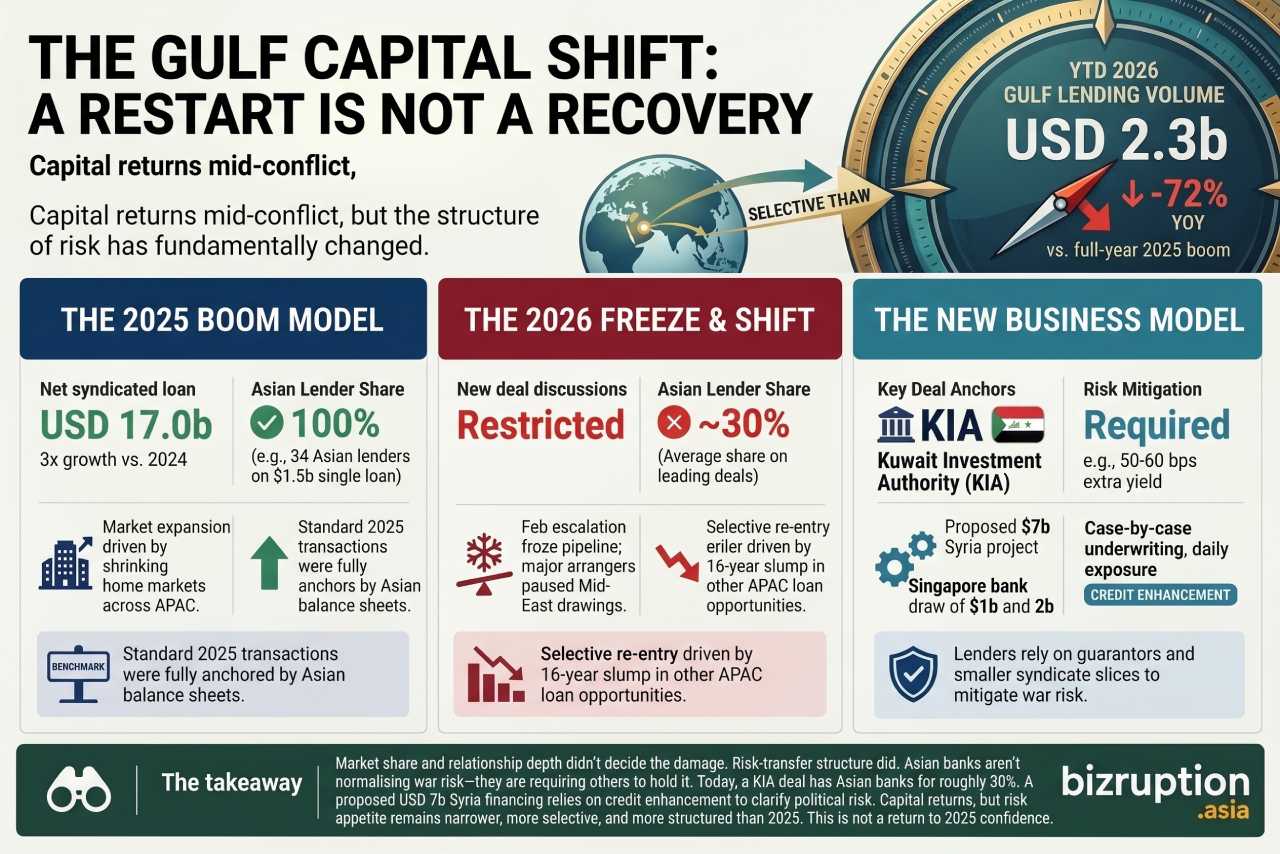
The clearest evidence of selective re-entry sits inside the deal structures. In the Kuwait Investment Authority financing, Asian lenders including China Construction Bank and Korea Development Bank accounted for roughly 30% of total lending. A year earlier, Riyad Bank SJSC’s USD 1.5 billion loan drew 34 participating banks, all from Asia.
This is not a return to the 2025 model. Asian banks extended USD 2.3 billion to Gulf borrowers through August 2026, down 72% from the same period in 2025. The difference is not only volume. It is also the share of risk Asian banks are willing to retain in each transaction.
A proposed USD 7 billion financing for infrastructure projects in Syria shows how credit enhancement may compensate for political risk that lenders are less willing to hold directly.
Bloomberg reported that Qatar National Bank, Abu Dhabi Commercial Bank and JPMorgan were involved in arranging financing for projects linked to Qatar’s Power International Holding.
IFR reported that Gulf lenders were seeking wider compensation for renewed political and liquidity risk, including an additional 50 to 60 basis points in some cases. The signal is not that guarantees eliminate war risk. It is that lenders are demanding a clearer allocation of who holds it.
What the Headline Number Misses
A headline announcing that Asian banks have restarted Gulf lending should not be read as proof that Iran-related risk has been priced out. Deal-level evidence instead points to case-by-case underwriting, lower participation and internal exposure guardrails that bankers say have remained in place since the conflict began.
The forward signal is not the USD 6.8 billion in requests. It is the participation ratio inside each deal that closes. A Gulf borrower attracting a broad Asian syndicate again, at the scale Riyad Bank achieved in 2025, would be stronger evidence that risk appetite is normalising.
Asian banks are not lending into this war because the risk has passed. They are lending into it because they have found ways to make someone else hold that risk instead: a Qatari guarantor, a smaller slice of the syndicate, a wider spread charged to the borrower.
That is not a return to 2025 confidence. It is caution that has found a business model.
References:
- Asian Banks Cautiously Restart Gulf Lending Despite Iran Risks – The Straits Times / Bloomberg
- Asian Banks Restart Lending to Gulf States as Confidence Holds Despite Iran War – Arabian Business
- Asian Banks Pause Gulf Lending Drive on Mounting Risks from War – The Business Times / Bloomberg
- Chinese Bank Halts Abu Dhabi Loan as Creditors Cut Middle East Risk – The Business Times / Bloomberg
- Middle Eastern Borrowers Revisit Asia – International Financing Review / LSEG
- APAC Lenders Hit Pause on Middle Eastern Loans – International Financing Review / LSEG
- JPMorgan Joins Gulf Banks on USD 7 Billion Loan for Syrian Projects – Bloomberg
- Asian Banks Cautiously Restart Gulf Lending Despite Iran Risks – Bloomberg