
Every account of Asian banks’ Gulf lending this year reads as a war story: a conflict broke out, banks pulled back, banks cautiously returned. That framing misses the more useful fact sitting underneath it.
Asia’s syndicated loan market outside Japan is in its deepest slump in 16 years. For a bank sitting on capital and short of places to lend it domestically, the Gulf was never primarily about risk. It was about growth, in a market a war happened to interrupt.
A Market That Was Already the Better Bet
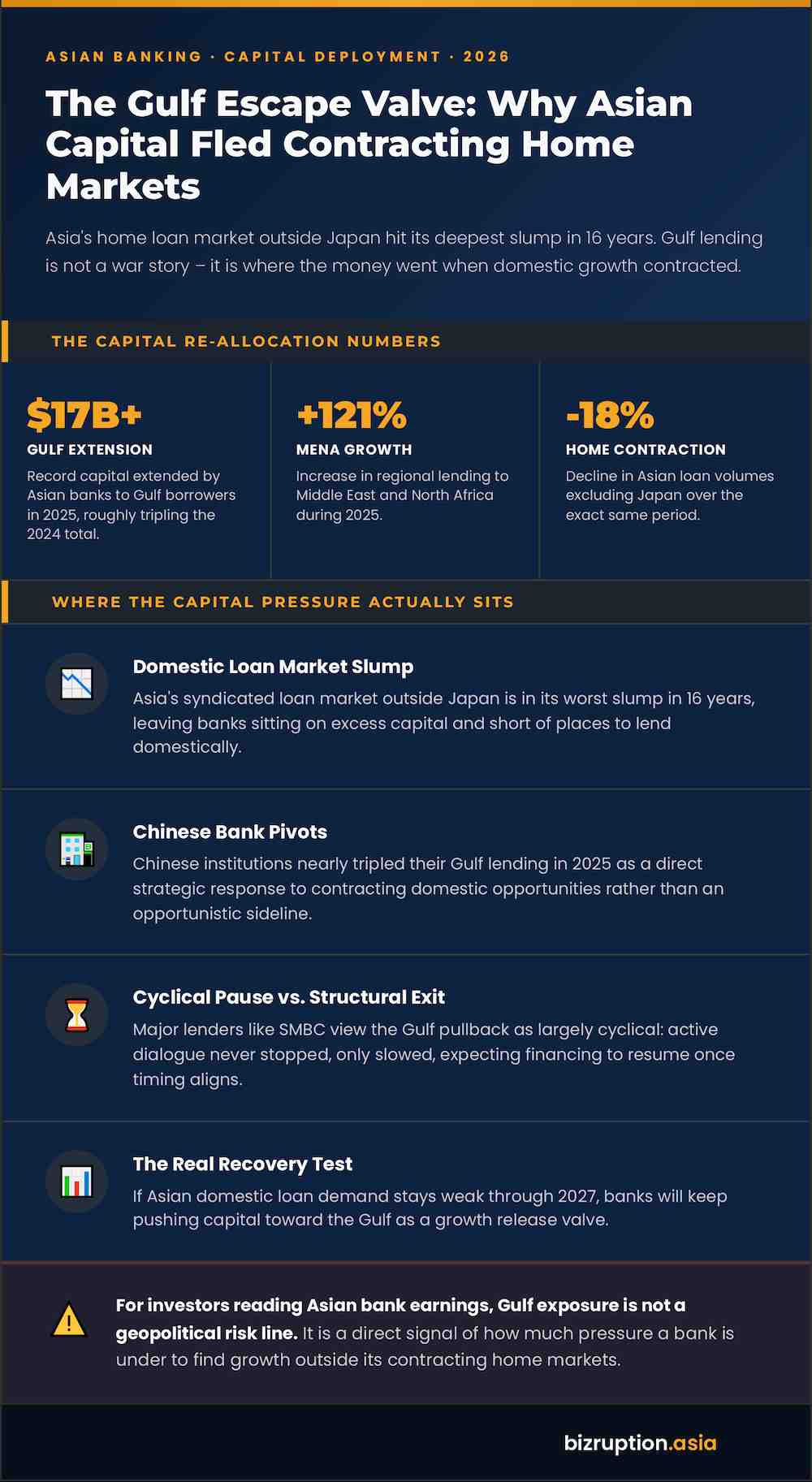
The scale of that growth decision is easy to lose in the risk headlines. Asian banks extended more than USD 17 billion to Gulf borrowers in 2025, a record and roughly triple the 2024 total.
Regional lending to the Middle East and North Africa rose 121% that year, even as loan volumes excluding Japan fell 18%. Chinese banks alone nearly tripled their Gulf lending in 2025.
Those are not the numbers of an opportunistic sideline. They are the numbers of a bank sector redirecting growth toward the one large market still expanding, while growth at home was contracting.
The war forced that shift to pause. It did not remove the reason the shift existed.
The Bankers Who Never Really Left
That reasoning is exactly what separates the region’s most measured lenders from the rest. Sumitomo Mitsui Banking Corp’s Tatsuya Hasegawa, as quoted by International Financing Review, called the Gulf pullback “largely cyclical,” expecting investors to return “absent any major disruptive events.”
His colleague Yuji Harada described the practical version of that view: dialogue with Middle East borrowers never stopped, only slowed, with financing expected to resume “once the timing aligns.”
Read against the loan-market slump, that confidence looks less like optimism about Iran and more like arithmetic about everywhere else. A bank that still believes the Gulf is its best growth market has little incentive to treat a war as more than a delay.
What a Real Recovery Would Look Like
The test is not whether the war ends. It is whether Asia’s home lending market recovers before Gulf risk appetite does. If domestic loan demand stays weak through 2027, banks have every reason to keep pushing capital towards the Gulf.
The alternative is doing nothing with it at all. If home markets recover first, the Gulf reverts to being one growth option among several, not the release valve it became in 2025.
For investors reading Asian bank earnings this year, Gulf exposure is not really a geopolitical risk line. It is a signal about how much pressure that bank is under to find growth anywhere else.