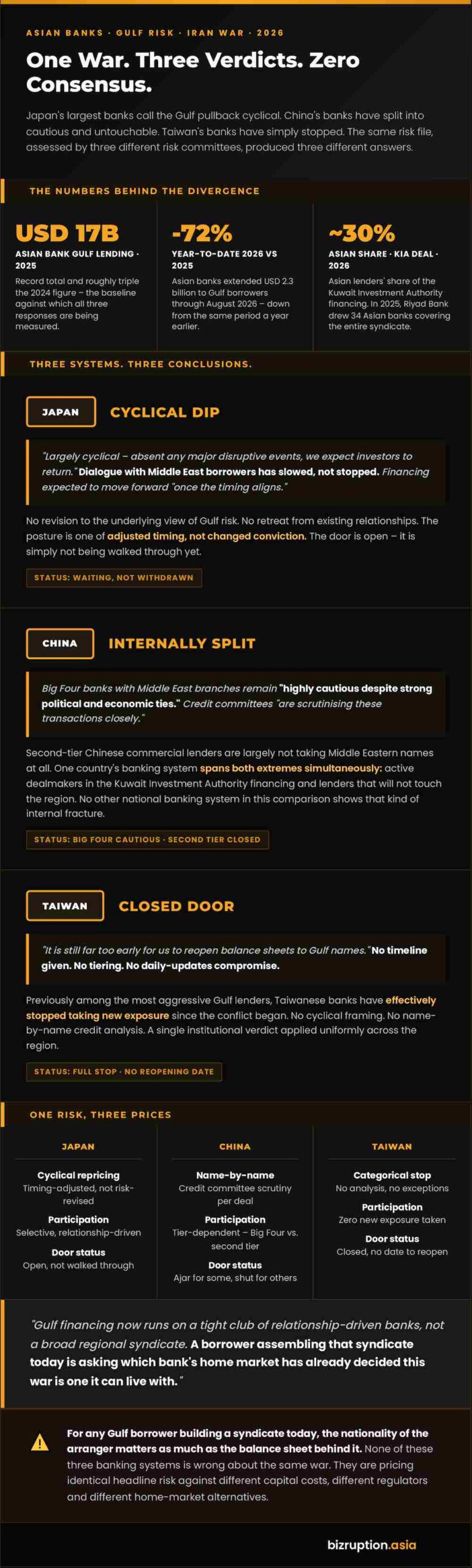
By June 2026, three of Asia’s largest banking systems had reached three different conclusions about the same war. Japan’s largest lenders called the Gulf pullback a temporary dip. China’s split into banks still cautiously dealing and banks refusing to touch the region at all. Taiwan’s stopped lending outright.
The companion cover story, Why Asian Banks Are Lending Into a War, treats “Asian banks” as one actor recalibrating its Gulf exposure together. The underlying data does not support that framing.
The gap between these three national responses says more about how institutional risk appetite actually forms than any regional average can.
The Bank That Is Waiting It Out
Sumitomo Mitsui Banking Corp’s read is the most measured of the three. Tatsuya Hasegawa, director in the bank’s distribution department, as quoted by International Financing Review, called the Gulf pullback “largely cyclical,” adding that “absent any major disruptive events, we expect investors to return.”
His colleague Yuji Harada described what that view looks like in daily practice. Dialogue with Middle East borrowers had slowed, not stopped, with financing moving forward “once the timing aligns.”
That is a bank keeping its options open, not a bank retreating. Nothing in either quote suggests SMBC has revised its underlying view of Gulf risk. It has simply adjusted its timing.
The Bank Split Against Itself
Chinese lenders show no such consensus internally. Even the sector’s Big Four, all of which maintain branches in the Middle East, “remain highly cautious despite strong political and economic ties between China and Gulf countries.”
One senior loan banker at a Chinese lender described a bank “reassessing pipelines and revisiting country limits for Middle East exposure.”
Credit committees, the same banker added, “are scrutinising these transactions closely.” Risk tolerance drops further down the tier. Second-tier Chinese commercial lenders are largely not taking on Middle Eastern names at all.
One country’s banking system, in other words, spans both extremes. It contains the most active dealmakers in the Kuwait Investment Authority financing, and lenders that will not touch the region at all. No other national banking system in this comparison shows that kind of internal fracture.
The Bank That Simply Stopped
Taiwanese banks make the divergence starkest. Previously among the most aggressive lenders to Gulf borrowers, they “effectively stopped taking new exposure” once the conflict began.
“It is still far too early for us to reopen balance sheets to Gulf names,” a senior Taiwanese banker said. There is no cyclical framing here, no tiering, no daily-updates compromise. Just a closed door.
What the Gap Actually Measures
None of these three banking systems is wrong about the same war. They are pricing identical headline risk against unequal capital costs, separate regulators and different home-market alternatives.
A senior loan banker at an international bank captured what that produces at deal level. Gulf financing now runs “on a tight club of relationship-driven banks,” not a broad regional syndicate.
A borrower assembling that syndicate today is not really asking which bank has the strongest balance sheet. It is asking which bank’s home market has already decided this war is one it can live with.