SK Hynix just posted the best quarter in its history. Investors sold it anyway.
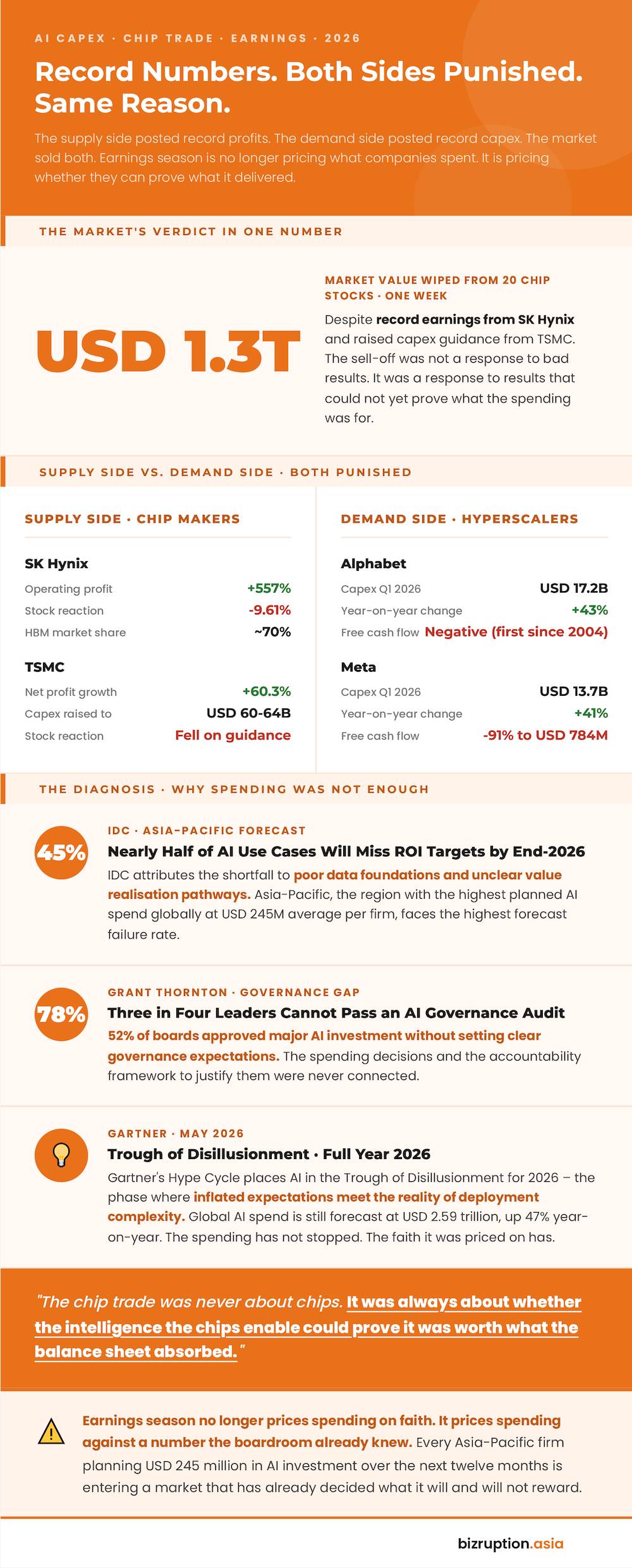
Operating profit surged 557% year-on-year to KRW 60.54 trillion (approximately USD 41.6 billion), an all-time record, on 29 July 2026. The stock closed 9.61% lower the same day, because the record still landed short of the roughly KRW 64 trillion analysts had priced in.
Thirteen days earlier, TSMC had made the same bet, only louder. It raised its 2026 capital expenditure guidance from USD 52–56 billion to USD 60–64 billion. “Our conviction in the multi-year AI megatrend remains very high,” said C.C. Wei, Chairman and CEO, TSMC, 16 July 2026.
TSMC’s US-listed shares fell anyway.
Two of Asia’s most important chip companies had just proved the same thing inside a fortnight: a record number is no longer enough. What “beating expectations” requires has quietly changed and it did not stop at chipmakers.
Beating Earnings Stopped Being Enough
SK Hynix and TSMC were not isolated cases. In the same week SK Hynix reported, 20 of the world’s most valuable chip stocks lost USD 1.3 trillion in combined market value. The figure comes from a CNBC analysis of FactSet data. Nvidia lost USD 238 billion. SK Hynix lost USD 176 billion, Samsung Electronics USD 173 billion, TSMC USD 119 billion, Micron USD 113 billion and AMD roughly USD 110 billion.
Michael Field, Chief Equity Strategist, Morningstar, told CNBC on 29 July 2026 that the moves reflect sentiment rather than fundamentals. “Simply put, it’s loss of confidence,” he said. Charlie Dai, VP Principal Analyst at Forrester Research, pointed to a different worry: that AI infrastructure spending had reached its high point sooner than the market expected.
The Demand Side Has Its Own Cash-Flow Problem
The companies buying the chips face the same scrutiny as the companies making them. Alphabet’s free cash flow turned negative for the first time since its 2004 initial public offering, at USD 5.9 billion for the second quarter of 2026. Capital expenditure had doubled year-on-year to USD 44.9 billion. Management raised full-year 2026 capex guidance to USD 195-205 billion, up from USD 180-190 billion.
Meta’s quarter told the same story with sharper numbers. Free cash flow fell 91% year-on-year, from USD 8.55 billion to USD 784 million. Quarterly capital expenditure reached USD 31.1 billion. Meta narrowed its full-year 2026 capex guidance to USD 130-145 billion by raising the floor, not the ceiling.
Both companies beat revenue estimates. Both were punished anyway, on the demand side of the same trade SK Hynix and TSMC had already shown on the supply side.
What the Boardroom Already Knew
None of this should surprise anyone who read the research published months before the sell-off. KPMG’s inaugural Global AI Pulse survey drew on more than 2,100 executives across 20 countries. It found that Asia-Pacific firms plan to invest an average of USD 245 million in AI over the next 12 months. That is the highest of any region, well above the USD 186 million global average.
IDC forecasts that by the end of 2026, 45% of AI-fuelled digital use cases across Asia-Pacific and Japan will fail to meet their return-on-investment targets. IDC attributes the shortfall to poor data foundations and unclear value realisation, not the technology itself.
Gartner named the dominant frame for the year in January 2026. “AI is in the Trough of Disillusionment throughout 2026,” said John-David Lovelock, Distinguished VP Analyst, Gartner. Its most recent forecast, published in May 2026, put worldwide AI spending at USD 2.59 trillion for the year, up 47% year-on-year.
Grant Thornton’s 2026 AI Impact Survey covered nearly 1,000 senior US business leaders. It found that 78% lack confidence their organisation could pass an independent AI governance audit within 90 days. That figure is US-only, but the mechanism it names travels. Three in four boards approved major AI investment, yet only 52% set clear governance expectations for it.
Two Symptoms, One Diagnosis
The market is not pricing AI’s technology risk. It is pricing a monetisation-proof problem that KPMG, IDC and Grant Thornton had already quantified before the chip sell-off began. Investors are now reacting, in real time, to a gap that internal CIO and AI Impact surveys were already flagging months earlier.
Enterprises are spending at record levels and cannot yet reliably show the spend is converting into value. Asia-Pacific sits at the centre of both halves of that trade. It is the region with the highest planned AI spend and the one IDC forecasts will see the highest rate of ROI failure.
Not every analyst reads the sell-off as a verdict. Bank of America’s Vivek Arya has long pushed back on that logic. Markets cannot simultaneously price AI capex as unsustainable and AI adoption as powerful enough to make software obsolete, he argues. The two premises, in his view, cannot both be true.
That argument has force and it complicates any simple bear case on AI infrastructure. It does not, however, address what KPMG, IDC and Grant Thornton had already measured directly. The question was never whether AI works. It was whether enterprises spending on it can prove that it does.
What Closes the Gap
The proof gap does not close by next quarter’s earnings call. It closes when Asia-Pacific enterprises can show, not claim, that AI spending converts into measurable value. That is a governance problem, not a technology one.
Until then, every capex headline from here to Q4 will be read against a single number. IDC put it at 45% of Asia-Pacific’s AI use cases missing their return this year, published months before a single chip stock fell.
Earnings season no longer prices spending on faith. It prices spending against a number the boardroom already knew.
References:
- SK hynix Announces 2Q26 Financial Results – SK hynix Newsroom, 29 July 2026
- Chip Stocks Shed More Than USD 1 Trillion as Selloff Hits Companies Powering AI Boom – CNBC, 29 July 2026
- TSMC Raises Capex and Revenue Forecast, Highlighting Growing AI Chip Demand – Reuters via Yahoo Finance, 16 July 2026
- Google (GOOG) Q2 2026 Earnings Report: Live Updates – CNBC, 22 July 2026
- Hyperscalers Face Higher Capex Scrutiny After Alphabet Report Panned – CNBC, 28 July 2026
- Meta’s Stock Drops on Disappointing Guidance, Dwindling Free Cash Flow – CNBC, 29 July 2026
- Asia Pacific Moves From AI Adoption to AI Advantage – KPMG Global AI Pulse, April 2026
- IDC FutureScape 2026 Predictions: AI to Drive 50% of New Economic Value From Digital Businesses in APJ by 2030 – IDC, 17 November 2025
- Gartner Says Worldwide AI Spending Will Total USD 2.5 Trillion in 2026 – Gartner, 15 January 2026
- Gartner Forecasts Worldwide AI Spending to Grow 47% in 2026 – Gartner, 19 May 2026
- A Widening ‘AI Proof Gap’ Is Emerging – Grant Thornton, 13 April 2026
- Why SaaS Stocks’ Tech Selloff Looks Overblown, BofA Argues – Fortune, 4 February 2026