
Three research houses’ data, read together, already separates the Asia-Pacific enterprises that can show AI is working from the 45% IDC forecasts will not. The Proof Gap Trade analysis of the July chip sell-off showed why the market has stopped taking AI capex on faith. This piece answers the question that leaves boards with: which side of that gap is a given company actually on.
Three variables in the data are observable before a single dollar is committed. They are board composition, deployment maturity and the barrier the organisation itself names as the biggest obstacle to proof. None of them require inside information.
The Board Test
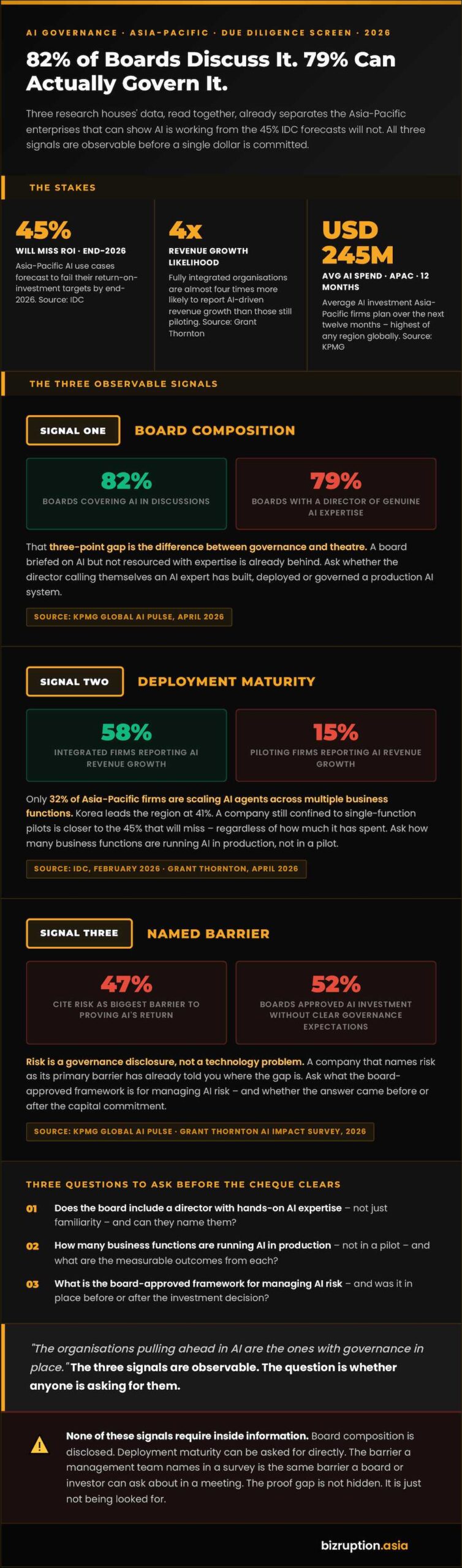
The first signal is board composition. KPMG’s Global AI Pulse survey found 82% of Asia-Pacific boards now cover AI in their discussions, but only 79% include a director with genuine AI expertise.
That three-point gap is small in isolation. It is the difference between governance and theatre. A board that treats AI as a topic to be briefed on, rather than a competency to be resourced, is already behind.
The Pilot Trap
The second is deployment maturity. Only 32% of Asia-Pacific firms are scaling AI agents across multiple business functions, rather than running isolated pilots. Korea leads the region at 41%. A company still confined to single-function pilots is closer to the 45% than the 55%, regardless of how much it has already spent.
IDC’s own research explains why the gap persists even at well-resourced firms.
Traditional ROI metrics fail to capture indirect benefits such as faster decision-making, improved customer experience and organisational resilience. A company measuring AI only against cost savings is using the wrong ruler. It will show up in the 45% regardless of how the technology actually performs.
The Validation From Outside Asia
The clearest validation of the mechanism comes from outside Asia-Pacific. Grant Thornton’s 2026 AI Impact Survey covered nearly 1,000 senior US business leaders. It found that fully integrated organisations are almost four times more likely to report AI-driven revenue growth than those still piloting: 58% against 15%.
“The organisations pulling ahead in AI are the ones with governance in place,” said Tom Puthiyamadam, Managing Partner of Advisory Services, Grant Thornton Advisors, 13 April 2026. The figure is US data, but the mechanism it describes, that integration maturity predicts value, does not stop at a border.
What To Ask Before The Cheque Clears
The same KPMG survey found the constraint respondents named themselves. 47% cited risk considerations as the single biggest barrier to demonstrating AI’s return, ahead of measurement difficulty or the technology itself.
That is not a technology problem. It is a governance disclosure that any board or investor can ask for directly. For a board or an investor screening AI exposure, that is the question worth asking before the capital commitment not after the earnings call.
References:
- Asia Pacific Moves From AI Adoption to AI Advantage – KPMG Global AI Pulse, April 2026
- Asia/Pacific CIO Agenda 2026: Five Predictions Defining the Shift to Agentic AI – IDC, February 2026
- A Widening ‘AI Proof Gap’ Is Emerging – Grant Thornton, 13 April 2026
- 2026 AI Impact Survey Report – Grant Thornton