TSMC beat. Alphabet beat. Meta beat. SK Hynix beat by a record margin. Each one was punished by the market within hours of reporting. The Proof Gap Trade’s analysis of the chip sell-off explained why investors have stopped taking AI capex on faith.
This piece is the evidence file: what the new rule actually looked like, company by company. At issue is not whether AI works, but whether the billions being spent on it can be shown, not just promised, to generate a return.
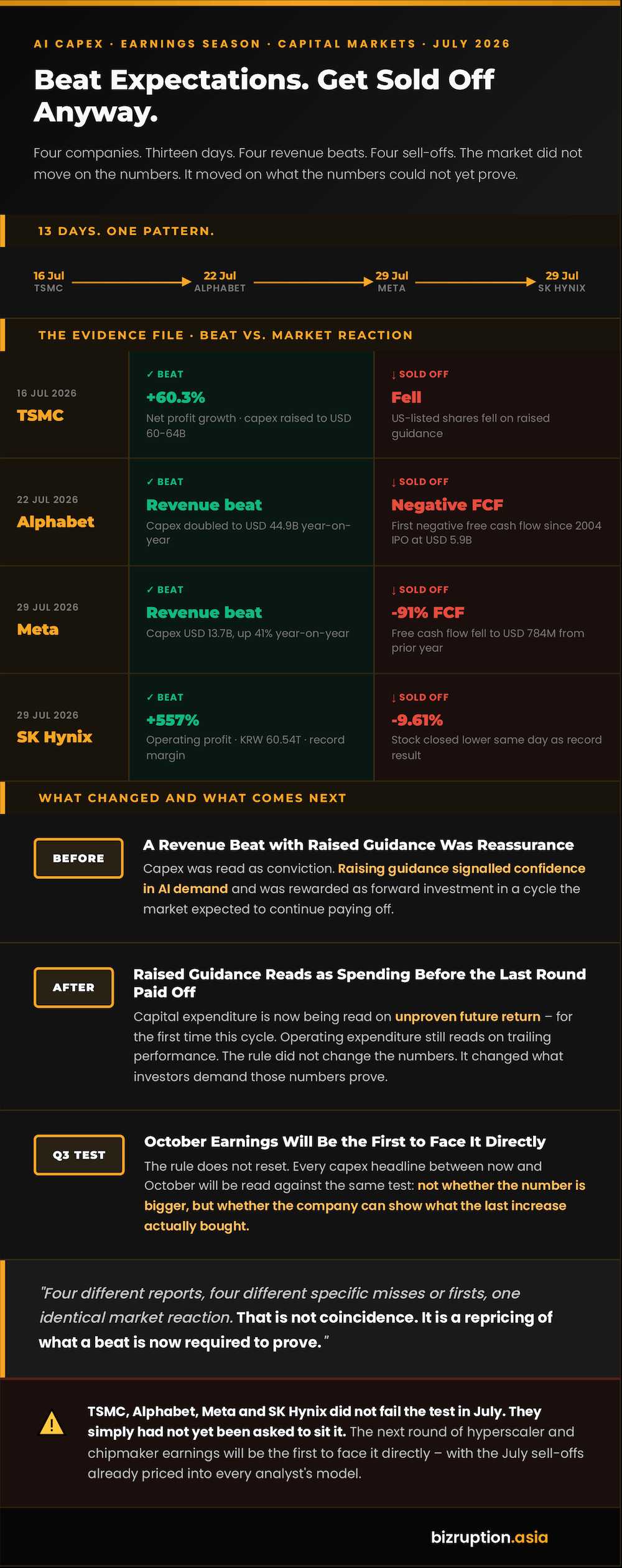
Four beats, zero protection
Line them up in order and the pattern is unmistakable.
TSMC raised its 2026 capex guidance from USD 52-56 billion to USD 60-64 billion on 16 July. CEO C.C. Wei cited AI megatrend conviction. Its US-listed shares fell anyway.
Alphabet posted its first negative free cash flow quarter since its 2004 listing, at USD 5.9 billion on 22 July. Capex had doubled to USD 44.9 billion. Shares fell in extended trading despite a revenue beat.
Meta’s free cash flow dropped 91% year-on-year to USD 784 million on 29 July. Shares fell in after-hours trading despite a revenue beat.
SK Hynix closed the window on 29 July with a record KRW 60.54 trillion operating profit, up 557% year-on-year. The stock closed 9.61% lower the same day.
The new rule
Four different reports, four different specific misses or firsts, one identical market reaction. That is not coincidence. It is a repricing of what a beat is now required to prove.
Before July, a revenue beat with raised guidance was reassurance. After it, raised guidance reads as a company promising more spending before it has shown the last round paid off.
The rule did not change the numbers companies report. It changed what investors demand those numbers prove. Operating expenditure still gets read on trailing performance. Capital expenditure, for the first time this cycle, is being read on unproven future return.
Not everyone agrees it is new
Michael Field, Chief Equity Strategist, Morningstar, told CNBC on 29 July 2026 that the moves reflect sentiment rather than fundamentals. “Simply put, it’s loss of confidence,” he said.
On that reading, nothing structural changed. Investors got nervous and the nervousness showed up in market-cap losses before AI infrastructure demand itself had shown any sign of slowing.
Both readings can be true at once. Sentiment and structural repricing are not mutually exclusive. A market that has grown genuinely cautious about proof is exactly the market that gets jumpy on any single data point.
The Test Q3 Earnings Will Face
The rule does not reset with the next earnings cycle. Every capex headline between now and October, when Q3 results land, will be read against the same test. Not whether the number is bigger, but whether the company can show what the last increase actually bought.
TSMC, Alphabet, Meta and SK Hynix did not fail that test in July. They simply had not yet been asked to sit it. The next round of hyperscaler and chipmaker earnings will be the first to face it directly.
References:
- SK hynix Announces 2Q26 Financial Results – SK hynix Newsroom, 29 July 2026
- Chip Stocks Shed More Than USD 1 Trillion as Selloff Hits Companies Powering AI Boom – CNBC, 29 July 2026
- TSMC Raises Capex and Revenue Forecast, Highlighting Growing AI Chip Demand – Reuters via Yahoo Finance, 16 July 2026
- Google (GOOG) Q2 2026 Earnings Report: Live Updates – CNBC, 22 July 2026
- Meta’s Stock Drops on Disappointing Guidance, Dwindling Free Cash Flow – CNBC, 29 July 2026