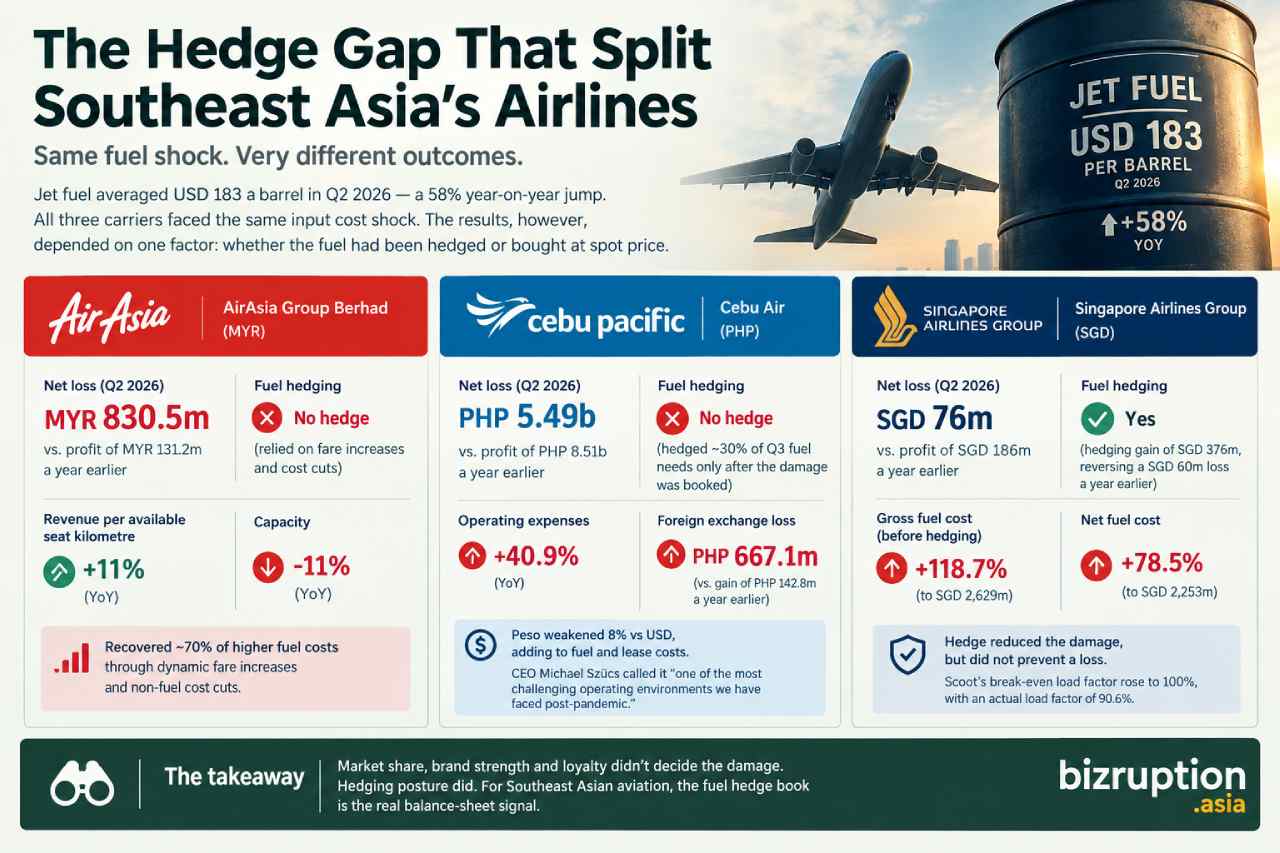
AirAsia Group Berhad reported a net loss of MYR 830.5 million for the second quarter on 13 August 2026. It was the last of three regional carriers to report results within three weeks. Jet fuel averaged USD 183 a barrel that quarter, a 58% year-on-year jump tied to the Middle East conflict that began on 28 February 2026.
Every Southeast Asian carrier absorbed the same input cost shock. The results that followed did not look remotely similar.
Cebu Air, the operator of Cebu Pacific, posted a net loss of PHP 5.49 billion for the same quarter. That reversed PHP 8.51 billion in net income a year earlier. Singapore Airlines Group, hedged, still swung to a net loss of SGD 76 million, against a SGD 186 million profit the year before.
All three carriers faced the identical oil price. The scale of the damage did not track company size, brand strength or market share. It tracked whether the fuel had already been hedged before the shock or bought at spot price afterward. One of the three hedged well and lost money anyway. Read on to find out which.
The Unhedged Carrier Paid Twice
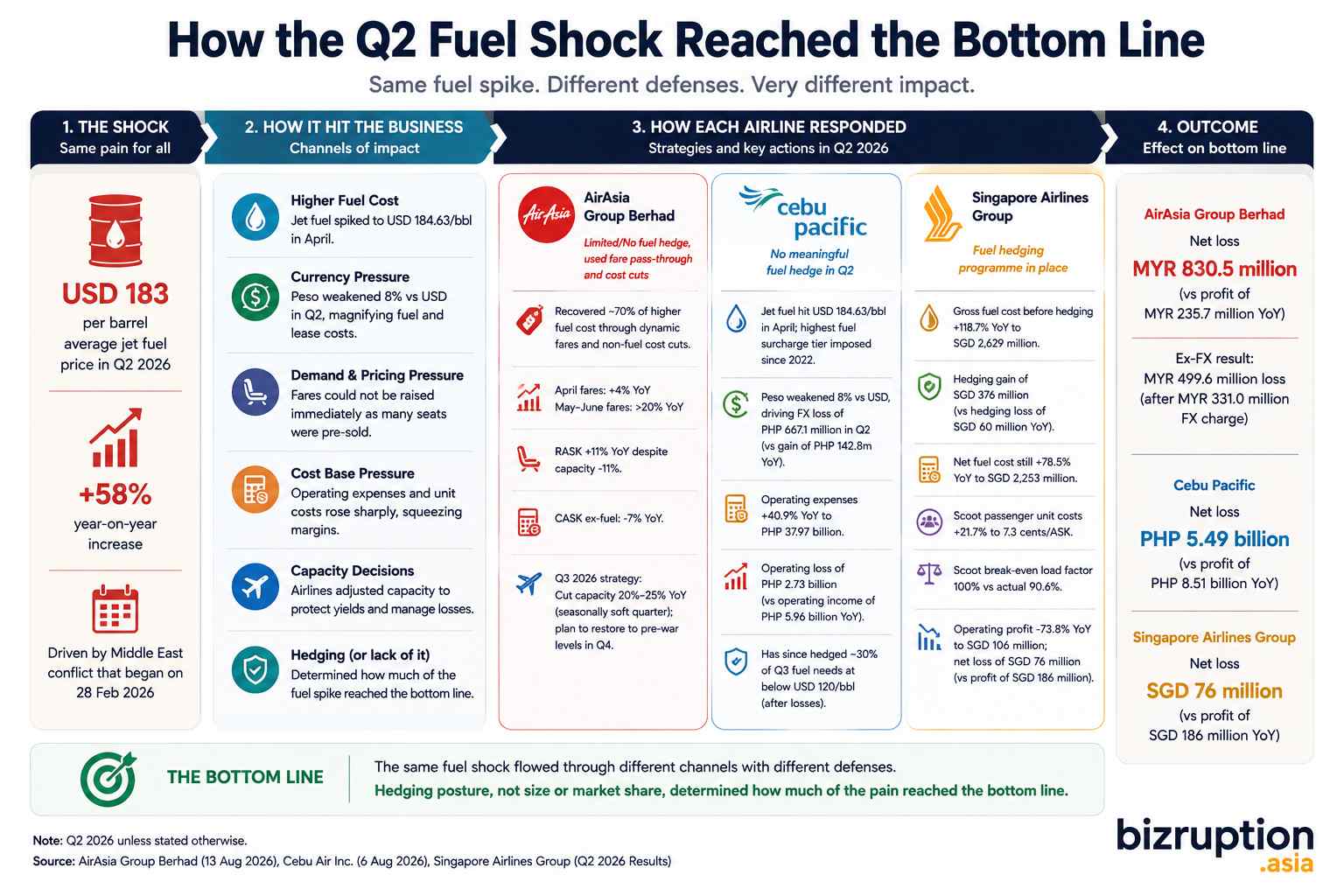
Cebu Pacific entered the second quarter with no meaningful fuel hedge in place, leaving it exposed on both the fuel and currency lines at once. Operating expenses surged 40.9% to PHP 37.97 billion. That drove an operating loss of PHP 2.73 billion, against PHP 5.96 billion in operating income a year earlier. Jet fuel reached USD 184.63 a barrel in April.
A weakening peso then compounded the fuel bill. The currency lost 8% against the US dollar in the quarter. That magnified the cost of dollar-priced fuel and leases. Cebu Air’s foreign exchange loss widened to PHP 667.1 million, from a PHP 142.8 million gain a year earlier. For the first half, that swing reached PHP 2.46 billion.
Those currency dynamics are explored in the companion analysis: When Four Currencies Fall Together, Fuel Is Only Half the Bill.
Cebu Air CEO Michael Szücs did not soften it. In a regulatory filing on 6 August 2026, he called it “one of the most challenging operating environments we have faced post-pandemic.” Cebu Pacific has since hedged about 30% of its third-quarter fuel needs at below USD 120 a barrel. The move came only after the damage was already booked.
Pass-Through Bought Time, Not Protection
AirAsia Group took a different route. Rather than hedging the fuel price itself, it moved fares. The Group recovered about 70% of its higher fuel cost through dynamic fare increases and non-fuel cost cuts.
Revenue per available seat kilometre rose 11% year-on-year even as capacity fell 11%. Cost per available seat kilometre excluding fuel dropped 7%.
The pass-through was not instant. April fares rose only 4% year-on-year, since seats were largely pre-sold before the spike. Fares then jumped more than 20% across May and June as the pricing strategy took full effect.
That timing gap explains most of the difference between AirAsia’s MYR 830.5 million reported net loss and its ex-FX result. Stripping out a MYR 331.0 million foreign exchange charge leaves a MYR 499.6 million loss.
AirAsia Group CEO Bo Lingam framed the quarter as an inflection point. The Group is “treating 2Q26 as our floor quarter,” he said. AirAsia is taking a calculated, tactical approach to Q3, trimming capacity by 20%-25% year-on-year, typically the softest travel period.
The Group plans to restore capacity to pre-war levels in the fourth quarter.
Hedging Cushioned the Blow, Not the Loss
Singapore Airlines Group shows what a hedge book can and cannot do. Gross fuel cost before hedging more than doubled, up 118.7% to SGD 2,629 million. A fuel-hedging gain of SGD 376 million softened the blow. Net fuel cost still rose 78.5% to SGD 2,253 million.
Within the Group, Scoot’s passenger unit costs rose 21.7% to 7.3 cents per available seat kilometre. That pushed its break-even load factor to 100%, against an actual load factor of 90.6%. Scoot’s operating loss nearly doubled to SGD 32 million, from SGD 17 million a year earlier, despite fare increases and hedge coverage.
Operating profit still fell 73.8% to SGD 106 million, alone enough to tip the Group into a loss. A further SGD 42 million hit from its 25.1% stake in Air India widened it to SGD 76 million. That reversed a SGD 186 million profit the year before.
The hedge did exactly what it was built to do. Air India was the risk nobody was hedging against.
Hedging Explains Exposure, Not Every Outcome
The pattern across all three carriers holds on one point and complicates on another. Hedging posture, or the speed of fare pass-through in AirAsia’s case, decided how directly each carrier felt the fuel shock. It did not decide whether a loss appeared at all, as Singapore Airlines Group’s own results just showed.
BofA Global Research’s Nathan Gee, head of Asia-Pacific transportation research, offers a second lens. Full-service carriers weathered the shock better than budget carriers, cushioned by stronger premium demand and loyalty programmes that low-cost models lack.
Hedging determines fuel-price exposure. Business model determines how much of the rest gets absorbed.
Whether that discipline extends into the fourth quarter, or reflects only a bet on cheaper fuel, is addressed in the companion analysis: Q4 Will Test Whether Southeast Asia’s Airlines Learned the Right Lesson.
Independent aviation analyst Brendan Sobie offered a blunter view. “The short-term outlook is rather bleak,” he said. Any fourth-quarter improvement, in his assessment, remains too early to call with confidence.
Market share and brand loyalty are not the numbers to watch. The fuel hedge book is the starting point: it shows whether protection was built before the war started or assembled afterward. Whether that protection was enough is a different question. Singapore Airlines Group hedged as well as any carrier in the region. It still posted a loss.
References:
- AirAsia Group Financial Results Second Quarter 2026 – AirAsia Newsroom, 13 August 2026
- Cebu Air Swings to P5.49-Billion Net Loss in Q2 – BusinessWorld, 7 August 2026
- SIA Group Reports $76M Q1 Net Loss – Singapore Airlines, 28 July 2026
- Southeast Asia’s Budget Airlines Eye Recovery But Fuel Scars Linger – The Star / Reuters, 24 August 2026