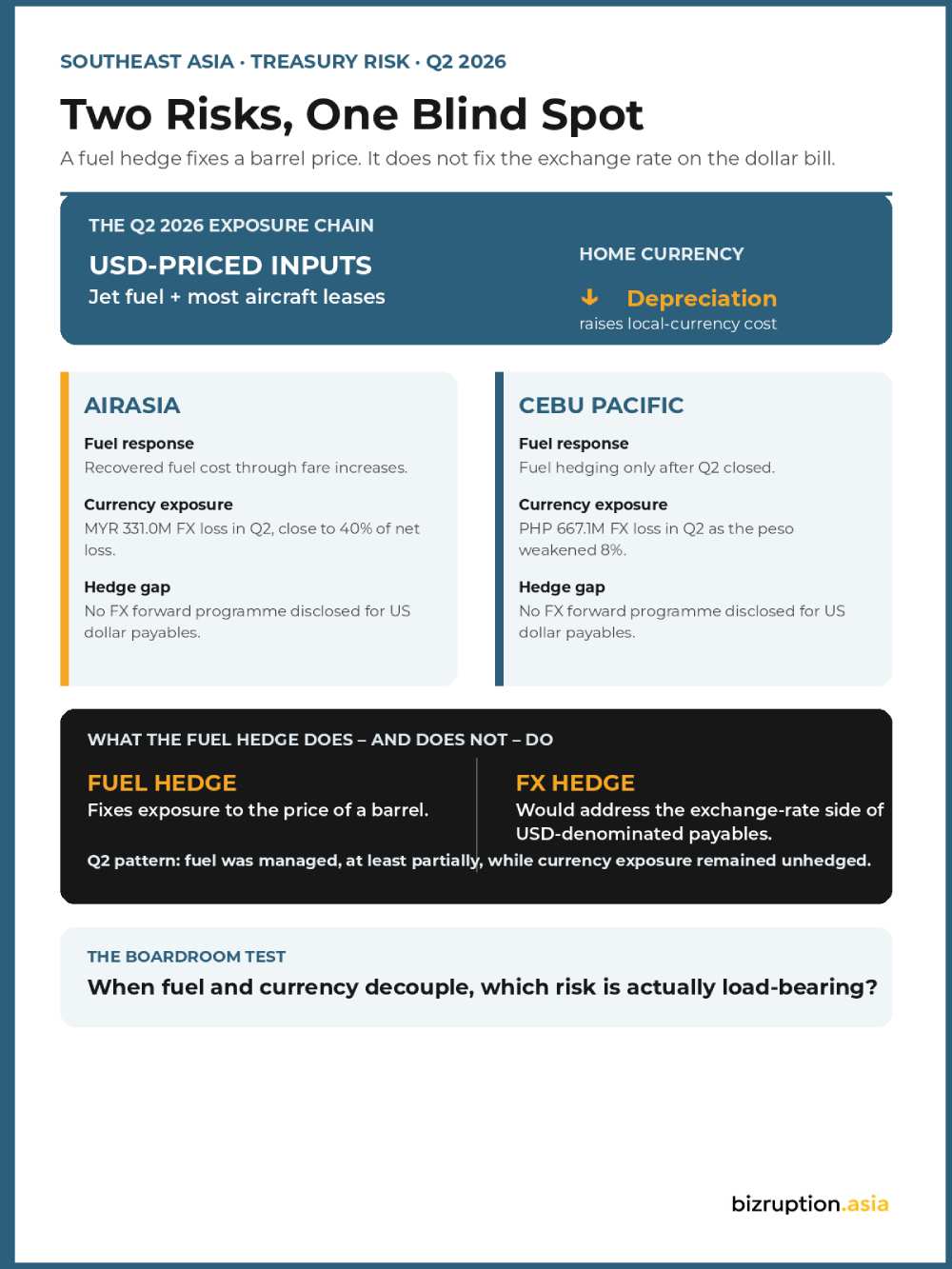
AirAsia Group Berhad disclosed a MYR 331.0 million foreign exchange loss for the second quarter on 13 August 2026. That sat alongside a MYR 830.5 million net loss. Currency alone accounted for close to 40% of the total. Strip it out, and the Group’s operating loss was MYR 499.6 million.
For a CFO tracking regional fuel exposure, that split is the detail most models miss.
Two Airlines, Two Currencies, the Same Blind Spot
Cebu Pacific’s exposure moved the same way. The Philippine peso weakened 8% against the US dollar during the quarter, raising the cost of dollar-priced fuel and leases the airline was not hedging. Cebu Air’s foreign exchange loss reached PHP 667.1 million, against a PHP 142.8 million gain a year earlier.
For the first half, that swing widened to PHP 2.46 billion, from a PHP 106.8 million loss a year earlier. The company attributed it to depreciation against three currencies at once: the Japanese yen, the Singapore dollar and the US dollar.
Jet fuel and most aircraft leases are priced in US dollars. That holds regardless of where an airline is based or which currency its tickets are sold in. A weaker home currency raises the local-currency cost of both, on top of whatever the oil price is doing. The two pressures normally move independently. In Q2 2026, they moved together.
Neither airline’s fuel response touched this
AirAsia recovered fuel cost through fare increases. Cebu Pacific hedged fuel only after the quarter closed. A fuel hedge fixes a barrel price, not an exchange rate. Neither carrier disclosed an FX forward programme on its US dollar payables for the quarter. The currency exposure ran unhedged throughout, in both cases.
A carrier can hedge fuel and currency separately. Between these two, at least, Q2 2026 shows a common pattern: one risk was managed, if partially, and the other was not managed at all. The companion cover story, The Hedge Gap That Split Southeast Asia’s Airlines, sets out how unevenly that fuel-hedging decision alone reshaped the region’s Q2 results.
Cebu Air CEO Michael Szücs struck an optimistic note in the same 6 August 2026 regulatory filing, saying he remains “confident in Cebu Pacific’s long-term growth opportunity.” The currency line running through that filing tells a less settled story than the one his statement points to.
Fuel and currency moved in the same direction this quarter. That will not always hold. When the two decouple, whichever carrier hedged only one of them will find out which risk was actually load-bearing all along.
References