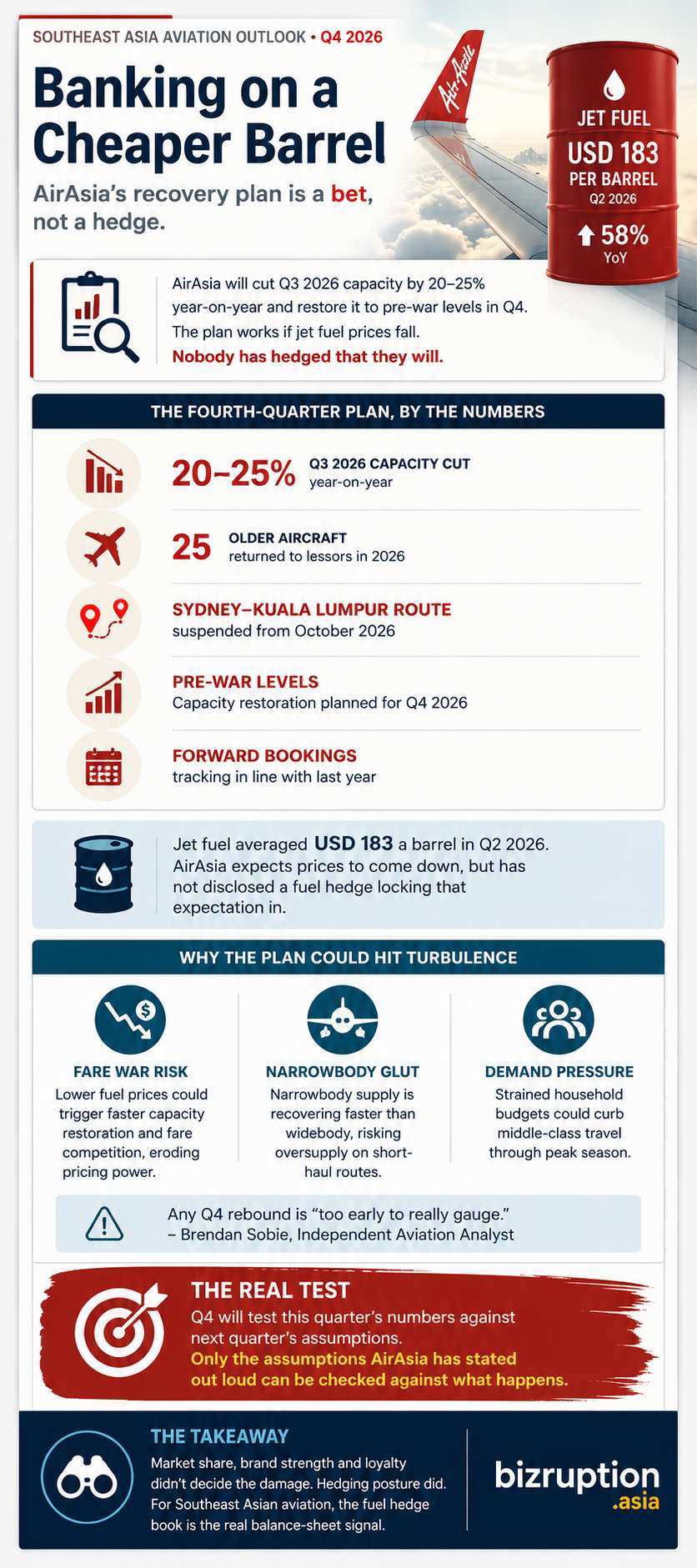
AirAsia Group Berhad confirmed on 13 August 2026 that it will cut third-quarter seat capacity by 20% to 25% year-on-year. It plans to restore capacity to pre-war levels in the fourth quarter.
The airline is also returning 25 older aircraft to lessors during 2026 and suspending its Sydney-Kuala Lumpur route from October. Forward bookings, the Group said, are tracking in line with last year.
The Bet Behind the Fourth-Quarter Plan
CEO Bo Lingam described the approach as “a deliberate, tactical approach to protect our bottom line.” The Q3 cut is real cost discipline, timed to the region’s seasonally softest travel quarter.
The Q4 restoration plan rests on a separate premise. Jet fuel averaged USD 183 a barrel in the second quarter, and AirAsia expects that figure to come down. That expectation is not hedged. It is a forecast.
AirAsia’s own results show why the distinction matters. A hedge protects a cost base regardless of where prices go. A forecast only pays off if it turns out to be right.
That distinction is the mechanism explored across the region in the companion cover story, The Hedge Gap That Split Southeast Asia’s Airlines. Restoring capacity on the assumption that Q2’s fuel spike does not repeat is a directional bet. It is not protection against being wrong.
The Recovery Has Its Own Risks
BofA Global Research’s Nathan Gee, head of Asia-Pacific transportation research, flags a complication with the good scenario, not just the bad one. Lower fuel prices could ease cost pressure.
They could also push airlines to restore capacity faster and compete harder on fares. That would erode the same pricing power that let AirAsia recover 70% of its Q2 fuel cost increase.
Intra-Asian routes carry an added structural risk. Narrowbody aircraft supply is recovering faster than widebody supply, meaning seats could return to the region’s short-haul routes before demand does.
Independent aviation analyst Brendan Sobie has flagged the demand side directly. Strained household budgets, he has said, could curb travel by Southeast Asia’s middle class through the year’s peak season. Any Q4 rebound, in his assessment, remains “too early to really gauge.”
None of this is specific to AirAsia. A weaker household budget or a narrowbody glut would test any regional carrier banking on the fourth quarter. That is true whether or not the carrier has said so publicly. AirAsia is simply the one that has put a number on its bet and told the market when it expects to collect.
That is what makes the fourth quarter worth watching closely. It tests this quarter’s numbers against next quarter’s assumptions, and only the assumptions AirAsia has stated out loud can actually be checked against what happens.
SIDEBAR: THE FOURTH-QUARTER PLAN, BY THE NUMBERS
AirAsia Group: Q3 2026 capacity cut of 20–25% year-on-year; 25 older aircraft returned to lessors during 2026; Sydney-Kuala Lumpur route suspended from October 2026; capacity restoration to pre-war levels planned for Q4 2026, with forward bookings tracking in line with the prior year.
Jet fuel averaged USD 183 a barrel in Q2 2026. AirAsia does not expect prices to sustain at that level, but has not disclosed a fuel hedge locking that expectation in.
References