On 15 April 2026, Philippine President Ferdinand Marcos Jr. stood before the AZEC Plus summit and delivered the meeting’s sharpest moment. “The mechanism exists and it should be tested now,” he told assembled leaders, then offered Manila as host of the first-ever emergency simulation exercise under the ASEAN Petroleum Security Agreement.
The first ever. In a live crisis. Forty years after APSA was signed.
That detail matters more than any headline number from the summit. For the full analysis of what POWERR Asia can and cannot deliver for ASEAN sovereigns and corporates, see the companion piece: Washington Closed the Strait. Beijing Is Calm. Tokyo Just Mobilised USD 10 Billion
A Framework Built for a Crisis It Has Never Faced
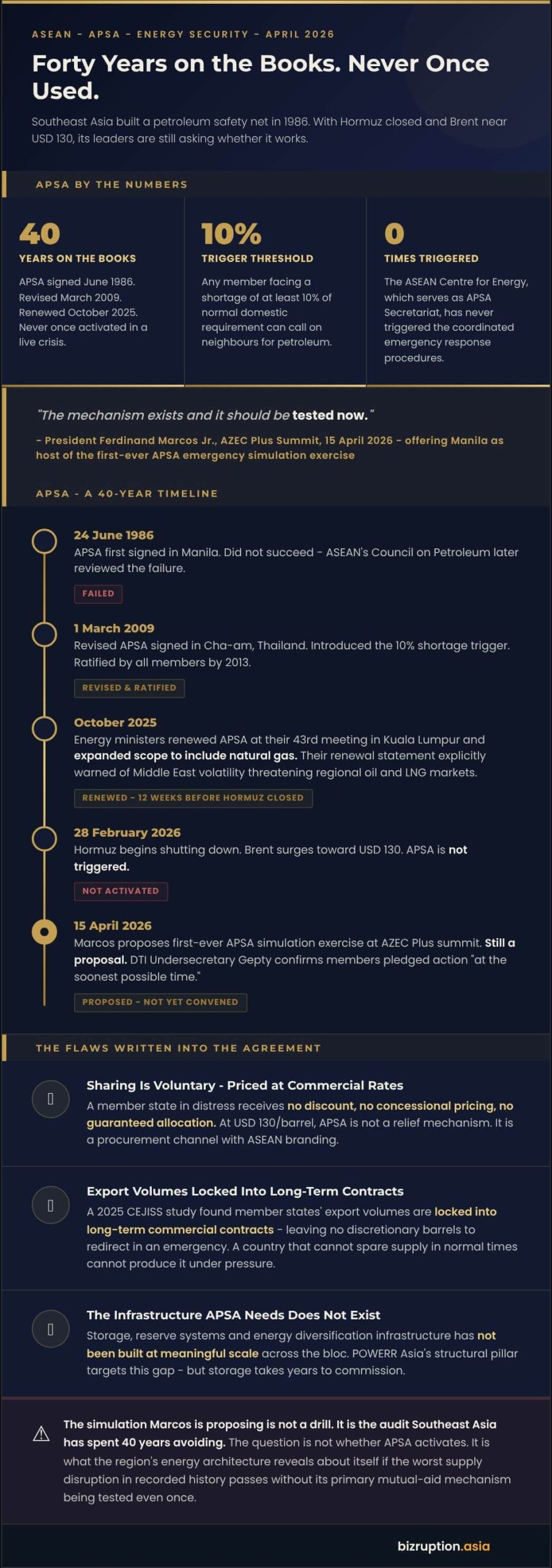
APSA was first signed in Manila on 24 June 1986. It did not succeed. ASEAN’s Council on Petroleum reviewed the failure and produced a second version, signed in Cha-am, Thailand on 1 March 2009. The revision introduced a specific trigger: any member state facing a shortage of at least 10% of its normal domestic requirement could call on neighbours for petroleum. All members ratified it by 2013.
In October 2025 – twelve weeks before Hormuz closed – energy ministers renewed APSA at their 43rd meeting in Kuala Lumpur and expanded its scope to include natural gas. Their renewal statement warned explicitly of Middle East volatility threatening regional oil and LNG markets.
When the strait began shutting down on 28 February 2026, APSA was not triggered.
The Flaw Written Into the Agreement Itself
Sharing under APSA is voluntary. Every transaction is priced at commercial rates. A member state in distress receives no discount, no concessional pricing, no guaranteed allocation – only a regional framework within which it may attempt bilateral negotiation.
At USD 130 per barrel, that is not a relief mechanism. It is a procurement channel with ASEAN branding.
A 2025 study in the Central European Journal of International and Security Studies examined why Indonesia – a founding APSA member and the bloc’s largest oil producer – had not implemented the agreement in the decade following ratification.
The core finding: member states’ export volumes are locked into long-term commercial contracts, leaving no discretionary barrels to redirect in an emergency. A country that cannot spare supply in normal times cannot produce it under pressure.
This is the gap POWERR Asia’s structural pillar targets – financing storage construction, reserve systems and energy diversification. But storage takes years to commission. The infrastructure APSA was supposed to underpin does not exist at meaningful scale across the bloc.
What Marcos Is Actually Proposing
The Philippines chairs ASEAN in 2026. A simulation exercise, if convened, would mark the first time APSA’s coordinated emergency response mechanism had been operationally tested – not reviewed, not modelled, but run with real supply flows, real bilateral negotiations and real pricing during a live disruption.
The ASEAN Centre for Energy, which serves as APSA Secretariat, has never triggered those procedures.
DTI Undersecretary Allan Gepty, speaking after the ASEAN Economic Ministers’ Retreat in March 2026, confirmed members had agreed to fast-track APSA’s finalisation and pledged action “at the soonest possible time.”
The shock APSA was designed for has arrived. The question every portfolio manager, sovereign risk analyst and corporate treasurer must answer is not whether the mechanism activates.
It is what the region’s energy architecture reveals about itself if the worst supply disruption in recorded history passes without its primary mutual-aid mechanism being tested even once.
The simulation Marcos is proposing is not a drill. It is the audit Southeast Asia has spent 40 years avoiding.
References:
- Philippines Backs Regional Fuel Sharing Amid Middle East Crisis – Philstar
- Marcos Urges ASEAN to Activate Fuel-Sharing Pact – Interaksyon/Philstar
- APSA Secretariat – ASEAN Centre for Energy
- ASEAN Ministers Urge Development of Petroleum Sharing Agreement – Presidential Communications Office Philippines
- ASEAN States Working on Fuel-Sharing Deal – Inquirer Global Nation
- Unravelling Indonesia’s Failure to Implement APSA – Central European Journal of International and Security Studies
- Turning to ASEAN for Help – Inquirer Opinion
- ASEAN Petroleum Security Agreement 1986 – ESCAP Policy Documents
- Oil Market Report – International Energy Agency