
The fragmentation that ASEAN’s Finance Track keeps acknowledging but not solving became harder to ignore in 2025. Three of the region’s most significant financial regulators each published substantive frameworks for managing the risks that compound shocks – climate disruption, AI governance failure – pose to their financial systems.
The frameworks are real, detailed and operational. They are also incompatible with each other in ways that create direct cost and pricing consequences for every institution running a cross-border book in the region.
Three Frameworks, Three Methodologies
Bank Negara Malaysia and the Securities Commission Malaysia launched the Climate Finance Innovation Lab in June 2025 under the Joint Committee on Climate Change.
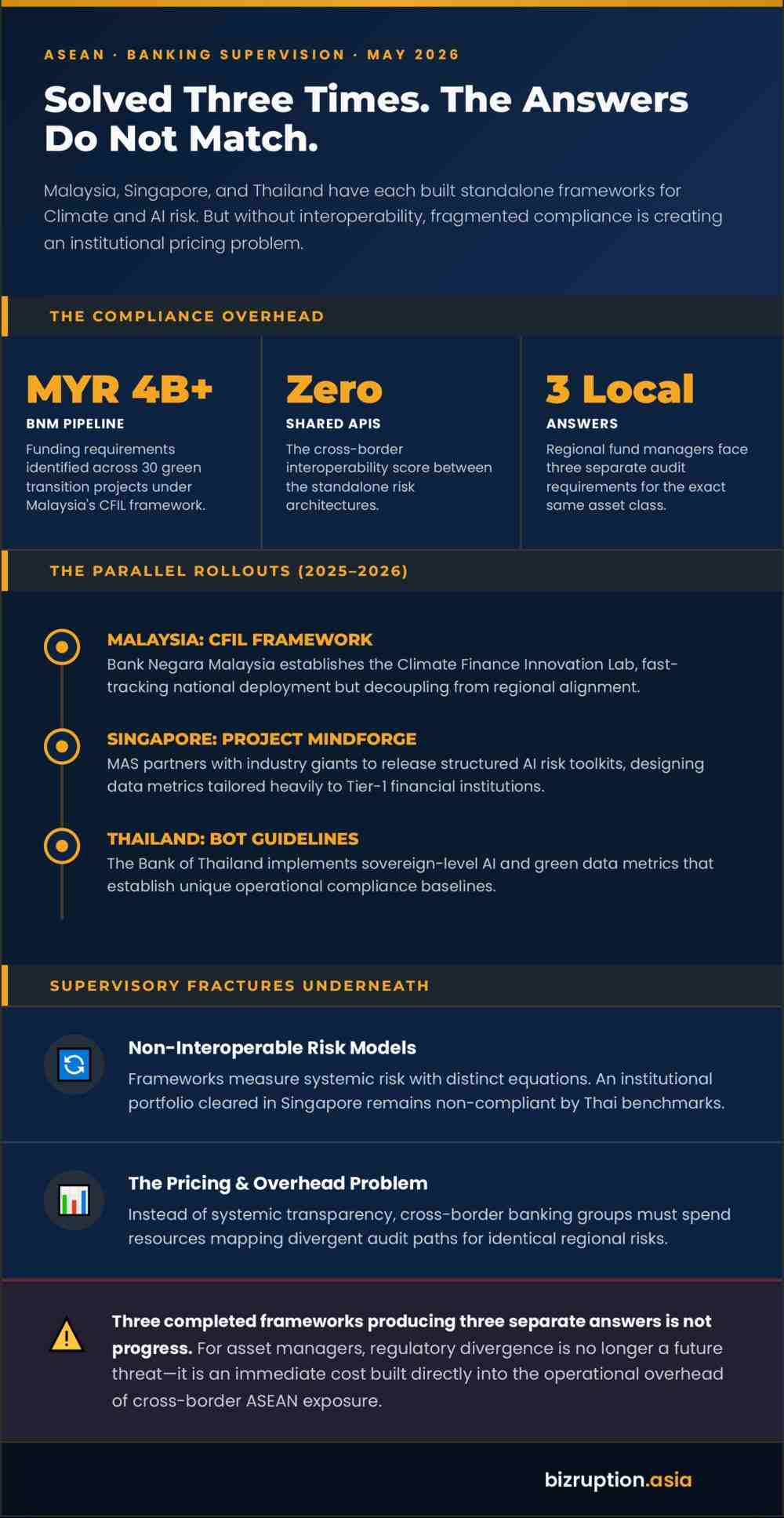
Administered by Bank Pembangunan Malaysia Berhad, the lab has already onboarded 30 projects with funding needs exceeding MYR 4 billion, focused on energy transition, sustainable agriculture, circular economy and nature-based solutions.
BNM has also integrated climate risk into its supervisory expectations since 2021, requiring financial institutions to apply the Climate Change and Principle-based Taxonomy framework to lending and monitoring processes. The supervisory baseline is embedded and growing.
The Monetary Authority of Singapore moved on two tracks simultaneously. Phase 2 of Project MindForge concluded in March 2026, producing an AI Risk Management Toolkit developed with a consortium of 24 banks, insurers and capital market firms including BlackRock, GIC and State Street.
The toolkit covers traditional AI, generative AI and agentic AI across four pillars: governance, risk management, lifecycle controls and organisational enablers.
MAS published a separate consultation paper on formal AI Risk Management Guidelines on 13 November 2025, against which the MindForge toolkit is explicitly positioned as the implementation companion.
The Bank of Thailand issued its AI Risk Management Guidelines for Financial Service Providers on 12 September 2025, building on a public consultation that closed on 30 June 2025.
The guidelines set risk-based expectations for governance, lifecycle controls, data quality, model testing and cybersecurity across all financial institutions and payment providers under BOT supervision.
The Gap That Three Finished Frameworks Did Not Close
Each framework is credible on its own terms. The problem is not quality. It is architecture. BNM addresses AI risk within its broader Technology Risk Management Framework, requiring institutions to extrapolate AI-specific controls from general technology risk principles.
MAS has produced the most granular standalone AI governance regime in the region. The BOT’s guidelines sit between the two in specificity.
A financial institution operating across all three markets must maintain three separate AI governance frameworks, calibrated to three different methodological standards, reported under three different disclosure regimes – for the same underlying risk in the same regional portfolio.
The climate side runs the same problem in a different direction. BNM’s taxonomy and supervisory expectations do not map directly onto MAS’s environmental risk management guidelines. Stress scenarios for climate transition risk are constructed differently in Kuala Lumpur than in Singapore.
For a fund manager running ASEAN infrastructure exposure or a bank with cross-border project finance across Malaysia, Singapore and Thailand, the practical consequence is that no single consistent scenario analysis can be produced.
Each jurisdiction requires its own model, its own assumptions and its own disclosure output. Three finished frameworks covering the same underlying risks, producing three different answers, is not regional progress. It is institutionalised divergence.
What Convergence Would Require and Why It Has Not Happened
The 13th ASEAN Finance Ministers’ and Central Bank Governors’ Meeting, convened in April 2026 under the Philippines’ chairmanship, acknowledged climate risk management as a priority deliverable. A supervisory convergence mechanism – a regional standard against which national frameworks could be calibrated – did not appear on the agenda.
The ASEAN Taxonomy for Sustainable Finance exists as a reference framework but national taxonomies are not required to align with it, and Malaysia’s own taxonomy is still in design, with a call for feedback issued in early 2026.
Convergence requires political will at the national level that regional chairmanship communiqués cannot mandate. Each central bank’s framework reflects domestic legislative architecture, industry consultation processes and supervisory philosophy that took years to develop.
Standardising them across eleven jurisdictions on a two-year chairmanship cycle is not a realistic deliverable.
For institutional investors, that is the working reality. The cost of regulatory divergence is not theoretical or future – it is already in the compliance budget and the model-building overhead of every institution running material cross-ASEAN exposure today.
The cover story accompanying this piece examines what the Philippines’ Finance Track is attempting to do at the regional level. The supervisory fragmentation documented here is the structural constraint that sits underneath all of it.
References:
- Climate Finance Innovation Lab – Joint Committee on Climate Change, Bank Negara Malaysia and Securities Commission Malaysia
- CFIL Onboards 30 Projects, Funding Needs Exceed MYR 4 Billion – Bernama
- MAS Partners Industry to Develop AI Risk Management Toolkit – Monetary Authority of Singapore
- Project MindForge – Monetary Authority of Singapore
- Consultation Paper on Guidelines on Artificial Intelligence Risk Management – Monetary Authority of Singapore
- Thailand Issues AI Risk Management Guidelines for Financial Service Providers – Tilleke & Gibbins
- MAS AI Risk Management Guidelines 2025 – Pertama Partners
- Joint Statement of the 13th ASEAN Finance Ministers’ and Central Bank Governors’ Meeting – ASEAN Secretariat
- Central Banks Must Guide ASEAN+3 Through Age of Novel Risks – Aziz Durrani and Julia Anna Bingler, The Business Times / Green Central Banking