Guy Carpenter’s April 2026 renewal report recorded double-digit price reductions across Indonesia, the Philippines and Singapore, alongside Japan and Korea. This came even as the Middle East conflict entered its second month. Treaty reinsurers moved to assess their exposure quickly.
They refused to soften the terms that matter most. Their stated position was “no acceptance of conflict exclusionary language in contractual terms.” Southeast Asian cedants kept cheaper cover and full protection in the same renewal cycle.
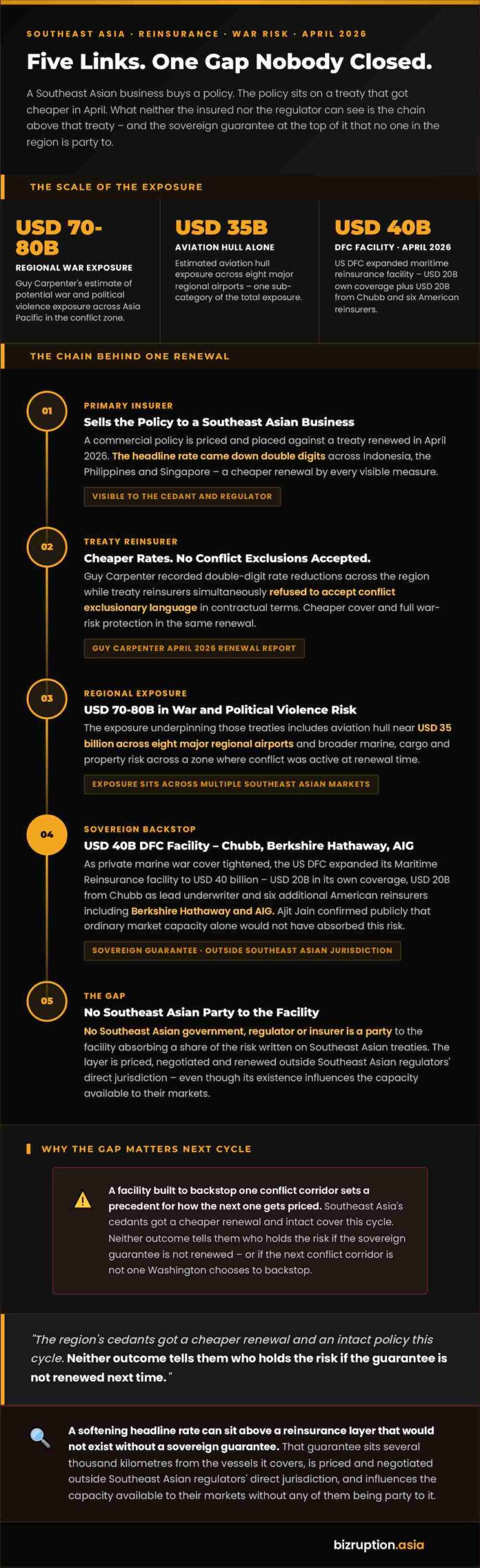
That combination only holds if someone else is absorbing the risk reinsurers declined to exclude. Guy Carpenter estimates potential war and political violence exposure in the conflict zone at USD 70 to 80 billion.
Aviation hull exposure alone across eight major regional airports was estimated near USD 35 billion. Tony Gallagher, CEO Asia Pacific at Guy Carpenter, described the region as “demonstrating robust capacity and competitive pricing” despite the backdrop.
The Layer Southeast Asia’s Insurers Do Not See
The answer sits above the primary insurer, in a market cedants rarely interact with directly. As private marine war cover for Gulf‑transiting vessels tightened, the US International Development Finance Corporation stepped in with a sovereign‑backed maritime reinsurance facility.
DFC expanded its Maritime Reinsurance facility to USD 40 billion in April 2026. That total comprises USD 20 billion in DFC’s own rolling coverage. A further USD 20 billion comes from Chubb, acting as lead underwriter, and six additional American reinsurers, including Berkshire Hathaway and AIG.
Ajit Jain, Vice Chairman of Berkshire Hathaway’s insurance operations, framed the participation plainly. The facility exists, he said, to “demonstrate how our industry can help to meet important needs.” That is a private reinsurer confirming, in public, that ordinary market capacity alone would not have absorbed this risk.
For a Southeast Asian insurer, the practical chain now runs further than a single treaty renewal. A softening headline rate can sit above a reinsurance layer that would not exist without a sovereign guarantee. That guarantee sits several thousand kilometres from the vessels it covers.
That layer is priced, negotiated and renewed outside Southeast Asian regulators’ direct jurisdiction, even though its existence influences the capacity available to their markets.
The Question Every Treasury Desk Should Be Asking
Southeast Asia’s insurers are not being asked to absorb this cost directly, and the April renewals confirm it. But a facility built to backstop one conflict corridor sets a precedent for how the next one gets priced. It also raises the question of whether a government guarantee will be available every time private capacity runs short.
The region’s cedants got a cheaper renewal and an intact policy this cycle. Neither outcome tells them who holds the risk if the guarantee is not renewed next time.
Bizruption’s cover story, Why Verification Is Becoming Insurance’s Fastest-Growing Cost sets out the front-end version of this problem. There, insurers price whether a claim or counterparty can be trusted. This piece is the back end: who absorbs that risk once it is written.
References
- Reinsurance Macro Trends and Market Softening Continues in Asia Pacific and India Against Backdrop of Middle East Conflict – Guy Carpenter
- DFC, Chubb Announce Additional American Reinsurance Partners and up to $40B in Coverage for Maritime Reinsurance – US International Development Finance Corporation