Iran’s disruption of Gulf energy flows in March delivered Southeast Asia’s largest energy shock in a decade. By late April, the region’s import bill had risen by an estimated USD 3.36 billion a month. AMRO held its 2026 ASEAN+3 growth forecast at 4.0% in June but raised its inflation call to 1.8% from 1.4%, because the war ran longer than expected and energy, commodity and logistics costs stayed high.
Headline growth no longer measures resilience. The real question is whether businesses still treat this as a passing oil shock rather than a permanent shift in the operating environment.
Inflation, subsidies, energy security and industrial competitiveness now move together. The war is not hitting Southeast Asia evenly. It is separating markets with real buffers from markets whose resilience runs out the moment the shock outlasts their patience.
The Region Looks Resilient. The Buffers Are Uneven
Southeast Asia entered 2026 from genuine strength. AMRO argues the region sits better than in past crises: inflation started low, energy efficiency improved, most governments kept policy room to manoeuvre. True in aggregate. False market by market.
The region still runs on imported hydrocarbons. The Middle East supplies roughly 55% of Southeast Asia’s crude oil imports. Oil and gas cover close to 90% of transport energy and 31% of electricity generation.
When Gulf shipments stopped moving, oil prices rose first. What mattered more: businesses had to rewrite assumptions about inflation, power costs, logistics, fiscal support and industrial competitiveness all at once.
This is not an energy shock. It is a repricing of how investors judge resilience across Southeast Asia.
The Assumptions That No Longer Hold
For years, Southeast Asia investment cases rested on four assumptions: cheap energy, cost-optimised supply chains, temporary geopolitical shocks, growth that outruns disruption. The war broke all four. Energy security is becoming a competitive advantage. Supply chains are being built for resilience, not cost. Disruption is becoming routine, not exceptional. Growth still matters, but capital is increasingly following staying power instead.
The Philippines Is the Clearest Stress Case
If one market shows the war’s direct transmission into economic risk, it is the Philippines. Manila declared a state of national energy emergency, expanded coal generation and pushed for regional energy cooperation. Transport subsidies and tax relief cushioned the initial blow but didn’t touch the underlying exposure.
The real risk isn’t the fuel price. It’s the speed: transport, food distribution and household spending all reprice fast once energy inflation accelerates, and a weakening consumer can turn a commodity shock into a demand shock.
For boards, the Philippine question isn’t headline GDP. It’s how fast inflation, subsidy strain and softer household demand start feeding each other.
Boardroom Implication: Stress-test Philippine demand forecasts against prolonged energy inflation. Don’t assume fuel costs snap back.
Indonesia Can Buffer the Shock, But the Fiscal Bill Matters
Indonesia looks more resilient, but the resilience is rented. Pertamina’s price controls have capped the pass-through of higher fuel costs, holding down headline inflation. The price is a growing subsidy bill: the longer the war runs, the more the government pays to keep pump prices still.
For investors, the risk isn’t an energy shortage. It’s a slow transfer of market risk onto the state’s balance sheet. Expand the subsidy and fiscal room narrows. Cut it and inflation jumps.
Indonesia’s lesson for boards: government intervention delays repricing. It doesn’t cancel it.
Boardroom Implication: Weigh Indonesia’s fiscal resilience against its resource strength. Subsidies move risk from consumers to the government’s balance sheet. They don’t remove it.
Thailand and Malaysia Have Better Shock Absorbers Than Their Neighbours
Thailand and Malaysia sit in a steadier middle, for different reasons. Thailand leans on its Oil Fuel Fund and refinery capacity to smooth prices at the pump. Malaysia has held its RON95 price at MYR 1.99 a litre throughout, a subsidy Prime Minister Anwar Ibrahim has said could reach MYR 24 billion this year if the war drags on.
Neither is insulated. Both face higher energy costs, softer demand and pressure on energy-intensive industry. What separates them is that both still have policy levers left to pull.
The sharper question isn’t whether they can absorb today’s prices. It’s whether prolonged disruption changes the competitiveness of the industries they’re courting.
Thailand is building itself into a regional hub for EVs, advanced manufacturing and logistics. Malaysia is fighting for semiconductor production, AI infrastructure and hyperscale data centres – sectors that need reliable power and predictable costs far more than they need a tax holiday.
If energy costs stay structurally higher, the next competitive edge goes to governments that can guarantee power and fiscal room, not the ones offering the biggest incentive package.
The war hasn’t broken either country’s investment case. It has raised the price of executing it.
Boardroom Implication: Weigh long-term energy availability alongside labour costs and incentives. The next competitive edge may come from resilience, not price.
Vietnam Shows How Quickly Transition Narratives Can Reverse
Vietnam shows how fast a transition story can reverse. Its manufacturing success now depends on energy resilience as much as labour costs and supply-chain diversification. During the crisis, Hanoi loosened fuel pricing, cut fuel taxes and restricted exports.
More telling: coal-fired generation jumped 44% month on month in March. That single number says more about the region’s energy vulnerability than any policy speech.
Vietnam is still Southeast Asia’s strongest long-term manufacturing story. But the war proved how fast an ambitious transition plan yields to immediate energy security, and that matters to boards, lenders and long-term investors well beyond environmental policy.
It touches electricity reliability, financing assumptions, operating costs, and the economics of export manufacturing assets priced under a different energy scenario.
The difference now: investors should price a higher premium for energy resilience than most valuation models assumed six months ago.
Boardroom Implication: Stress-test manufacturing investments against scenarios where energy security beats decarbonisation, temporarily or not.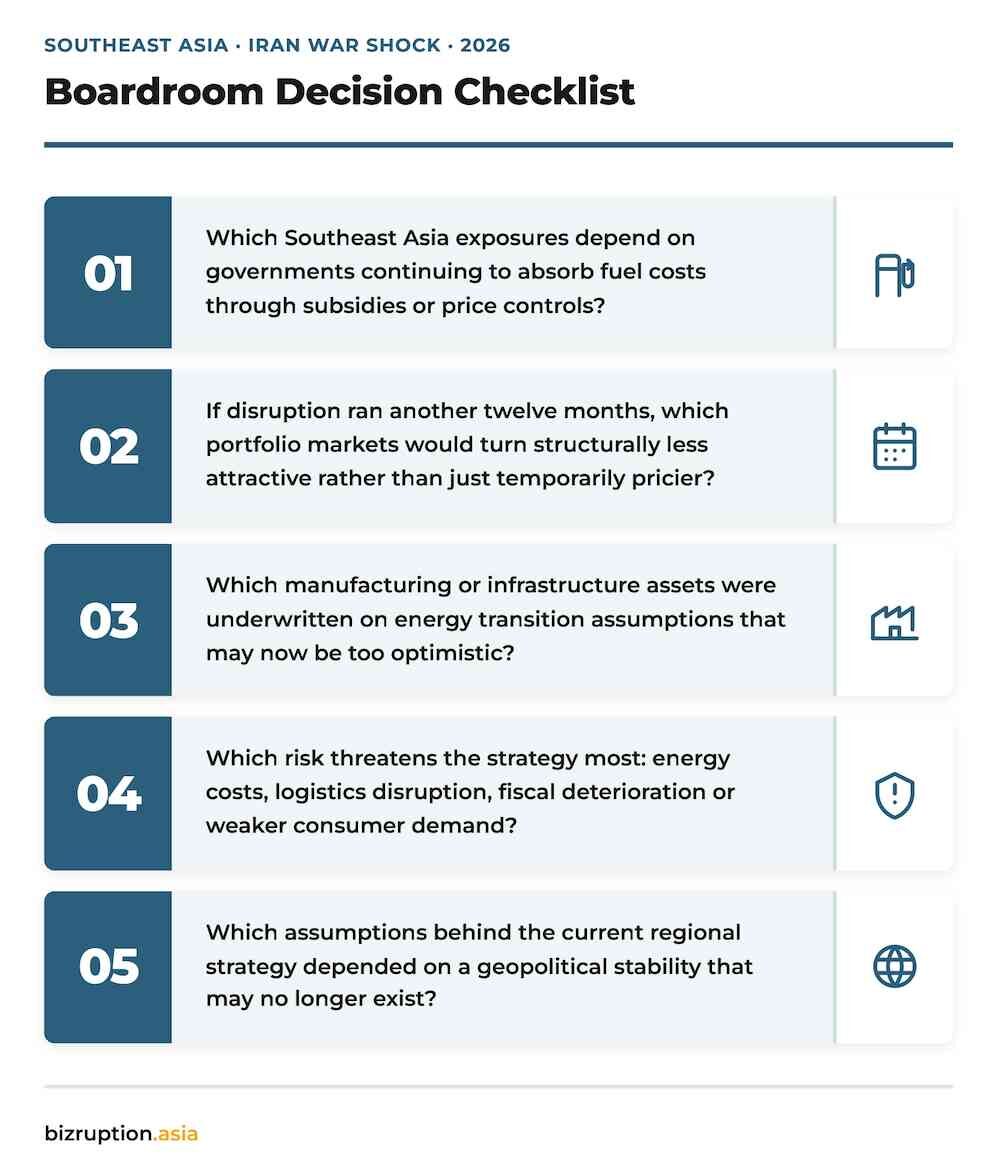
The Second Shock Is Strategic
AMRO’s June update confirms the damage has spread past fuel markets. Energy, commodity and logistics costs have surged; petroleum supplies have tightened; disruption has reached industrial inputs including helium, sulfur and fertiliser.
This is where geopolitics becomes a boardroom risk: logistics costs, insurance premiums, commodity prices and financing conditions keep moving long after the military headlines fade.
It’s also where Southeast Asia’s markets start to separate. Smoothing pump prices for a month is easy. Absorbing logistics costs, protecting fiscal space, holding industrial competitiveness and keeping an energy transition on track – all at once, for a year – is not. That gap is the real divide opening across the region.
The Iran War Is Repricing Resilience
The war’s first phase was an energy shock. Its second phase is a strategy shock. Markets that once looked equally attractive are diverging by their ability to absorb repeated disruption.
Energy security, fiscal flexibility, industrial competitiveness and policy credibility are converging into a single investment consideration, not four separate ones. That’s why this conflict matters past the Middle East: it is quietly rewriting how capital gets allocated across Southeast Asia.
Companies still evaluating the region on labour costs, consumer growth and incentives alone are missing the forces now deciding who wins. The region remains one of the world’s most attractive destinations for capital. Resilience, though, is no longer evenly distributed and preparing for the next shock matters less than accepting that disruption is now part of the operating environment.
Photo Credit Tom Fisk
References:
- AMRO – Interim Update of the ASEAN+3 Regional Economic Outlook
- AMRO – Macroeconomic Prospects and Challenges, AREO 2026 Chapter 1
- The Diplomat – How the Iran War Disrupted ASEAN’s Energy Transition
- Reuters – Foreign outflows hit Asian stocks as Iran war drives oil shock fears
- Reuters – Iran conflict disrupts oil supply to Asian countries dependent on Middle East
- Reuters – ASEAN ministers urge halt to Middle East war as crisis rattles energy and trade