4th China–Southeast Asia Economic Forum Targets AI, Pharma, Advanced Manufacturing
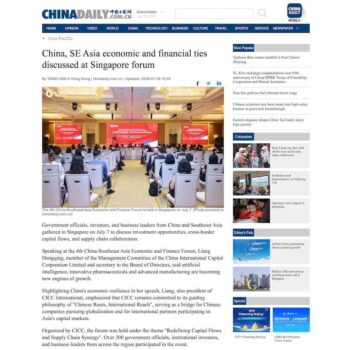
Government officials, investors, and business leaders from China and Southeast Asia gathered at CICC’s 4th China–Southeast Asia Economic and Finance Forum in Singapore on July 7. Forum examined cross-border capital flows, supply chain collaboration and new engines of growth – AI, innovative pharmaceuticals and advanced manufacturing. Yuan financing seeing broader adoption across regional trade and infrastructure.
Editor’s View: China positions itself as ASEAN’s capital partner. Southeast Asia offers critical minerals, manufacturing base, consumer market. Alignment deepens as geopolitical bifurcation locks in. Question: whether partnership translates to value capture for ASEAN or structural dependency.
Indonesia, Singapore Reaffirm Malacca Strait Openness Under International Law
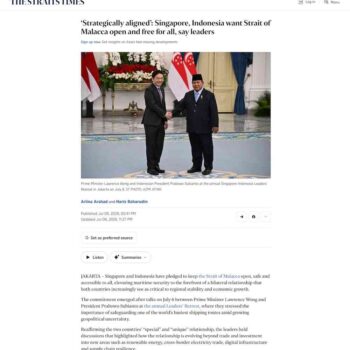
President Prabowo Subianto and Singapore Prime Minister Lawrence Wong agreed Monday to keep the Malacca Strait and Singapore Strait open for international shipping under United Nations Convention on Law of Sea. Agreement signals coordinated stance on maritime security amid geopolitical tensions and regional concern over freedom of navigation.
Editor’s View: Both countries benefit from Malacca traffic; both face Chinese pressure on South China Sea claims. Joint statement affirms UNCLOS – diplomatic code for “we won’t tolerate unilateral closures.” Enforcement depends on US naval presence, not Indonesian resolve.
ASEAN Steps Up Digital Push for Agriculture MSMEs to Boost Competitiveness
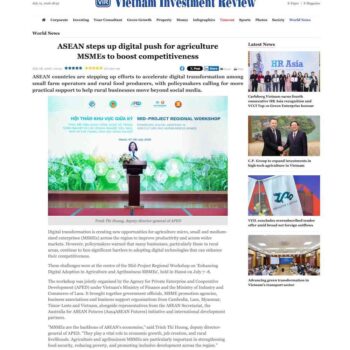
ASEAN countries accelerating digital transformation among agricultural micro, small and medium–sized enterprises to enhance competitiveness and rural development. Mid–Project Regional Workshop held in Hanoi July 7–8 brought together government officials, MSME promotion agencies and business support organisations from five focus countries.
Editor’s View: MSMEs are digitally active via social media but lack deeper integration – inventory tracking, export compliance, digital lending – that actually cuts costs and boosts productivity. Infrastructure gap is real; awareness alone won’t close it
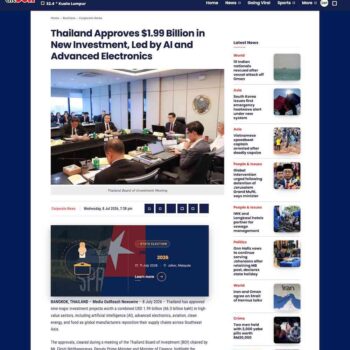
Thailand Approves $1.99 Billion in Nine High–Value Investment Projects
Board of Investment approved nine major projects worth combined USD 1.99 billion across AI, advanced electronics, aviation, clean energy and food sectors. Approvals signal Thailand’s competitive positioning as global manufacturers reposition supply chains across Southeast Asia amid geopolitical uncertainty.
Editor’s View: Thailand approves investment faster than it builds infrastructure. AI and electronics projects need reliable power, skilled labour, digital connectivity. BOI track record shows approvals outpace execution. Capital arrives; projects stall waiting for electricity supply.
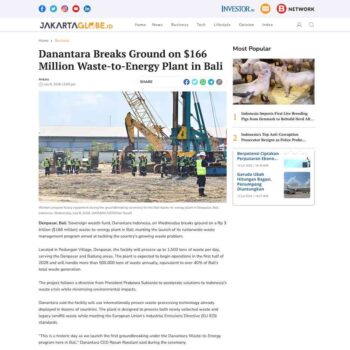
Danantara Breaks Ground on Bali Waste-to-Energy Plant
Indonesia’s sovereign wealth fund Danantara broke ground on Rp3 trillion waste–to–energy (PSEL) facility in Bali, marking first major infrastructure project. Plant intended to address waste management while generating electricity – aligning with renewable energy and waste reduction targets.
Editor’s View: Danantara moves from commodity export control to infrastructure deployment. PSEL plant is genuine capex bet. Success hinges on waste stream reliability and grid offtake agreements – both fragile in Bali. Political will matters; technical execution more so.