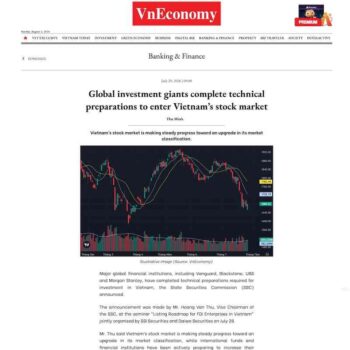
Vanguard, Blackstone, UBS and Morgan Stanley Complete Technical Prep for Vietnam Market Entry
State Securities Commission Vice Chairman Hoang Van Thu confirmed at a Ho Chi Minh City seminar that Vanguard, Blackstone, UBS and Morgan Stanley have completed technical arrangements to access Vietnam’s market through domestic brokers SSI Securities and Vietcap. SSC is fast–tracking Circular 08, which would let foreign funds trade through global broker networks rather than opening local accounts first – a step widely seen as removing the final procedural barrier to Vietnam’s frontier–to–emerging market upgrade.
Editor’s View: Four of the world’s largest asset managers cleared their paperwork; Circular 08 is the last box left to tick. Vietnam’s upgrade has been “coming soon” for years. This time the technical plumbing is actually done. The wait is now regulatory, not operational.
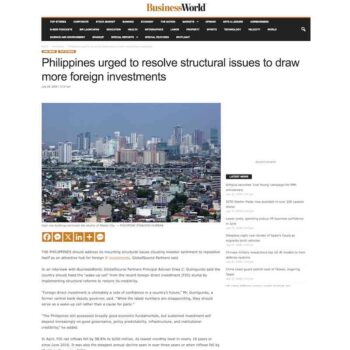
Philippines Urged to Resolve Structural Issues to Draw More Foreign Investment
Philippines captured only USD 9 billion of Southeast Asia’s USD 244 billion FDI total in 2025, ranking sixth in the region for the fifth consecutive year. April net inflows fell 58.8% to USD 250 million, the lowest monthly level since June 2016. GlobalSource Partners’ Diwa Guinigundo attributes the slump to governance uncertainty, the Senate impeachment trial and weaker policy predictability compared with Vietnam, Indonesia and Malaysia.
Editor’s View: Manila keeps citing good fundamentals while investors watch the Senate, not the GDP print. Guinigundo’s line lands: investors dislike uncertainty more than risk. Risk gets priced; uncertainty gets avoided entirely. Right now, it seems like the Philippines is choosing the latter.
Malaysia Tells Foreign Investors: Build With Us, Don’t Just Sell to Us
Investment, Trade and Industry Minister Johari Abdul Ghani said foreign investment must strengthen Malaysia’s narrowing trade surplus, which fell to RM 147.15 billion in the first six months of 2026 versus RM 151.80 billion for all of 2025, as import value hit RM 1.45 trillion. Speaking at Proton’s e.MAS 7 PHEV launch, Johari cited Proton’s Geely partnership – IP registration, local production, RM 806 million in tax contribution – as the template Malaysia wants: investors embedding in the local industrial ecosystem rather than treating the country as a pure export market.
Editor’s View: Malaysia has given EVs four years of duty–free entry at a cost of RM3.3 billion in forgone tax revenue. Johari’s message to investors is really a message to Treasury: that bill needs local production, IP transfer and jobs to show for it, not just market access.
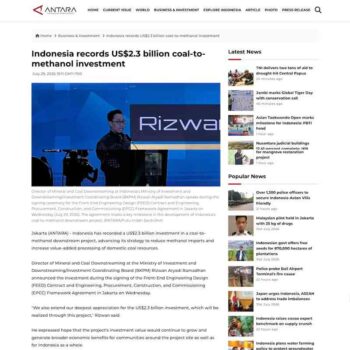
Indonesia Locks In $2.3 Billion Coal-to-Methanol Investment
PT Bumi Etam Chemical signed FEED and EPCC agreements for a coal–to–methanol gasification plant in East Kalimantan, targeting 2030 commercial operations at 2 million tonnes annually. Project aims to cut Indonesia’s methanol import dependence, which supplied 68% of domestic demand in 2025 at a cost of roughly USD 400 million. A joint venture between Arutmin, Kaltim Prima Coal and China National Chemical Engineering, the plant follows the collapse of an earlier $2 billion coal–to–DME project after Air Products withdrew in 2023.
Editor’s View: Indonesia’s last flagship coal–downstream project died when its foreign partner walked. This one swaps Air Products for a Chinese state contractor – a different risk, not a smaller one. Import substitution only works if construction actually finishes by 2030.
Thailand Targets Advanced Green Manufacturing Hub Status
Ministry of Commerce’s Trade Policy and Strategy Office says Thailand holds substantial latent capacity to become a regional green manufacturing hub, citing World Bank data showing a Green Complexity Index of 0.7 against a Green Complexity Potential Index of 1.4. Thailand remains the world’s leading air–conditioning exporter – USD 1.13 billion in 2025, 18.2% of global trade – and TPSO argues over half of existing automotive components can be repurposed for EV production.
Editor’s View: Thailand isn’t starting from zero. It’s starting from air conditioners and combustion engines. TPSO’s own numbers show a doubling gap between current and potential green exports. That gap closes only if Bangkok converts existing factories, not if it waits for new ones.