Capital is flowing into Southeast Asia at a pace that continues to reshape regional investment maps. On the surface, the region looks strong. Vietnam continues to attract manufacturing capital at scale. Indonesia remains a major destination for industrial investment. The Philippines is drawing more strategic attention. Malaysia is strengthening its position in digital infrastructure.
But the bigger investment story in Southeast Asia is not only where capital is flowing. It is also where higher-quality capital is still limited.
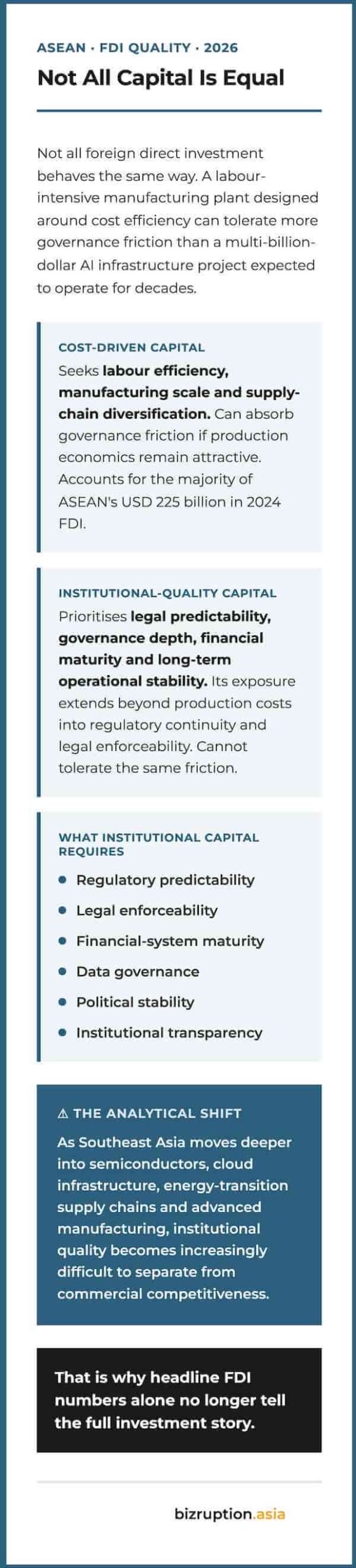
Across the region, foreign investment is increasingly splitting into two categories. The first is cost-driven capital, which seeks labour efficiency, manufacturing scale and supply-chain diversification.
The second is institutional-quality capital, which prioritises legal predictability, governance depth, financial maturity and long-term operational stability. Those two forms of capital are not always going to the same places.
That divergence is becoming one of the defining investment questions in Southeast Asia.
The New Matrix of Capital Competition
For decades, foreign investment into the region was driven mainly by manufacturing economics. Labour costs, export access and industrial capacity shaped most decisions. Today, Southeast Asia is competing for more complex forms of capital: AI infrastructure, advanced semiconductors, sovereign investment, private credit and long-duration digital infrastructure projects.
Those investments carry different risk requirements.
A factory relocation strategy can often tolerate more governance friction if production economics remain attractive. A multi-billion-dollar AI infrastructure investment expected to operate across decades usually cannot. The deeper the capital structure, the more institutional quality matters.
That is what makes Southeast Asia’s FDI story more complicated than the headline figures suggest.
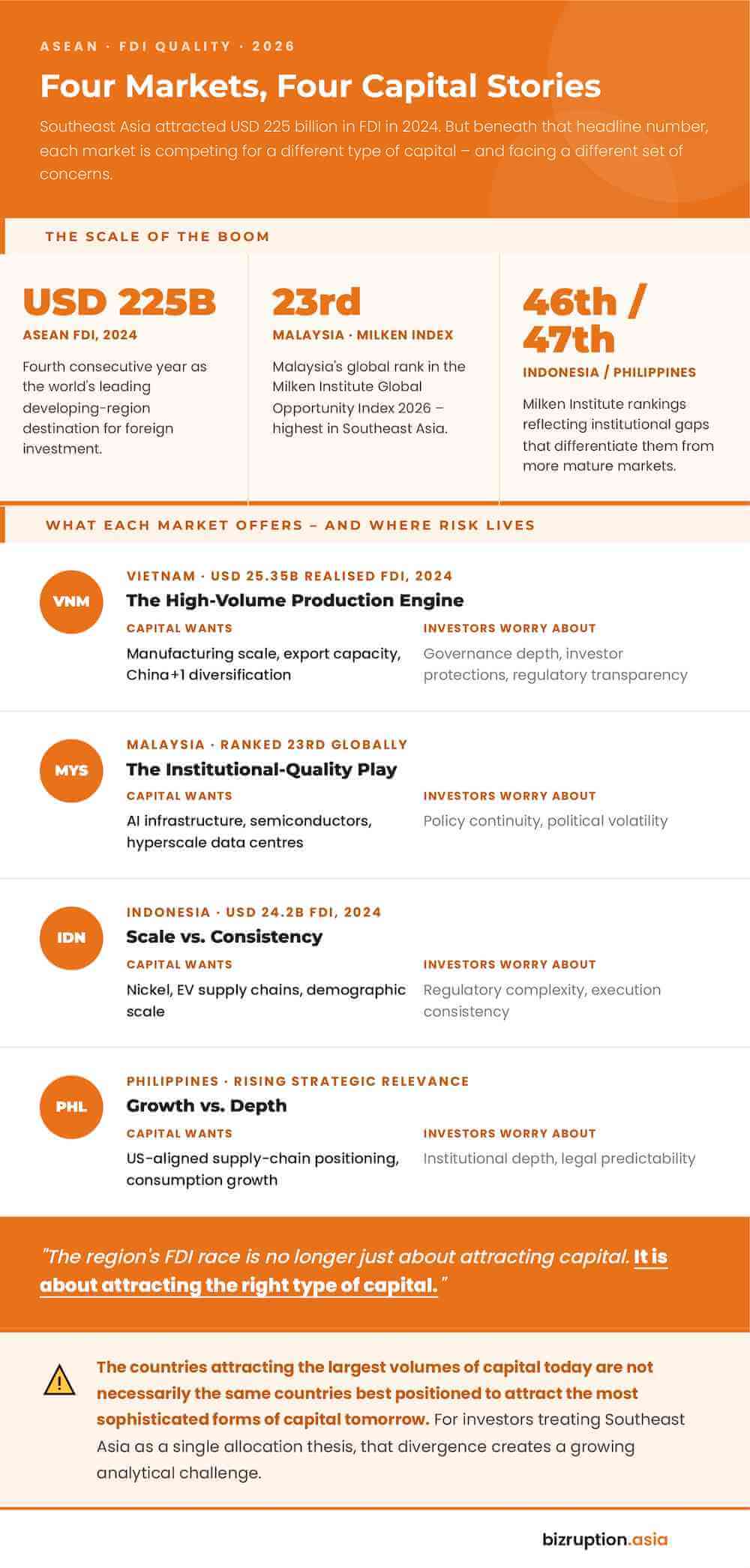
According to UNCTAD’s World Investment Report 2025, Southeast Asia absorbed roughly USD 225 billion in FDI in 2024, marking a fourth consecutive year as the world’s leading developing-region destination for foreign investment. Vietnam recorded USD 25.35 billion in realised FDI, while Indonesia attracted USD 24.2 billion. The Philippines posted strong growth, while Malaysia saw rising inflows alongside expanding digital investment activity.
Viewed purely through volume, Vietnam appears to be the region’s dominant investment story. Viewed through institutional quality, the picture looks different.
The Institutional Disconnect
The Milken Institute’s Global Opportunity Index 2026, which assesses investment environments across governance, financial systems, business perception and economic fundamentals, ranked Malaysia 23rd globally overall.
Indonesia ranked 46th and the Philippines 47th, while Vietnam ranked lower on indicators related to governance, transparency and investor protections.
That distinction does not diminish Vietnam’s success. Vietnam remains one of the region’s most strategically important manufacturing economies within the broader supply-chain realignment away from China.
Its export infrastructure, labour competitiveness and industrial clustering continue to attract multinational manufacturers at scale. But manufacturing capital and institutional-quality capital operate under different risk calculations.
A multinational electronics manufacturer seeking production efficiency can often tolerate more governance friction if labour economics, export access and supply-chain positioning remain attractive.
A sovereign wealth fund, private equity manager or infrastructure investor typically cannot. Their exposure extends beyond production costs into regulatory continuity, legal enforceability, financial-market maturity and long-term operational predictability.
Four Divergent Paths
The distribution of capital is increasingly shaping markets across the region in different ways.
1. Malaysia: The Institutional-Quality Play
Malaysia has become one of the region’s more attractive destinations for higher-specification digital and technology investment. Its relatively mature financial system, stronger institutional indicators and deeper regulatory infrastructure make it well suited to AI infrastructure, advanced semiconductor investment, hyperscale data centres and complex cross-border capital structures.
That shift is visible in Johor and Selangor, where hyperscalers and global cloud platforms are driving large-scale data-centre and digital infrastructure expansion.
Malaysia’s institutional advantages do not eliminate concerns around policy continuity or political volatility. But the country still offers a more mature operating environment for long-duration capital than many of its regional peers.
The Asian Development Bank’s Asian Economic Integration Report 2026 noted strong growth in digital FDI across Asia, driven by AI infrastructure, fintech and data-centre expansion. Malaysia appears well positioned to benefit from that trend.
2. Indonesia: The Scale vs. Consistency Matrix
Indonesia occupies a more complicated middle ground. The country continues to attract major investment into nickel processing, EV supply chains, logistics and digital infrastructure. Its population of more than 280 million gives it structural advantages that few emerging markets can match.
Indonesia has also made progress in investment facilitation and financial-sector development in recent years.
At the same time, institutional consistency remains uneven. Investors continue to weigh Indonesia’s long-term economic potential against regulatory complexity, policy unpredictability and governance considerations that still differentiate it from more institutionally mature markets.
3. The Philippines: The Growth vs Depth Gap
The Philippines presents a different version of the same tension. Its economy has remained resilient, supported by consumption growth, remittances and services exports.
Its stronger strategic alignment with the United States has also increased its relevance in semiconductor and supply-chain discussions. Recent industrial initiatives linked to economic corridors and advanced manufacturing could improve the country’s long-term positioning.
Yet the gap between economic momentum and institutional depth remains significant. Strong growth alone does not automatically translate into investor confidence at scale, especially for capital that requires legal certainty and regulatory continuity over long investment cycles.
4. Vietnam: The High-Volume Production Engine
Vietnam’s investment model remains closely tied to manufacturing relocation and export production. Companies linked to Apple, Intel, Nike and broader electronics supply chains have spent years building integrated production ecosystems across the country.
Vietnam offers scale, workforce depth and geopolitical relevance within the broader China+1 diversification trend. Much of that investment, however, remains fundamentally cost and production driven.
Changing the Analytical Paradigm
This is the divide now shaping Southeast Asia’s next phase of competition. The region is no longer competing only for investment volume. It is competing for investment quality.
That distinction changes how risk should be understood across Southeast Asia. Not all foreign capital behaves the same way and not all FDI carries the same institutional demands. A labour-intensive manufacturing operation designed around cost arbitrage can often tolerate governance weaknesses that would be unacceptable for a multi-decade AI infrastructure project or a complex private-capital structure.
As Southeast Asia moves deeper into semiconductors, digital infrastructure, energy-transition supply chains and advanced manufacturing, institutional quality becomes increasingly difficult to separate from commercial competitiveness.
The countries attracting the largest volumes of capital today are not necessarily the same countries best positioned to attract the most sophisticated forms of capital tomorrow.
For investors treating Southeast Asia as a single allocation thesis, that divergence creates a growing analytical challenge. Beneath the aggregate FDI numbers sit four very different institutional risk profiles, each attracting different forms of capital for different reasons.
The region’s investment boom is real. But the headline numbers are no longer telling the whole story.
References:
- Milken Institute – Global Opportunity Index 2026: Growth Markets in Southeast Asia
- UNCTAD – World Investment Report 2025
- UNCTAD – Developing Asia: Mixed Picture for Foreign Investment in 2024
- Asian Development Bank – Asian Economic Integration Report 2026
- VietnamPlus / Vietnam Foreign Investment Agency – Vietnam Achieves Record FDI Disbursement in 2024
- Department of Statistics Malaysia – Statistics of Foreign Direct Investment in Malaysia 2024
- Investment Monitor – FDI in 2026: Regional Experts Weigh In