On 13 August 2026, Temasek-backed ST Telemedia Global Data Centres secured a green financing facility of up to USD 1.37 billion for Phase 1 of its STT Johor campus. UOB Malaysia coordinated the deal, with OCBC Malaysia, Standard Chartered Bank Malaysia and CIMB Bank participating.
The transaction was not an isolated capital-markets event. AirTrunk secured USD 2.325 billion in green financing in July for its JHB2 hyperscale campus in Johor Bahru. DayOne Data Centres had already closed a RM15 billion equivalent multicurrency facility in June 2025, comprising a RM7.5 billion Islamic financing tranche and a USD 1.7 billion offshore term loan.
IFR reported in June 2026 that DayOne was seeking roughly USD 3.7 billion of additional financing. IFR also expected Malaysian data-centre financing to exceed USD 8 billion in 2026. Both figures describe a market estimate or financing activity at different stages, not necessarily debt already drawn.
The headline numbers show demand for Malaysian digital infrastructure. They do not show whether the projects will produce durable returns. That distinction matters because the market is moving from construction finance into a more demanding question: how much of the asset’s value sits in the building, and how much sits in a tenant’s willingness to keep paying for it?
The debt is arriving before the proof
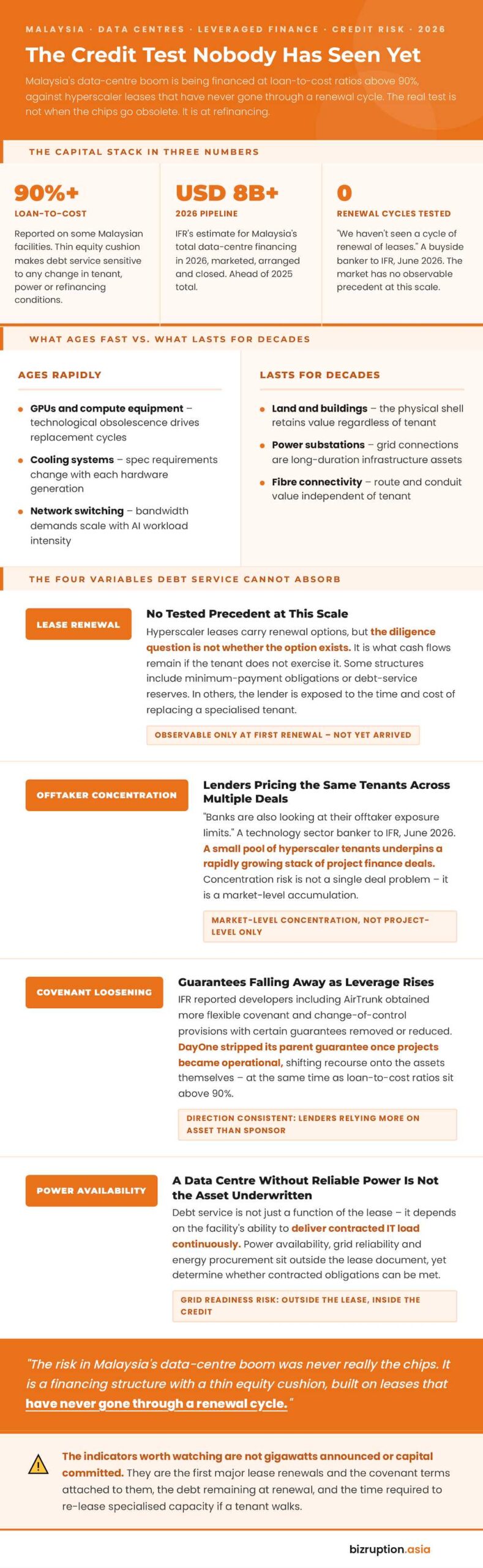
IFR reported loan-to-cost ratios above 90% for some Malaysian data-centre financings. That structure can work when a project has a strong tenant, firm power arrangements, construction protections and debt amortisation aligned with contracted cash flow. It leaves less room for error when any of those assumptions weaken.
The risk is not simply that a tenant defaults. A project can remain technically sound and still disappoint lenders if energisation is delayed, power costs rise, a tenant takes less capacity or refinancing arrives before the debt has amortised sufficiently.
That is why the phrase “useful life” needs care. GPUs and other compute equipment may become uneconomic quickly. Land, substations, buildings, fibre connectivity and cooling infrastructure can retain value for decades. A lender must therefore separate technology-replacement risk from the residual value of the physical site.
IFR reported that some developers, including AirTrunk, had secured more flexible covenant and change-of-control provisions, with certain guarantees removed or reduced. The direction matters, but the conclusion cannot be that lenders have abandoned protection.
The real question is what remains after completion: parent support, debt-service reserves, minimum-payment commitments, security over the asset or a credible route to re-lease it.
The financing question also connects to the wider infrastructure constraint examined in the companion analysis, “The Grid Cannot Keep Up”. That article is aimed at investors and infrastructure executives assessing whether Malaysia’s power and water systems can support the capacity being financed.
The lease is the underwriting hinge
None of this leverage works without contracted demand or a credible path to contracted demand. Hyperscaler-backed structures may include multi-year leases and extension options, but the terms differ by tenant, project and financing. Renewal rights, termination payments, parent support, residual-value guarantees and reserve accounts determine how much risk remains with the lender.
“We haven’t seen a cycle of renewal of leases,” a buyside banker told IFR in June 2026. The comment is not evidence that renewals will fail. It identifies the market’s information gap: there is limited observable evidence on how large, specialised data-centre leases will reprice or renew at scale.
The distinction is important. A renewal option may belong to the tenant, but that does not mean the tenant can walk away without consequence. The lease may include minimum payments or termination obligations. The financing may include reserves or residual-value support.
Equally, the lender may still face months of downtime and a costly retrofit before a replacement tenant can move in.
A specialised data centre is therefore not valued as a conventional building. Debt service depends on the lease, the tenant’s credit quality, power availability, connectivity and operating readiness. It also depends on whether another tenant can use the facility without expensive changes.
Johor is where risks can correlate
Johor has become the centre of Malaysia’s data-centre expansion. Cushman & Wakefield reported 897MW of operational capacity in the state at the end of 2025, with further capacity under construction and in the planned pipeline. Planned capacity is not the same as operational capacity, secured power, contracted demand or financial close.
The concentration creates an infrastructure question as well as a credit question. Reuters reported that Johor was facing greater scrutiny over electricity and water use, while Malaysian guidance sets expectations for data-centre water efficiency. Johor’s approval process also requires projects to demonstrate that utilities and location are suitable.
That scrutiny should not be read only as a threat. Tighter approvals can protect the value of existing projects by limiting speculative capacity that cannot secure reliable utilities. For lenders, however, the test is whether power and water commitments are firm, timed to commissioning and reflected in the project documents.
A renewal problem affecting several large facilities could create correlated stress within Johor if tenant concentration coincided with power, water or connection constraints. This is a stress scenario, not a forecast. It is also why national capacity figures can conceal local concentration risk.
The bullish case is not trivial
The bearish interpretation is incomplete. Hyperscaler counterparties are generally stronger than ordinary commercial tenants, and moving a live workload can involve technical, operational and contractual costs. Lenders may also rely on minimum-payment commitments, parent support, completion protections, amortisation schedules and residual-value arrangements.
The base case for many transactions may therefore be continued tenant performance. But a base case is not a guarantee. Credit committees still need to test weaker renewal pricing, lower utilisation, delayed energisation, technology substitution and refinancing at wider spreads.
The United States offers a useful comparison, but not a direct template. Oracle-linked Vantage financings have been cited as examples of very high leverage in hyperscaler-backed data-centre structures. The reported USD 37.5 billion aggregate financing and 93% to 98% loan-to-cost figures should be retained only if confirmed through the original IFR or Bloomberg reporting, a rating-agency publication or transaction documents.
Malaysian projects differ in tenant contracts, sponsor support, power arrangements, legal structure, lender protections and market depth. The US comparison can illustrate the mechanism without proving that Malaysia has reached the same level of risk.
The test is not one event
The market will not be judged by a single lease renewal. It will be judged by the interaction of lease terms, debt amortisation, power availability and technology reinvestment across several projects.
The indicators worth watching are the first major renewals, the rent and covenant terms attached to them, the debt remaining at renewal, refinancing spreads, power-connection milestones and the time required to re-lease specialised capacity.
For lenders and investors, the next diligence question is simple: if the tenant does not renew on the original terms, what exactly pays the debt? The answer should be visible in the financing documents before the project reaches financial close.
References:
- Malaysian Data Centres Test Lenders – IFR
- STT GDC Deepens Malaysia Commitment with up to USD1.37 Billion Green Financing for STT Johor Campus – STT GDC
- Singapore Entity Secures Green Financing for Johor Data Centre Campus – The Star
- AirTrunk Secures USD2.325 Billion Green Financing to Support Sustainable Digital Infrastructure Growth in Malaysia – AirTrunk
- AirTrunk Gets USD2.3 Billion Green Loan for Malaysia Data Centre – The Edge Malaysia
- DayOne Secures RM15 Billion Landmark Deal for Sustainable Data Centres – The Star
- DayOne Gets USD4.6 Billion Funding for Johor Data Centres – The Straits Times
- Power Without Delivery – Moody’s Ratings
- Rising US Data Centre Completion Risk Drives Better Lease Protections – Fitch Ratings
- Data Centres: A Project Finance View – DBRS Morningstar
- Project Finance Digital Infrastructure Rating Criteria – Fitch Ratings
- APAC Data Centre Development Pipeline Hits Record in 2025 – Cushman & Wakefield
- Malaysia’s Resource Anxiety Tests Asia’s Fastest Data-Centre Build-Out – Reuters
- Guideline for Sustainable Development of Data Centre – MIDA
- How Johor Vets Data Centres: Water Efficiency, Utilities and Location – Malay Mail