More than two-thirds of Southeast Asia’s data centre construction pipeline runs through Malaysia. In February 2026, the government that built that position admitted it can no longer support it. Prime Minister Anwar Ibrahim told parliament on 24 February that Malaysia had quietly blocked non-AI data centre approvals for nearly two years. Not announced. Not debated. Stopped.
The grid cannot take the load. Water supply in Johor and Selangor is already strained. NVIDIA, Microsoft and ByteDance have between them committed more than USD 8 billion to facilities on Malaysian soil. The infrastructure meant to power those facilities is running out of headroom.
RM342 billion in approved digital investments. The world’s second-largest developing-economy destination for digital FDI, behind only India. Malaysia won the race every country in the region was running. What nobody modelled was what winning would cost.
The Infrastructure Is Already Telling the Story
In 2021, Malaysia had roughly 10 megawatts of data centre capacity. By 2024, 1.3 gigawatts. The Malaysia Digital Investment Department counts 34 operating facilities with 33 more under construction. The binding constraint is not generation. It is connection – transmission lines and substations unable to absorb the density of continuous, large-scale power draws the pipeline demands.
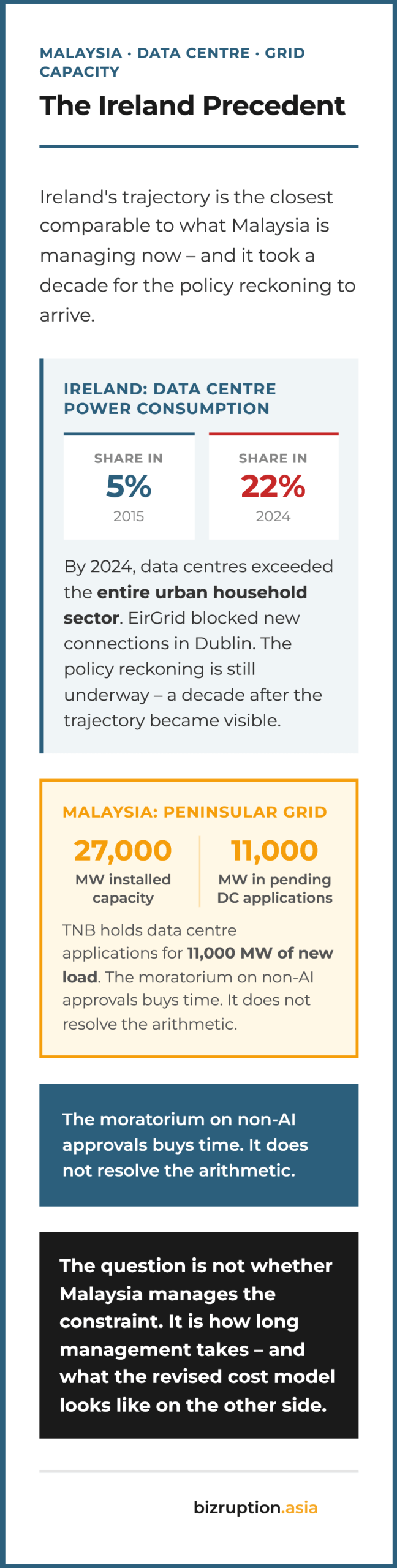
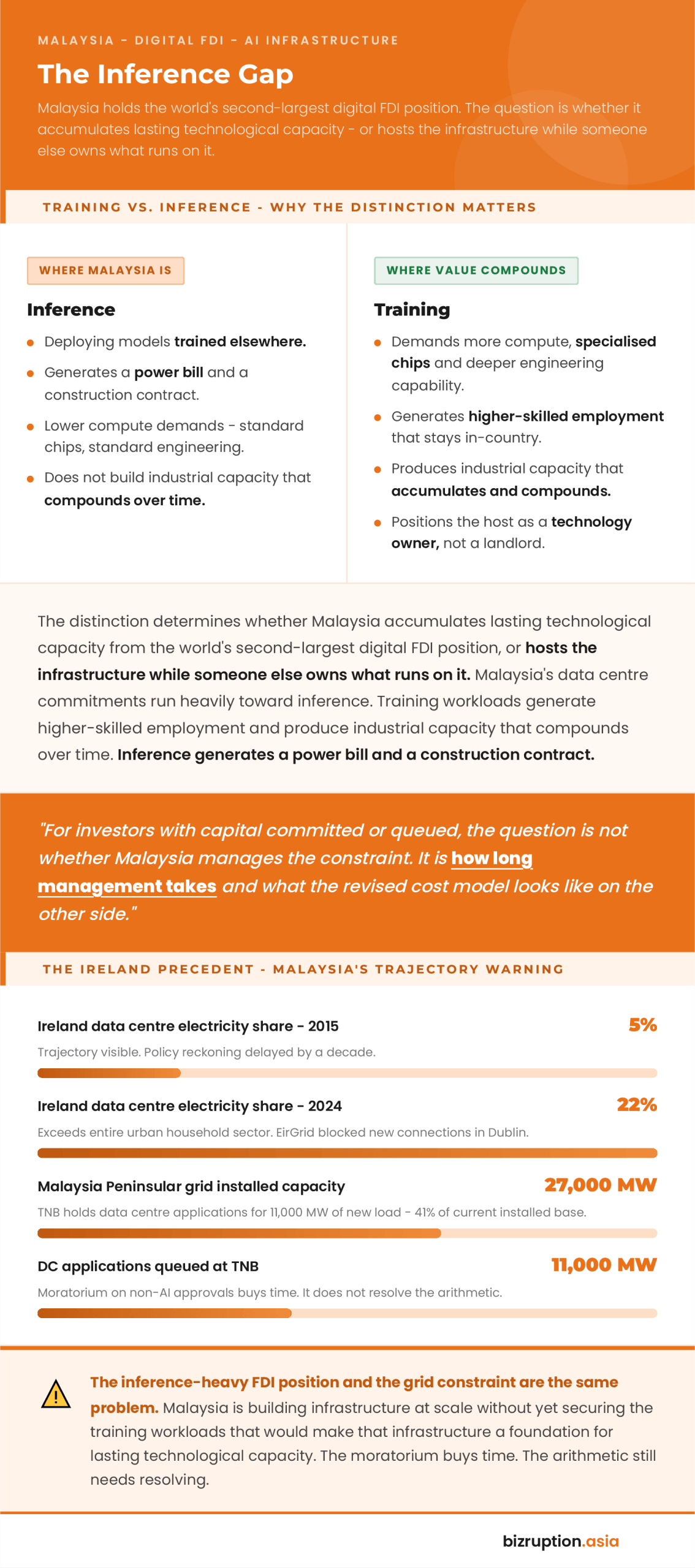
TNB holds applications exceeding 11,000 MW against Peninsular Malaysia’s entire installed capacity of roughly 27,000 MW. EY’s Asia-Pacific energy leader Mark Bennett puts data centre electricity demand at 5 to 6 gigawatts by 2035 on current trajectory. Water is the second front. Shortages in Johor and Selangor have forced state authorities to slow construction approvals, per independent analysts.
Ireland reached this point first: data centres consumed 22% of its metered electricity in 2024, up from 5% in 2015, and EirGrid blocked new Dublin connections. The trajectory points the same way.
The Grid Constraint Is Also a Talent Problem
The infrastructure pressure would be manageable if the jobs being created were building domestic capability. They are not.
Malaysia’s digital investment pipeline is projected to generate 114,854 positions. Of those, 97% require knowledge-worker skills, per the Knight Frank and MDEC whitepaper published in February 2026. The headline reads as a workforce transformation. The reality is narrower.
Data centres produce the fewest jobs per square foot of any major facility type – thousands during construction, fewer than 200 in operation. The high-value engineering and research roles fill with foreign workers as fast as the pipeline demands.
Human Resources Ministry secretary-general Datuk Azman Mohd Yusof put it directly at the BICSI Southeast Asia Conference in April 2026. “While investments and opportunities are expanding at pace, talent development must keep up, and in many cases move faster, to avoid bottlenecks in Malaysia’s digital economy ambitions. From the perspective of the Ministry of Human Resources, this is a national priority.”
The grid strains, the construction crews arrive, the facilities go live, and the operational work goes to whoever already holds the certifications. That is not a transformation. It is a landlord arrangement.
The Talent Gap Is Also a Geopolitical Problem
Into that gap, Chinese capital has moved with speed and scale no other source has matched. China is not merely an investor in Malaysia’s data centres. It is building the grid those facilities run on. DayOne, the international arm of Chinese operator GDS Holdings, committed USD 3.5 billion to Johor in 2025.
PowerChina operates gas power and hydropower projects across the country. Huawei runs smart grid upgrades. Tianneng Group launched a 1 GWh solar-storage-computing project in early 2026, framed explicitly as a power solution for regional data centre operators.
Washington has pressed Malaysia to tighten semiconductor export controls. Kuala Lumpur is simultaneously deepening its reliance on Chinese capital to power the very facilities those restrictions are designed to protect. Successive governments have built an economic model around avoiding that binary.
The model is now under pressure from both sides at once.
The Geopolitical Problem Is Also a Sovereignty Problem
The deepest exposure is structural and it predates both the grid crisis and the US-China pressure. Most of Malaysia’s approved digital commitments target inference – running models trained elsewhere – rather than training. Training demands far greater compute, specialised chips and the engineering depth to operate them.
Between 2020 and 2024, Malaysia captured 14% of all digital greenfield investment projects across developing economies globally, per UNCTAD’s World Investment Report 2025. The bulk of that capital built facilities that process other people’s intelligence: on Malaysian land, drawing Malaysian power, staffed largely by workers Malaysia cannot yet produce at scale.
Data centres do not generate the industrial spillover that semiconductor fabs or advanced manufacturing plants produce. Malaysia bears the grid load, the water draw and the land cost. The hyperscalers take the value.
The moratorium is the government’s answer to the infrastructure problem. The talent and sovereignty gaps have no equivalent policy response. Investors and executives who have mapped where each gap closes are positioned ahead of the next move. The ones who have not are still working from the investment headline.
The analysis starts with the grid. It does not end there.
References:
- UNCTAD World Investment Report 2025 – UN Trade and Development
- Malaysia Economic Monitor, October 2025 – World Bank
- Malaysia as a Regional Digital Economy Gateway – Knight Frank / MDEC
- Malaysia Freezes New Non-AI Data Centres – Malay Mail
- Malaysia’s Data Centre Policy: AI In, Everything Else Out – Tech Wire Asia
- Malaysia’s Gamble: Turning Data Centres Into Industrial Power – Asia Society Policy Institute
- Malaysia’s Digital Investment Boom Widening the Talent Gap – The Sun
- China Steps In as Malaysia’s Data Center Surge Puts the Power Grid to the Test – China-Global South Project
- Malaysia Breaks Investment Record with RM426.7 Billion in 2025 – MIDA
- Malaysia Curbs Non-AI Data Centres as Power Squeeze Looms – Gulf Times