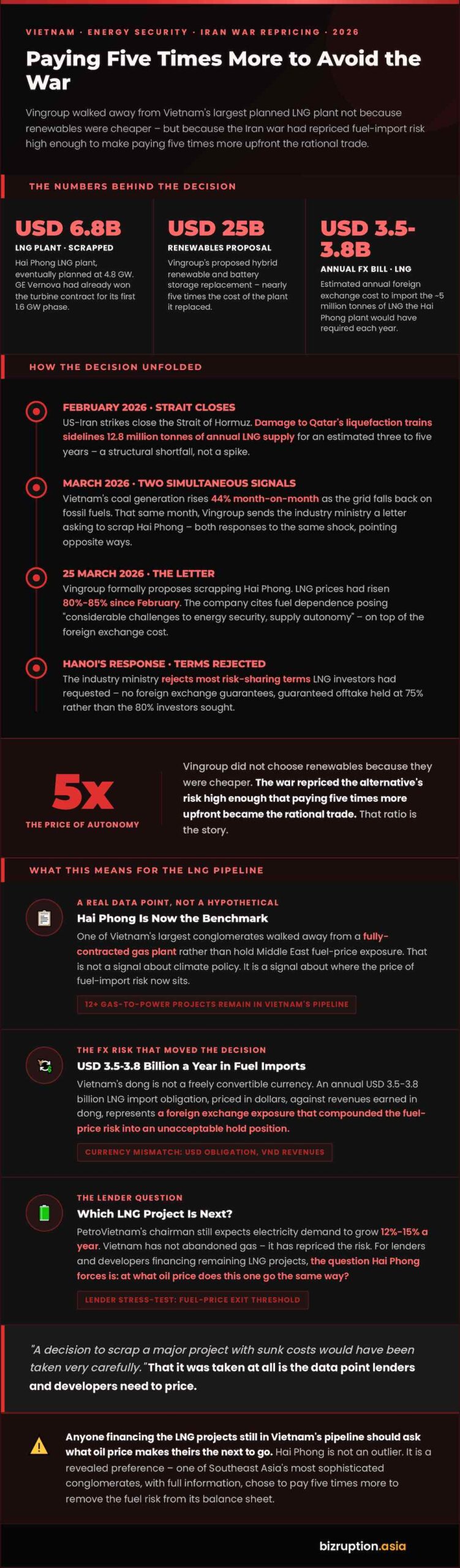
On 25 March, Vingroup sent Vietnam’s industry ministry a document asking to scrap the country’s largest planned LNG power plant. Two weeks earlier, GE Vernova had won the contract to supply turbines for its first 1.6 gigawatt phase. The USD 6.7-6.8 billion Hai Phong plant was eventually planned at 4.8 gigawatts.
It was meant to anchor Vietnam’s push toward more than 20 gigawatts of LNG capacity by 2030. Vingroup wanted out.
That same month, in the same country, coal-fired generation rose 44% month on month. Vietnam fell back on the fuel its own energy transition was supposed to retire – the coal reversal covered in The Iran Wars Second Shock. Vingroup’s move is the other half of that same war, inside the same market, pointing the opposite way.
The Reasoning Wasn’t Climate Policy
LNG prices had risen 85% since February’s strikes closed the Strait of Hormuz. Damage to Qatar’s liquefaction trains had sidelined 12.8 million tonnes of annual supply for three to five years, a structural shortfall, not a spike.
Importing the roughly 5 million tonnes of LNG the Hai Phong plant would need every year now carried an estimated USD 3.5-3.8 billion annual foreign exchange bill. That came on top of fuel-price risk Vingroup no longer wanted to hold.
The Ratio Is the Story
In its place, Vingroup proposed a hybrid renewable and battery storage project. Estimated cost: USD 25 billion, nearly five times the LNG plant, by Vingroup’s own comparison in the letter. The company was explicit about why: fuel dependence, it wrote, poses “considerable challenges to energy security, supply autonomy,” on top of the cost risk.
Vingroup didn’t choose renewables because they were cheaper. It chose them because the war had repriced the alternative’s risk high enough that paying five times more upfront became the rational trade.
Hanoi Didn’t Make the Switch Easy
The industry ministry rejected most of the risk-sharing terms Vingroup and other LNG investors had requested: foreign exchange guarantees, higher minimum purchase commitments. It held the guaranteed offtake ceiling at 75%, not the 80% that investors wanted.
Gary Zieff, an energy expert who has advised Hanoi’s government and industry on renewables through a US-backed technical assistance programme, put it plainly: “They don’t do anything lightly.” A decision to scrap “a major project with sunk costs would have been taken very carefully,” he said.
Vietnam isn’t abandoning LNG. More than a dozen gas-to-power projects remain in the pipeline. PetroVietnam’s chairman still expects electricity demand to grow 12%-15% a year to sustain double-digit economic growth. What changed is the price at which fuel-import risk stopped being worth carrying.
Boardroom Implication
For lenders and developers financing ASEAN energy assets, Hai Phong is now a real data point, not a hypothetical. One of the region’s largest conglomerates walked away from a fully-contracted gas plant rather than hold Middle East fuel-price exposure. Anyone financing the LNG projects still in Vietnam’s pipeline should ask what oil price makes theirs the next to go.
References:
- Vietnam’s Gas Projects Stall Amid Investor Claims of Unbankability and a Renewables Pivot – Eco-Business
- Exclusive – Vingroup Proposes Scrapping LNG-Powered Plant Plan for Renewables Amid Iran War, Document Shows – Reuters via Investing.com
- Vietnam LNG Power Project Eyes Green Pivot on Soaring Gas Prices – Bloomberg, via The Star
- How the Iran War Disrupted ASEAN’s Energy Transition – The Diplomat