On 2 June 2026, President Prabowo Subianto dismissed National Nutrition Agency (BGN) chief Dadan Hindayana and his two deputies. The following day, prosecutors from the Attorney General’s Office raided BGN’s Jakarta headquarters.
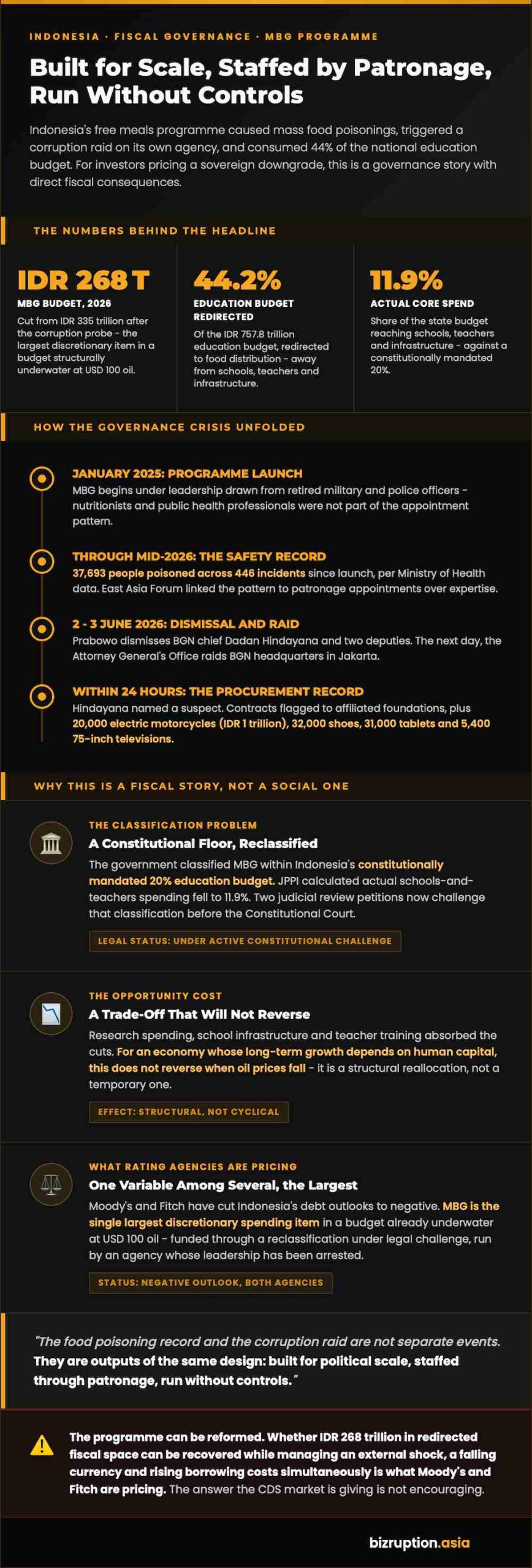
Hindayana was named a suspect within 24 hours: contracts to affiliated foundations and procurement of 20,000 electric motorcycles worth IDR 1 trillion, 32,000 pairs of shoes, 31,000 tablets and 5,400 units of 75-inch televisions.
This is not about procurement fraud. The fiscal damage it reveals was present long before the raid. The policy context is in the cover story: The Shock Did Not Break Indonesia. The Decisions Made Before It Did.
The Budget Classification That Broke the Fiscal Floor
The Free Nutritious Meals programme – Makan Bergizi Gratis, or MBG – was budgeted at IDR 335 trillion for 2026. After the corruption probe, that figure was cut to IDR 268 trillion. The reduction did not fix the underlying problem. It confirmed the original allocation was constructed without operational controls.
The deeper issue is where the money came from. The government classified MBG within Indonesia’s constitutionally mandated 20% education budget. Indonesia’s Education Monitoring Network, JPPI, calculated the result: spending on schools, teachers and infrastructure fell to 11.9% of the state budget. The constitution requires 20%.
Two judicial review petitions now challenge that classification before the Constitutional Court.
The opportunity cost is measurable. Roughly 44.2% of the total IDR 757.8 trillion education budget was redirected to food distribution. Research spending, school infrastructure and teacher training took the cuts. For an economy whose long-term growth depends on human capital, the trade-off is not temporary.
It will not reverse when oil prices fall.
The Safety Record Was the First Signal
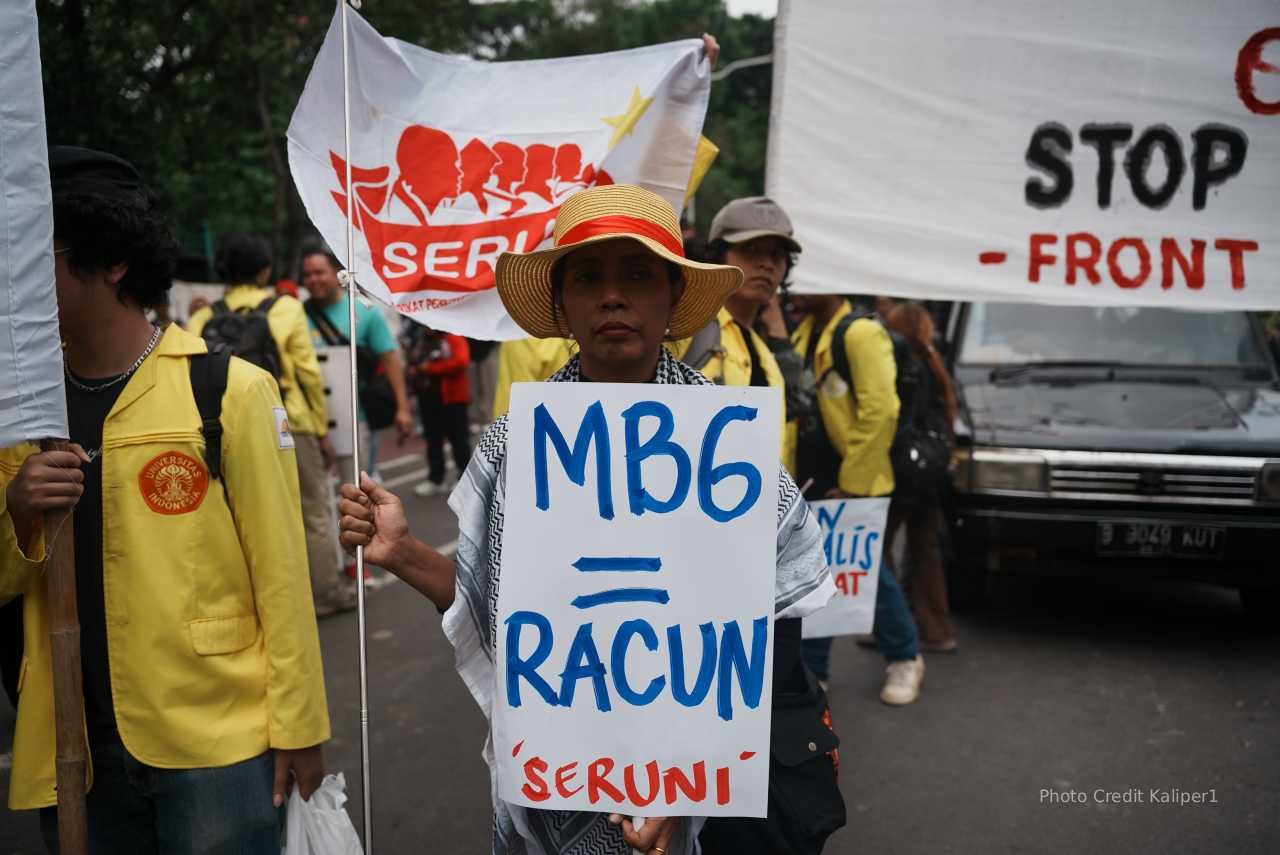
The governance crisis did not begin in June. According to Ministry of Health data, 37,693 people suffered poisoning across 446 MBG-related incidents since the programme’s January 2025 launch.
The National Nutrition Agency’s leadership was drawn from retired military and police officers. Nutritionists and public health professionals were not. East Asia Forum described the appointment pattern as reflecting Prabowo’s reliance on patronage over expertise.
The food poisoning record and the corruption raid are not separate events. They are outputs of the same design: built for political scale, staffed through patronage, run without controls.
What Investors Are Actually Pricing
Financial markets flagged the risk at launch. Reuters reported warnings that MBG costs could erode Indonesia’s reputation for fiscal prudence – built through two decades of post-crisis reform.
Moody’s and Fitch have since cut their Indonesian debt outlooks to negative. MBG is not the only variable in that assessment. It is, however, the single largest discretionary spending item in a budget structurally underwater at USD 100 oil.
It is funded through a constitutional reclassification under legal challenge. The agency that ran it has had its leadership arrested.
Prabowo has ordered a recipient audit and a governance overhaul. The programme can be reformed. Whether IDR 268 trillion in redirected fiscal space can be recovered while managing an external shock, a falling currency and rising borrowing costs simultaneously is what Moody’s and Fitch are pricing.
The answer the CDS market is giving is not encouraging.
References:
- Indonesia Opens Corruption Probe into Free Meals Programme – Asia News Network / AFP
- How Indonesia’s Free Meals Program Became a Patronage Feeding Frenzy – Asia Times
- Indonesia AG Searches Nutrition Agency after Prabowo Sacks Leaders – The Online Citizen
- Indonesia Tightens Oversight of MBG Program – Jakarta Globe
- Free Meals Overshadow Indonesia’s Core Education Spending in 2026 Budget – Asia News Network
- Indonesia’s Free Meal Program Cracks under Poor Leadership – East Asia Forum
- Indonesia Needs USD 6 Billion More to Fast-Track Free Meals Programme – Reuters