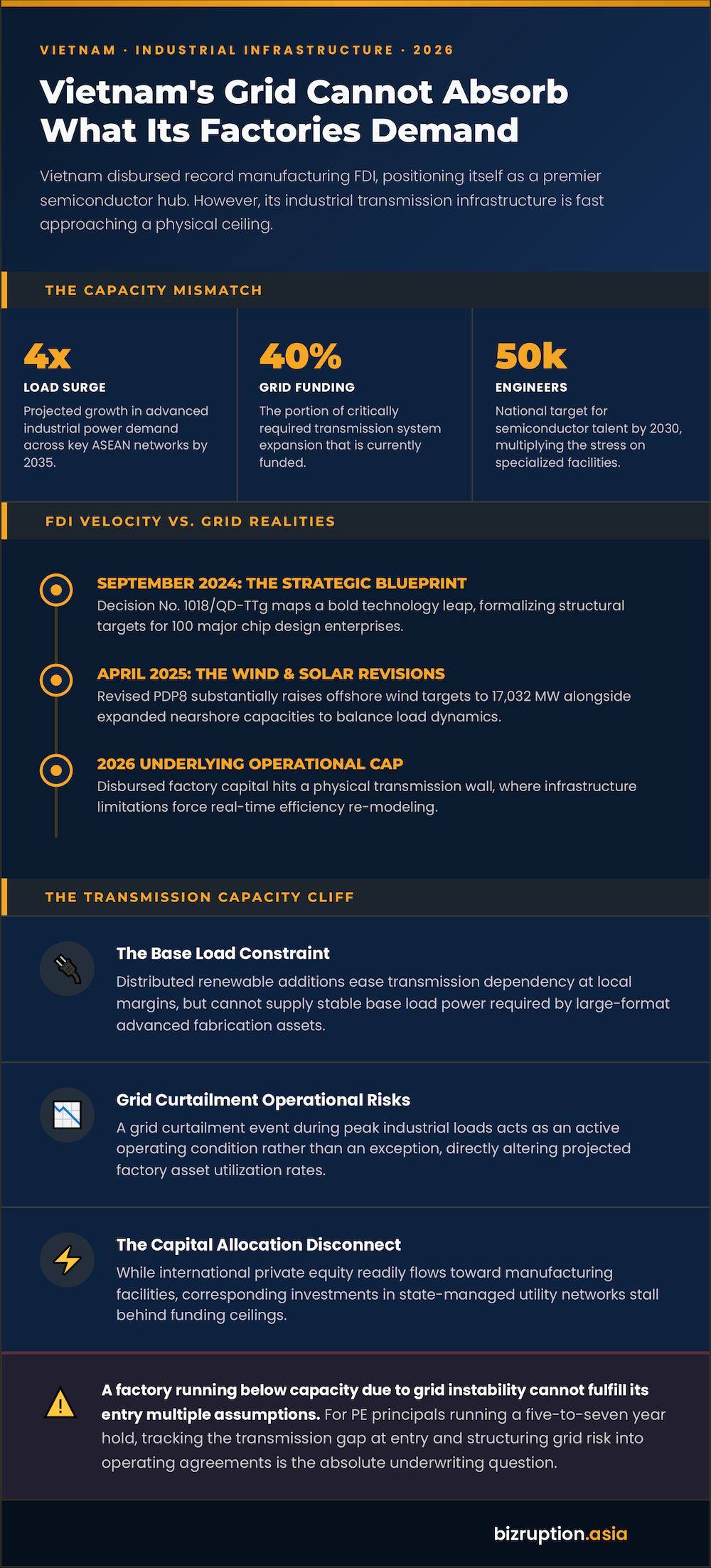
Vietnam’s manufacturing FDI story has a physical ceiling the inflow figures do not show. Power demand for data centres and advanced manufacturing across the six largest ASEAN economies will quadruple between 2025 and 2035 – from 2.6 GW to 10.7 GW, per Ember Energy analysis cited in the ASEAN Investment Report 2025.
Vietnam is absorbing a disproportionate share of that industrial load. Its transmission infrastructure is not keeping pace with the factories already operational or the semiconductor commitments formalised under Decision No. 1018/QD-TTg – former Prime Minister Pham Minh Chinh’s September 2024 roadmap targeting 100 chip design enterprises and 50,000 engineers by 2030.
The full analysis – Vietnam’s grid bottleneck against Malaysia’s talent constraint and Indonesia’s disbursement gap – is in the companion piece: ASEAN Captured the Manufacturing Reallocation. Three Markets Got Different Deals.
The Funding Arithmetic Is Broken
EVN presented the numbers at the Forum on Realising the Goals of the Revised Power Development Plan VIII, held in Ho Chi Minh City on 14 August 2025. Transmission investment demand for 2025-2030 runs at approximately US$ 3 billion per year. EVN confirmed it can meet only 40% of that requirement, leaving USD 1.8 billion annually without a committed funding mechanism.
The Revised PDP8, approved under Decision No. 768/QD-TTg on 15 April 2025, raised transmission investment to USD 18.1 billion for 2026-2030, up from US$ 14.9 billion in the original plan. It also opened the legal framework for private sector participation in grid infrastructure.
What it did not deliver are mechanisms sufficiently attractive to close the gap at the pace industrial load requires – a point EVN made publicly at the August forum.
The Hold Period Risk
Pritesh Swamy, Head of Data Centre Research & Insights for Asia Pacific at Cushman & Wakefield, identified the structural pressure directly. Data centre growth is “straining power systems in ASEAN, where most electricity still comes from coal and gas.”
For semiconductor packaging and precision electronics facilities – the assets anchoring Vietnam’s industrial upgrade – reliable grid connectivity is the operating precondition, not supporting infrastructure.
A factory unable to draw contracted power at full capacity does not produce the revenue on which entry multiples are based. A grid curtailment event during peak industrial load is not force majeure. It is an operating condition the Revised PDP8 has effectively built into its own targets.
The Revised PDP8 raised offshore wind to 17,032 MW and onshore and nearshore wind to 26,066–38,029 MW by 2030. Distributed renewable generation reduces transmission dependency at the margin. It does not resolve the base load constraint for large-format industrial assets.
PE principals pricing Vietnamese manufacturing exposure must stress-test the transmission gap at entry. They must structure grid risk into operating agreements and map the private investment mechanism timeline against exit assumptions. The manufacturing thesis is sound. The grid arithmetic confirms it cannot be assumed.
References:
- ASEAN Investment Report 2025: Foreign Direct Investment and Supply Chain Development – ASEAN Secretariat and UNCTAD
- Forum on Realising the Goals of the Revised Power Development Plan VIII – Vietnam Energy Association / Electricity Authority of Vietnam
- Vietnam Revised Power Development Plan VIII (Decision No. 768/QD-TTg, April 2025) – US International Trade Administration Market Intelligence
- Solar and Wind Could Power Up to a Third of ASEAN’s Data Centres in 2030 – Ember Energy
- Vietnam Makes Major Updates to Power Development Plan VIII – Watson Farley and Williams
- Vietnam FDI 2025 – General Statistics Office of Vietnam via Vietnam Briefing