In April 2025, Vietnam approved the revised National Power Development Plan VIII – a USD 134.7 billion blueprint targeting 73 gigawatts of solar, 38 gigawatts of onshore wind and 17 gigawatts of offshore wind by 2030. Total installed capacity must roughly double in five years.
One month later, Enerdata confirmed Vietnam had delivered 57% of all ASEAN renewable additions between 2015 and 2024, and that the regional 2030 framework assigns it 73% of all projected additions through the decade.
For the full regional context, see the companion piece: ASEAN’s Clean Energy Decade Went Backwards. AI Is the USD 67 Billion Bet on What Comes Next.
Vietnam’s Renewable Execution Risk Is ASEAN’s Largest Single Point of Failure
If the country executes at PDP8’s required pace, ASEAN’s 2030 targets become achievable. If it stalls – through grid constraints, regulatory reversal or investor withdrawal – those targets miss by a margin no other member state can compensate for.
Indonesia, Malaysia and Thailand combined must multiply their own additions by at least five times versus the 2019–2024 period. Even so, Vietnam’s contribution remains structurally irreplaceable.
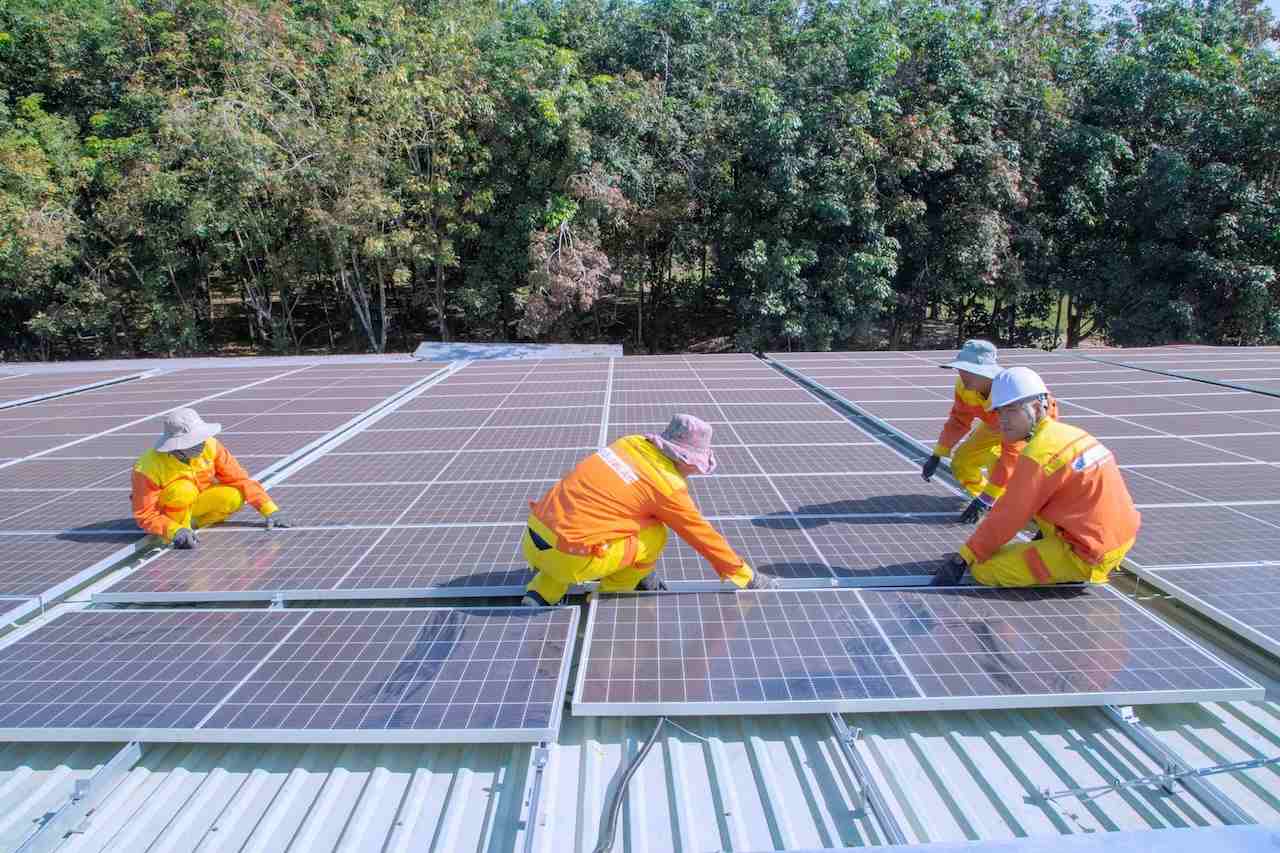
Hanoi has demonstrated it can build fast. Between 2019 and 2021, solar additions made the country briefly one of the fastest-growing clean energy markets in the world, reaching nearly 18 gigawatts of installed solar by April 2025 from 86 megawatts in 2018. The problem: it built faster than the network could absorb.
The Grid Cannot Yet Handle What PDP8 Requires
Transmission has not kept pace with generation. Severe curtailment hit solar and wind projects in Ninh Thuan and Binh Thuan – among the country’s highest-resource provinces – as output exceeded the system’s ability to move power north, where load is concentrated.
A 520-kilometre double-circuit 500 kV line completed in August 2024 doubled corridor capacity from 2,500 to 5,000 megawatts. Storms in October and November 2025 again forced significant renewable output offline. Battery storage must reach 10,000-16,300 megawatts by 2030. Today it is effectively zero at utility scale.
IEEFA calculates PDP8 requires more than USD 18 billion in transmission investment alone by 2030. Vietnam Electricity has been under-investing in the network for years because it sells power below cost recovery – a structural constraint the 2024 Electricity Law began addressing but has not resolved.
Norton Rose Fulbright flags bankability of power purchase agreements as a live concern for lenders, citing tariff uncertainty, curtailment exposure and the absence of government guarantees.
The Regulatory Risk That Stopped the Investment Clock
In 2024, authorities moved to retroactively revise purchase prices for 173 solar and wind projects, cutting expected revenues by 25-46%. The Vietnam Chamber of Commerce and Industry warned Parliament in March 2025 that proceeding risked “bankruptcies across the renewable energy sector” and the destruction of investor confidence required to execute PDP8.
The projects at risk are the same ones that proved the country could build at scale. The capital base that proved the model cannot be deterred and replaced simultaneously.
New frameworks – Direct Power Purchase Agreements under Decrees 57 and 58, both in force from March 2025 – replace the feed-in tariff model with competitive pricing. The architecture is structurally correct. Its delivery timeline competes directly with the PDP8 schedule.
The Question Every Vietnam Energy Investor Must Answer Now
The country’s gas fleet – 22,524 megawatts planned under PDP8 as a bridge fuel – is also directly exposed to the Hormuz disruption. LNG priced at crisis levels was not in any pre-February 2026 investment model.
Three questions require immediate answers from anyone holding Vietnam energy assets: whether grid access is contractually secured or subject to curtailment risk; whether PPA structures written under the old tariff regime are defensible against retroactive revision; and whether gas baseload assumptions have been stress-tested against a prolonged Hormuz closure.
Vietnam’s opportunity is real. The execution risk is the highest of any single market in any regional energy framework operating today. Those are not contradictory statements. They are the same investment thesis.
References:
- Vietnam Revised Power Development Plan VIII – U.S. Commercial Service / Trade.gov
- What Are the New Changes to Vietnam’s PDP8 – A&O Shearman
- Is ASEAN on Way to Reach Its 2030 Energy Targets? – Enerdata Executive Brief
- From Boom to Balance in Vietnam’s Clean Energy Transition – IEEFA
- Grid Upgrades and Market Reform: Reshaping Vietnam’s Renewable Energy Market – Reccessary
- Vietnam Power Sector Snapshot – Norton Rose Fulbright
- Vietnam Renewable Energy Reform 2025: Key Changes on DPPAs – Vietnam Briefing
- Vietnam Revises PDP8: Key Targets – Vietnam Briefing
- Vietnam – Strait of Hormuz Closure: Oil and Energy Shortages Key for VND – MUFG Research
- PDP8: Vietnam’s USD 135 Billion Power Plan for 2030 – World Economic Forum
- Managing Vietnam’s Grid Issues – Energy Transition Partnership / AMPERES / ANU