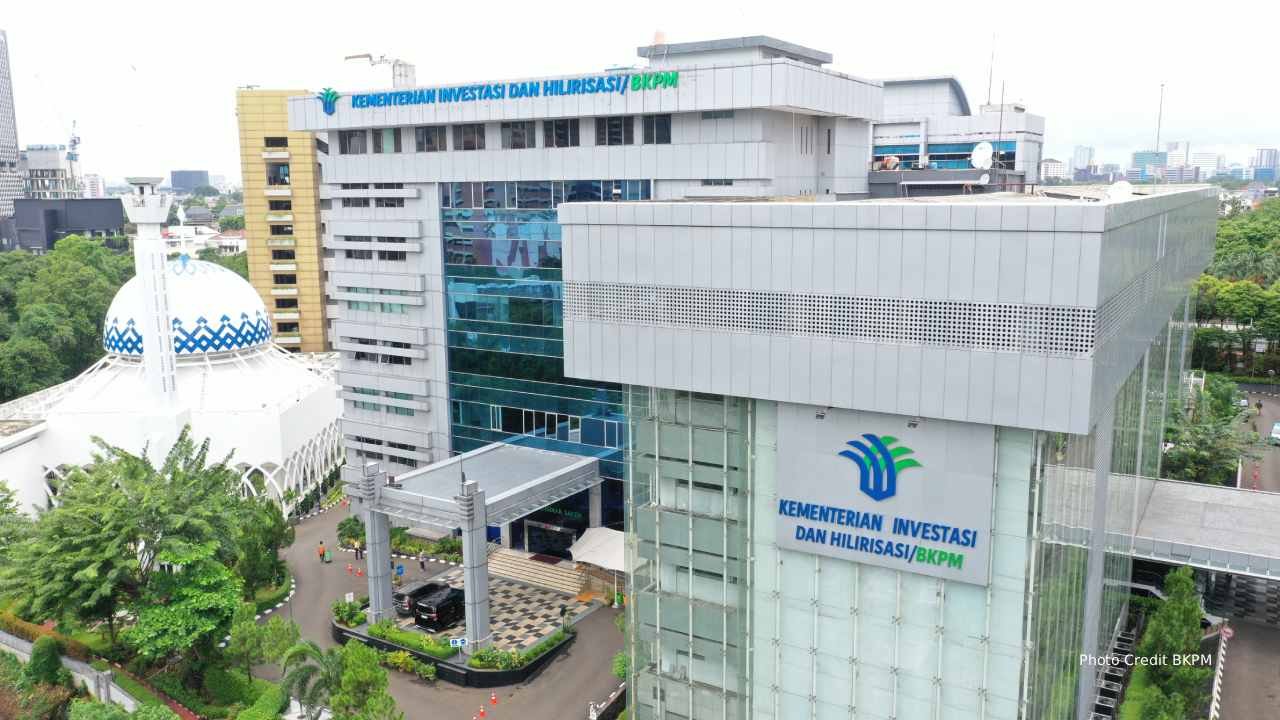
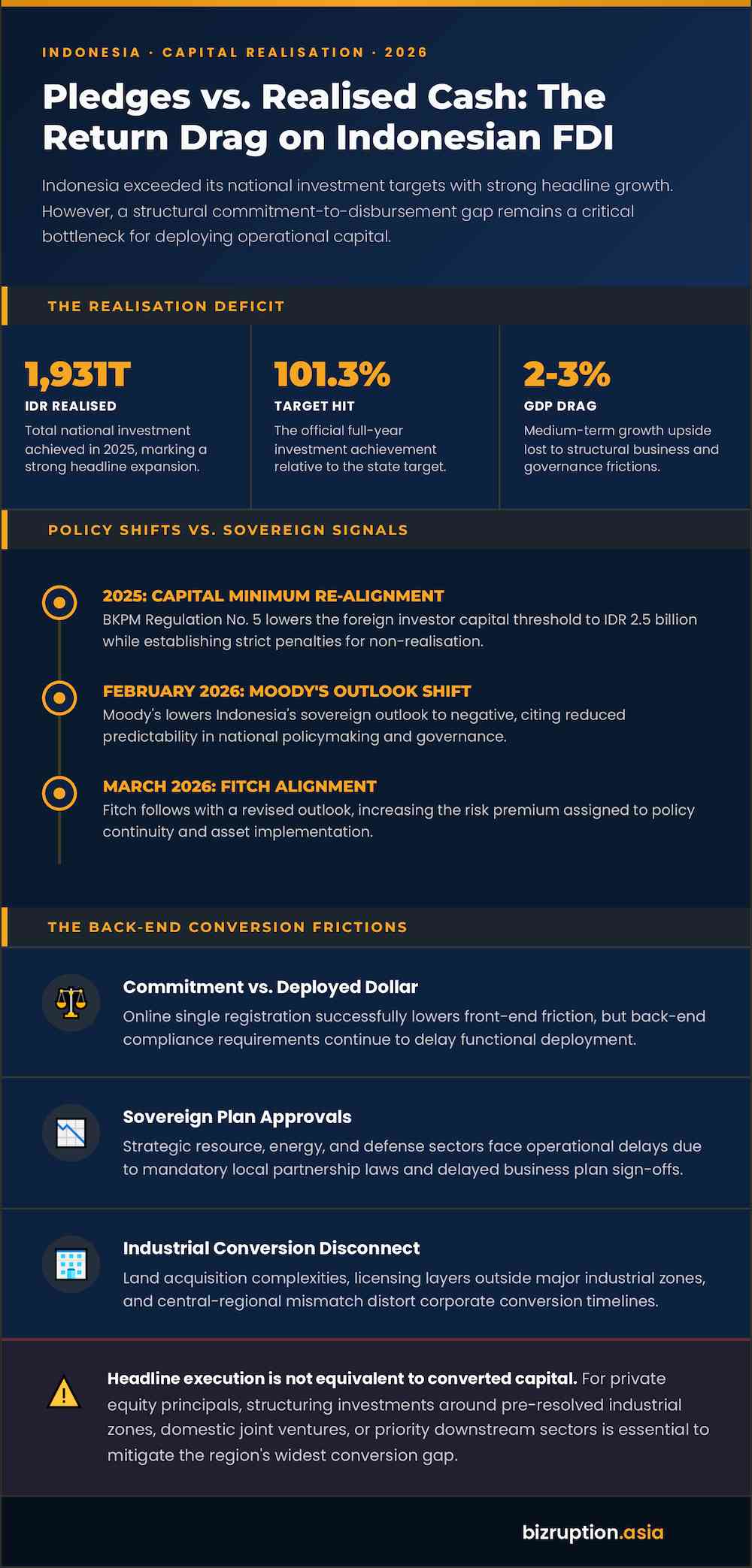
Indonesia’s full-year 2025 investment figures are, by conventional measure, exceptional. Realisation of IDR 1,931.2 trillion exceeded the national target and delivered 12.7% year-on-year growth, per BKPM’s January 2026 results report. The headline reads as a market executing at full capacity.
The underwriting problem sits beneath it. Indonesia’s investment architecture distinguishes between approved commitments – pledges registered through the Online Single Submission system – and realised disbursements. The gap between the two is structural, not cyclical and wider in Indonesia than in any comparable ASEAN market.
The full analysis – Indonesia’s disbursement constraint alongside Vietnam’s grid bottleneck and Malaysia’s talent gap – is in the companion piece: ASEAN Captured the Manufacturing Reallocation. Three Markets Got Different Deals.
Why the Gap Persists
The US Department of State’s 2025 Investment Climate Statement for Indonesia identifies the structural causes. Mining firms report persistent delays in receiving approved business plans required before operations commence. Strategic sectors – energy, natural resources, defence – require local partnership structures or government approval that extend timelines beyond the registration date.
The OSS system has reduced front-end friction. It has not resolved the back-end compliance requirements that separate a registered commitment from a deployed dollar. BKPM Regulation No. 5 of 2025 reduced the minimum paid-up capital threshold for foreign investors from IDR 10 billion to IDR 2.5 billion.
The same regulation introduced automatic administrative sanctions for zero realisation across four consecutive quarters. The reform acknowledges the gap by creating a penalty for non-conversion. It does not eliminate the causes.
The Sovereign Signal
In February 2026, Moody’s revised Indonesia’s sovereign outlook to negative, affirming Baa2. Fitch followed in March at BBB. Moody’s cited “reduced predictability in policymaking, which risks undermining policy effectiveness and points to weakening governance” – the first negative move by either agency since the post-1998 reforms.
The IMF’s January 2026 Article IV consultation quantified the stakes directly. Structural reforms to the business climate and governance could lift output by two to three percentage points over the medium term – framing the execution gap as a return drag, not a political risk.
For PE principals, a sovereign outlook downgrade does not directly reprice a manufacturing asset. It widens the risk premium assigned to the policy continuity on which disbursement timelines, permit approvals and subsidy frameworks depend.
Pricing the Risk Correctly
Three entry structures have historically closed the gap most reliably. Industrial estate transactions – where land title, grid connection and permitting are pre-resolved within a licensed zone – remove the primary sources of slippage.
Joint ventures with established domestic partners address local partnership requirements before they become delays. Downstream sector positions in nickel processing, palm oil refining and petrochemicals benefit from active government prioritisation that compresses approval timelines.
Rosan Perkasa Roeslani, Minister of Investment and Downstream Industry and Chairman of BKPM, set the operating standard at the Q3 2025 results briefing. “Beyond the numbers, the most important aspect is the quality of investment.”
The capital that converts fastest in Indonesia is the capital aligned with the employment and downstreaming outcomes the government is tracking. PE structures built around those priorities do not merely reduce execution risk. They price it correctly from day one.
References:
- Full-Year 2025 Investment Realisation – Indonesia Investment Coordinating Board (BKPM)
- Q3 2025 Investment Realisation Results Briefing – BKPM
- 2025 Investment Climate Statement: Indonesia – US Department of State
- BKPM Regulation No. 5 of 2025: Foreign Investment Capital Requirements – Norton Rose Fulbright, 2025
- Moody’s Cuts Indonesia Sovereign Outlook to Negative – DBS Bank Research
- Indonesia’s Fiscal Anchor Begins to Drift – East Asia Forum, March 2026
- Indonesia 2025 Article IV Consultation – International Monetary Fund
- ASEAN Investment Report 2025: Foreign Direct Investment and Supply Chain Development – ASEAN Secretariat and UNCTAD