ASEAN’s renewable share in primary energy did not rise between 2015 and 2024. It fell from 21% to 16%, while ministers were adding solar and wind capacity and calling it progress. Coal absorbed 84% of every new unit the region created. In October 2025, those same ministers gathered and set harder targets for 2030.
Then they handed the solution to artificial intelligence – a technology that could deliver USD 67 billion in grid savings by 2035 and is simultaneously responsible for the fastest-growing new source of fossil fuel consumption in the region.
The CFO signing a data centre MOU and the energy minister approving the next coal plant are, at this moment, solving the same problem from opposite ends.
Why ASEAN Missed Its 2025 Renewable Energy Targets and What It Means for 2030
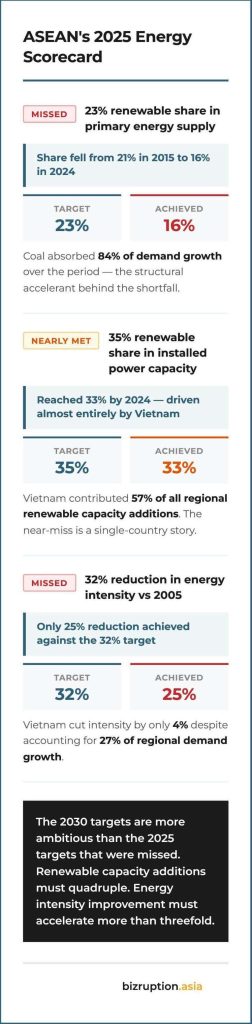
ASEAN’s primary energy supply grew 40% between 2015 and 2024, reaching 817 million tonnes of oil equivalent. Coal absorbed 84% of that growth – not because the region failed to build renewables, but because economic expansion running at 4% per year devoured every clean gigawatt added and demanded more.
Renewable share in primary energy fell while renewable capacity rose. The denominator outran the numerator.
Two markets drove the damage at scale. Indonesia accounted for 53% of the region’s additional consumption and 64% of the coal increase. Vietnam accounted for 27% and 22%.
On the measures that mattered most, ASEAN missed two of its three 2025 targets: renewable share in primary energy reached 16% against a 23% goal; energy intensity improved 25% against a 32% goal. Renewable capacity, at 33% against a 35% target, was the nearest miss, carried almost entirely by Vietnam, which delivered 57% of all regional additions.
The 2030 ambitions do not acknowledge any of this. Renewable capacity additions must quadruple versus the 2019-2024 period. Energy intensity must improve at 3.5% per year against a recent trend of 1.1%. ASEAN mobilised USD 30 billion in clean energy investment in 2021 against an annual requirement of USD 200 billion by 2030.
Almost all of it went to fossil fuels. The new targets assume a structural acceleration that has not yet begun.
AI Could Save ASEAN USD 67 Billion in Energy Costs, If It Scales Beyond Pilot Projects
Ember’s March 2026 analysis, built on Deloitte modelling and IEA projections, quantifies what is possible.
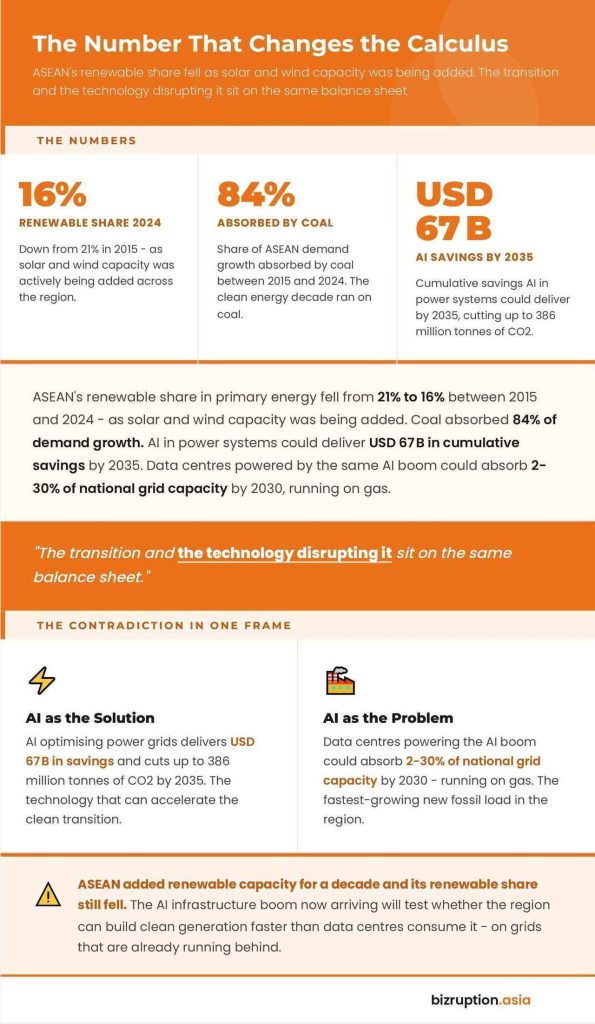
Under widespread adoption, AI in ASEAN’s power systems generates cumulative savings of USD 45-67 billion between 2026 and 2035, with CO2 reductions reaching 290-386 million tonnes.
Annual savings climb from USD 2.5-3.5 billion in 2026 to USD 7-10.5 billion by 2035.
Five proven applications deliver the gains:
- generation forecasting (25% accuracy improvement)
- predictive maintenance – Siemens documented an 85% improvement in downtime forecasting and a 50% cut in unplanned outages
- dispatch optimisation (1% fuel cost reduction, 5% efficiency gains)
- dynamic line rating (10%-30% additional transmission capacity 90% of the time)
- real-time grid control – Thailand, Vietnam and Malaysia have all run pilots with measurable results.
The constraint is adoption, not technology. Deployment across ASEAN is confined to individual assets. AI has not entered system-wide planning, cross-border coordination or market design, precisely where the USD 67 billion requires it.
Lam Pham, Data Analyst at Ember and lead author, said AI applications “have the potential to accelerate the transition by enabling greater integration of variable renewable energy.”
That potential stays theoretical until the pilot becomes the platform.
ASEAN Data Centres Are Driving a New Gas Dependency, Right When the Region Needs Less of It
Deloitte, cited by Ember, estimates AI in global energy sectors saves approximately four times the electricity data centres consume by 2030. The net arithmetic favours adoption. The problem is sequencing: the savings require system-wide deployment that does not yet exist, while the new load is locking in right now.
By 2030, data centres could account for 2%–30% of national electricity consumption across ASEAN, excluding Vietnam, per Ember. The IEA projects Southeast Asia’s server infrastructure electricity use will nearly double by 2030 versus 2024.
The market grows from USD 14 billion in 2024 to USD 30 billion by 2030. Hyperscaler commitments are already signed: Google USD 1 billion in Thailand, Microsoft and Amazon across Malaysia, Indonesia and the Philippines.
These facilities need stable, continuous baseload. Intermittent renewables cannot deliver it on today’s infrastructure. Gas fills the gap. In Malaysia, Ember estimates emissions could increase sevenfold if expansion continues on a fossil-heavy grid.
Dr. Daikichi Seki, Co-Founder and CEO of aiESG, called the USD 67 billion figure “the definitive financial hook needed to align risk-averse policymakers with a renewables-led future.” The hook exists. The gas contract is being signed before anyone reaches for it.
ASEAN’s gas dependency for baseload power is also directly exposed to the Hormuz disruption reshaping the region’s energy economics. The investment case for hyperscaler campuses across Southeast Asia was not priced against USD 130 per barrel crude. It is now.
The Capital Allocation Decision ASEAN’s CFOs and Energy Investors Cannot Defer
Two things must happen simultaneously: AI deployment must reach system-wide scale before data centre load fully materialises, and operators must lock in clean power procurement at the point of investment – not after the gas contract is signed. Neither is moving at the pace the 2030 targets require.
CFOs approving campus expansions, fund managers allocating to ASEAN energy infrastructure and ministers signing hyperscaler MOUs who treat this as a capital allocation question today are positioned to capture USD 67 billion.
Those who file it under sustainability disclosure for 2028 will find the opportunity has already been priced by someone who did not wait.
References:
- Is ASEAN on Way to Reach Its 2030 Energy Targets? – Enerdata Executive Brief
- AI to Unlock the Next Wave of Renewable Integration in ASEAN – Ember
- ASEAN Could Save USD 67 Billion and Cut 386 Million Tonnes of CO2 by 2035 – Ember
- From AI to Emissions: Aligning ASEAN’s Digital Growth with Energy Transition Goals – Ember
- ASEAN Plan of Action for Energy Cooperation 2026–2030 – ASEAN Centre for Energy
- 8th ASEAN Energy Outlook – ASEAN Centre for Energy
- ASEAN Aims for 45% of Power Capacity from Renewables by 2030 – Enerdata
- Thailand’s Data Centre Boom to Drive Electricity Demand to 6 TWh by 2030 – W.Media / Ember
- Highlights of the Global Energy Transition in 2025 – Ember
- AI to Unlock the Next Wave of Renewable Integration in ASEAN – Ember Full Report
- Southeast Asia’s Data Centre Renewable Energy Opportunity – Energy Monitor