Three of the world’s largest private banks published global family office surveys between February and May 2026. None of them intended to write the same story. Together, they have.
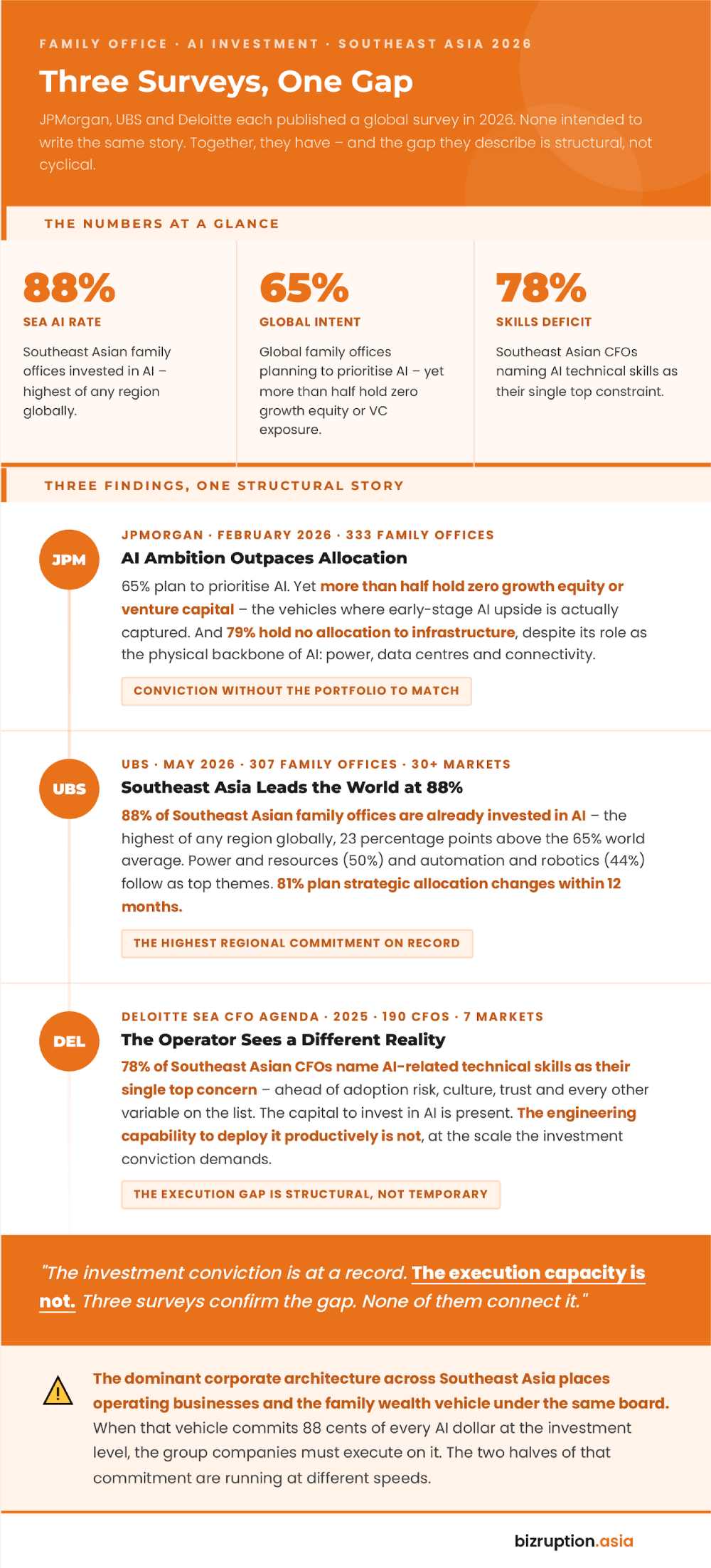
JPMorgan Private Bank’s 2026 Global Family Office Report surveyed 333 single-family offices across 30 countries, average net worth USD 1.6 billion. Its sharpest finding arrived in four words: AI ambition outpaces allocation. Sixty-five percent plan to prioritise AI. More than half carry zero exposure to growth equity or venture capital – the asset classes where early-stage AI upside is actually captured. Seventy-nine percent hold no allocation to infrastructure, despite its role as the physical backbone of AI through power, data centres and connectivity.
UBS published its Global Family Office Report 2026 on 28 May. It drew on 307 family offices across more than 30 markets, average net worth USD 2.7 billion. Its Southeast Asia finding is the sharpest regional number in the entire survey. Eighty-eight percent of Southeast Asian family offices are already invested in AI. That is the highest of any region globally – 23 percentage points above the 65% world average.
Yves-Alain Sommerhalder, Head of GWM Solutions at UBS, framed the stakes directly: “Artificial intelligence remains the defining investment theme of this decade.” Beyond AI, their top themes are power and resources at 50% and automation and robotics at 44%. Eighty-one percent plan strategic allocation changes within 12 months.
The Conviction Is Not the Problem
Deloitte’s SEA CFO Agenda 2025 surveyed 190 chief financial officers across seven Southeast Asian markets. Seventy-eight percent name AI-related technical skills as their single top concern. Adoption risk, culture and trust, and every other variable on the list follow behind. The capital to invest in AI is present. The engineering capability to deploy it productively inside the operating business is not, at the scale the investment conviction demands.
This tension is not generic. It is structural to Southeast Asia’s ownership model. The dominant corporate architecture across Indonesia, Malaysia, the Philippines and Thailand is the family-controlled conglomerate. Operating businesses and the family wealth vehicle sit under the same patriarch, the same board, the same strategic agenda. When that vehicle commits 88 cents of every AI dollar at the investment level, it is committing to a thesis the group companies must then execute. The two halves of that commitment are running at different speeds.
The WEF’s Future of Jobs Report 2025 put a number on the operating side of the gap. Ninety-six percent of Southeast Asian employers are actively prioritising upskilling – the highest rate globally, against an 85% average elsewhere. They are training because they cannot hire their way out of the shortage.
Demand for AI and machine learning specialists is outrunning supply across every major market in the region. Vietnam, Indonesia, Thailand and the Philippines all cite skills gaps as a leading barrier to AI deployment in the WEF data.
What the Portfolio Reveals
The JPMorgan finding on infrastructure is where the gap becomes a balance sheet risk, not just an operational one. Southeast Asian family offices are heavily committed to AI as an investment theme. Yet 79% of global family offices hold zero allocation to the infrastructure AI runs on – data centres, power generation, connectivity. The same infrastructure gap that constrains AI deployment inside their operating companies is absent from their investment portfolios.
This is not ideologically inconsistent. It is practically significant. A family office with AI software and semiconductor exposure but no infrastructure allocation is betting on the application layer while leaving the foundation unhedged. In Southeast Asia, where grid capacity is the binding constraint on data centre expansion in Vietnam and Malaysia alike, that gap carries direct consequences.
The BNP Paribas and Campden Wealth Asia-Pacific Family Office Report 2025 confirmed that family offices in the region already deploy AI for risk management and investment reporting. But it also identified spreadsheet over-reliance and manual processes as the top internal concerns – overtaking cybersecurity – because the back-office architecture has not kept pace with the investment ambition.
The Execution Window
The CFA Institute’s April 2026 analysis placed Southeast Asia’s intergenerational wealth transfer at USD 5.8 trillion by 2030. The IMF projects 4.3% GDP growth for the region in 2026 – the highest in the world after India. That volume of capital moving between generations within a single decade means the execution gap gets resolved regardless. The question is who closes it first, and on whose terms.
McKinsey and the Singapore Economic Development Board published “AI in Southeast Asia: An Era of Opportunity” in February 2026. The survey covered 330 senior executives across six markets. Nearly half (46%) have moved beyond piloting AI to actively scaling it, placing the region ahead of the global average of 35%. The bottleneck identified is not ambition.
One in five executives named talent as the leading barrier. The specific shortage: MLOps and software deployment skills needed to run AI in production at enterprise scale – not the data science capabilities most organisations have already assembled.
Benjamin Cavalli, Head of Strategic Clients and Global Connectivity at UBS Global Wealth Management, noted that family offices are “maintaining exposure to long-term themes such as artificial intelligence with greater selectivity.” Selectivity means the execution question has arrived.
For managed service providers, AI infrastructure developers and specialist training firms with a regional footprint, the conviction gap is not a risk to manage. It is a commercial opening. The capital is committed. The execution capacity is not built.
The family offices that close that gap inside their own operating companies in the next three years will not be making a bet. They will be collecting the return on one that was already paid for
References:
- UBS Global Family Office Report 2026 – UBS
- 2026 Global Family Office Report – J.P. Morgan Private Bank
- SEA CFO Agenda 2025 – Deloitte Southeast Asia
- Future of Jobs Report 2025 – World Economic Forum
- Asia-Pacific Family Office Report 2025 – BNP Paribas Wealth Management and Campden Wealth
- Next-Gen Investors Reshaping Family Offices in Southeast Asia – CFA Institute
- AI in Southeast Asia: An Era of Opportunity – McKinsey