Malaysia’s data centre boom rests on a single premise: that a country can sit between Washington and Beijing without choosing either. In 2026, both sides are testing that premise at the same time.
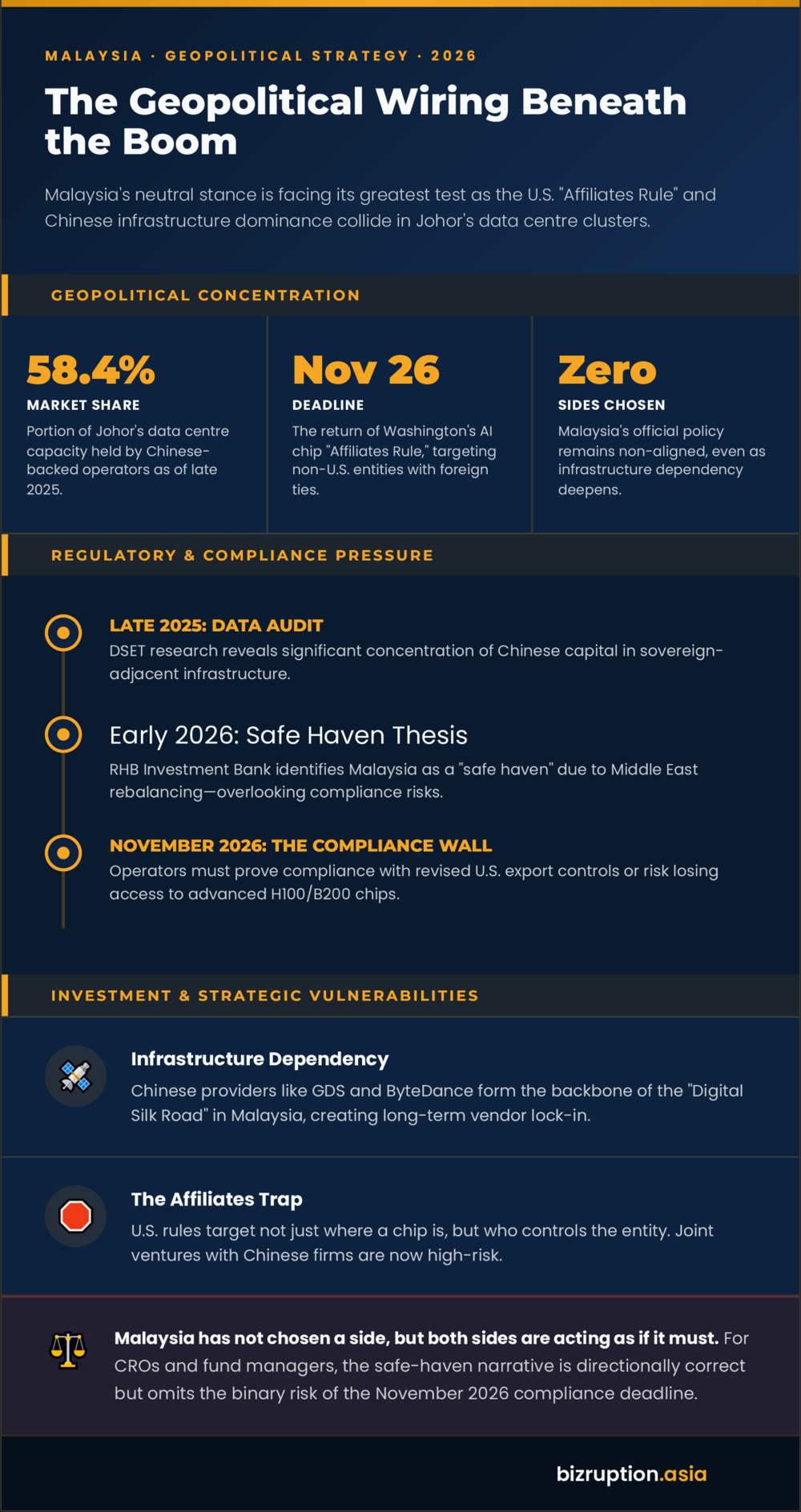
Chinese-backed operators account for 58.4% of Johor’s data centre capacity, per DSET – the Research Institute for Democracy, Society and Emerging Technology – in a report published October 2025. DayOne, the international arm of GDS Holdings, committed USD 3.5 billion to Johor in 2025.
DSET identifies four models through which Chinese capital has entered Malaysia’s stack: direct operator subsidiaries, joint ventures with local partners, third-party providers hosting Chinese clients and Chinese firms investing in the energy infrastructure that powers the facilities. ‘
Each model carries a different risk profile for institutional counterparties, and a different regulatory exposure under US policy.
The Chip Loophole Washington Is Closing
Faye Simanjuntak of the Asia Society Policy Institute noted in January 2026 that Malaysia’s neutrality has made it an attractive location for Chinese firms seeking advanced chips unavailable on the mainland under US export restrictions. By establishing facilities in Malaysia, operators can legally procure semiconductors barred from direct export to China.
Washington is moving to close that gap. The US Bureau of Industry and Security’s Affiliates Rule is suspended until November 2026. On reinstatement, it requires operators to disclose beneficial ownership structures and restricts AI chip access for facilities connected to listed Chinese entities.
When the rule reinstates, operators and investors with opaque ownership structures or Chinese counterparty exposure face material compliance risk. Farlina Said, a senior analyst at the Institute of Strategic and International Studies Malaysia, has warned stricter US rules could restrict Malaysia from providing compute to Chinese AI models, “potentially affecting profitability.”
The CSIS has documented the enforcement dimension. In 2024, Singapore charged a ring that purchased USD 390 million in servers with banned NVIDIA GPUs and routed them into Malaysia – a case CSIS assessed as likely representative of wider diversion traffic.
The Infrastructure Dependence That Complicates the Picture
The geopolitical exposure runs in both directions. China is not only occupying Malaysia’s data centre capacity; it is building the energy infrastructure those facilities depend on.
PowerChina operates gas power and hydropower projects across the country. Huawei runs smart grid upgrades. Tianneng Group launched a 1 GWh solar-storage-computing project in early 2026, framed as a clean power solution for regional data centre operators.
This creates an asymmetry that no Western-aligned policy response has yet addressed. Restricting Chinese operators from Malaysian data centres is a tractable regulatory problem. Replacing that capital in Malaysia’s power grid is not, at least not on any timeline investor models currently assume.
What Institutional Investors Need to Map Now
Three specific risk vectors have defined timelines.
The Affiliates Rule reinstates in November 2026. Operators and investors with Chinese beneficial ownership exposure, or contracts granting Chinese entities chip access, need compliance assessments before that date, not after.
Malaysia is taking a more selective approach to data centre approvals, per Natural Resources Minister Nik Nazmi Nik Ahmad’s January 2026 Financial Times interview.
Projects with significant Chinese counterparty structures are more likely to face scrutiny under a framework that is tightening on both environmental and security grounds simultaneously.
RHB Investment Bank’s April 2026 research identified Malaysia as a data centre safe haven, citing Middle East security concerns prompting portfolio rebalancing toward Southeast Asia.
That thesis is directionally correct. It does not account for the November 2026 compliance deadline or the infrastructure dependency that sits underneath the safe-haven narrative.
Malaysia has not chosen a side. Both sides are now acting as if it must.
References:
- A Shared Future? Economic Security Challenges from Malaysia-China Economic Cooperation and Data Centre Development – DSET
- Malaysia’s Gamble: Turning Data Centres Into Industrial Power – Asia Society Policy Institute / 9Dashline
- China Steps In as Malaysia’s Data Centre Surge Puts the Power Grid to the Test – China-Global South Project
- AI Chip Export Controls: A New Challenge for Data Centres – Data Centre Knowledge
- The Limits of Chip Export Controls in Meeting the China Challenge – CSIS
- BIS Revises Export Review Policy for Advanced AI Chips Destined for China – Morgan Lewis
- Chinese Companies Fuel Malaysia’s Data Centre Boom Amid Rising AI Demand – Malay Mail
- Malaysia Emerges as Data Centre Safe Haven as Geopolitical Risks Reshape Global Investment Flows – RHB / TechNode Global
- Regulation and Geopolitics Pressures on Southeast Asia Data Centres – FTI Consulting
- Why Malaysia’s Data Centre Boom Faces Water Sustainability Concerns – ISIS Malaysia / BenarNews