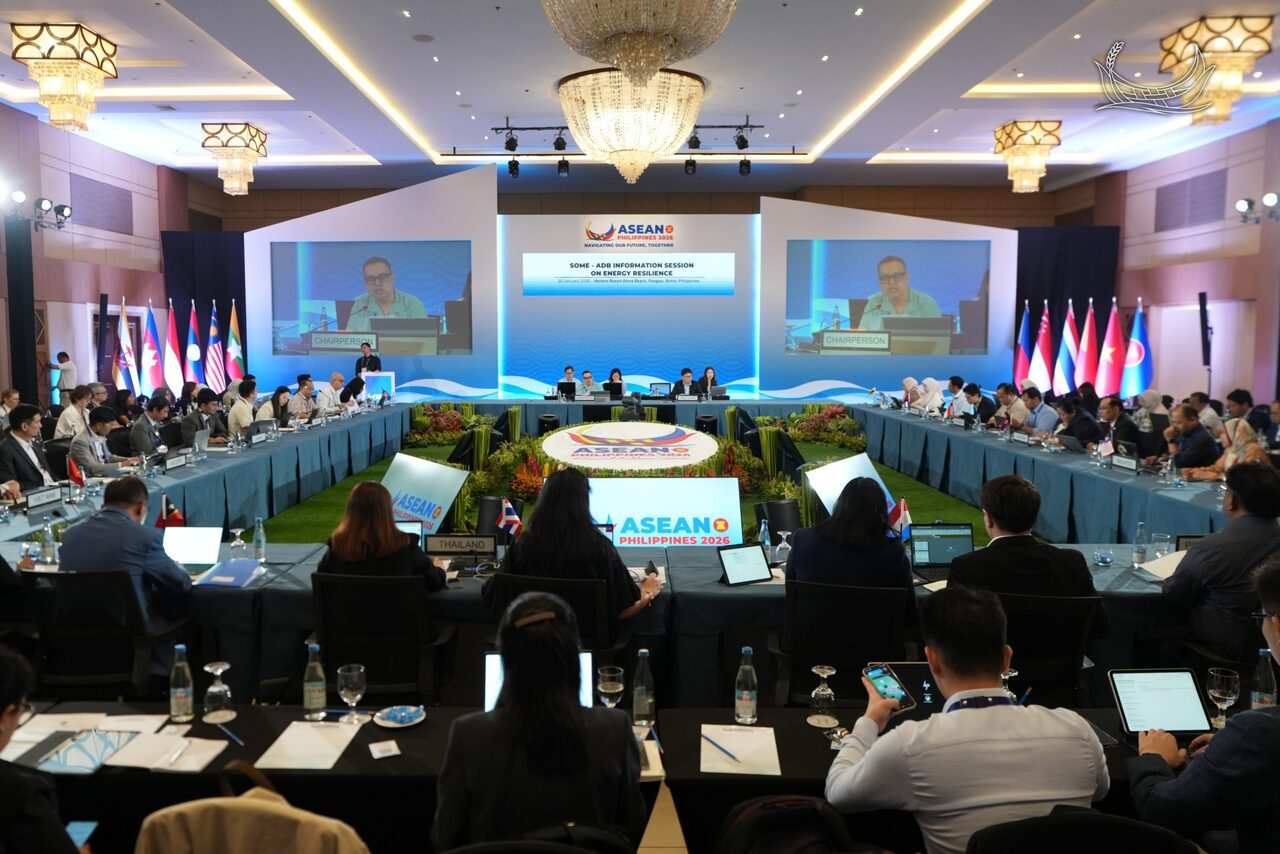
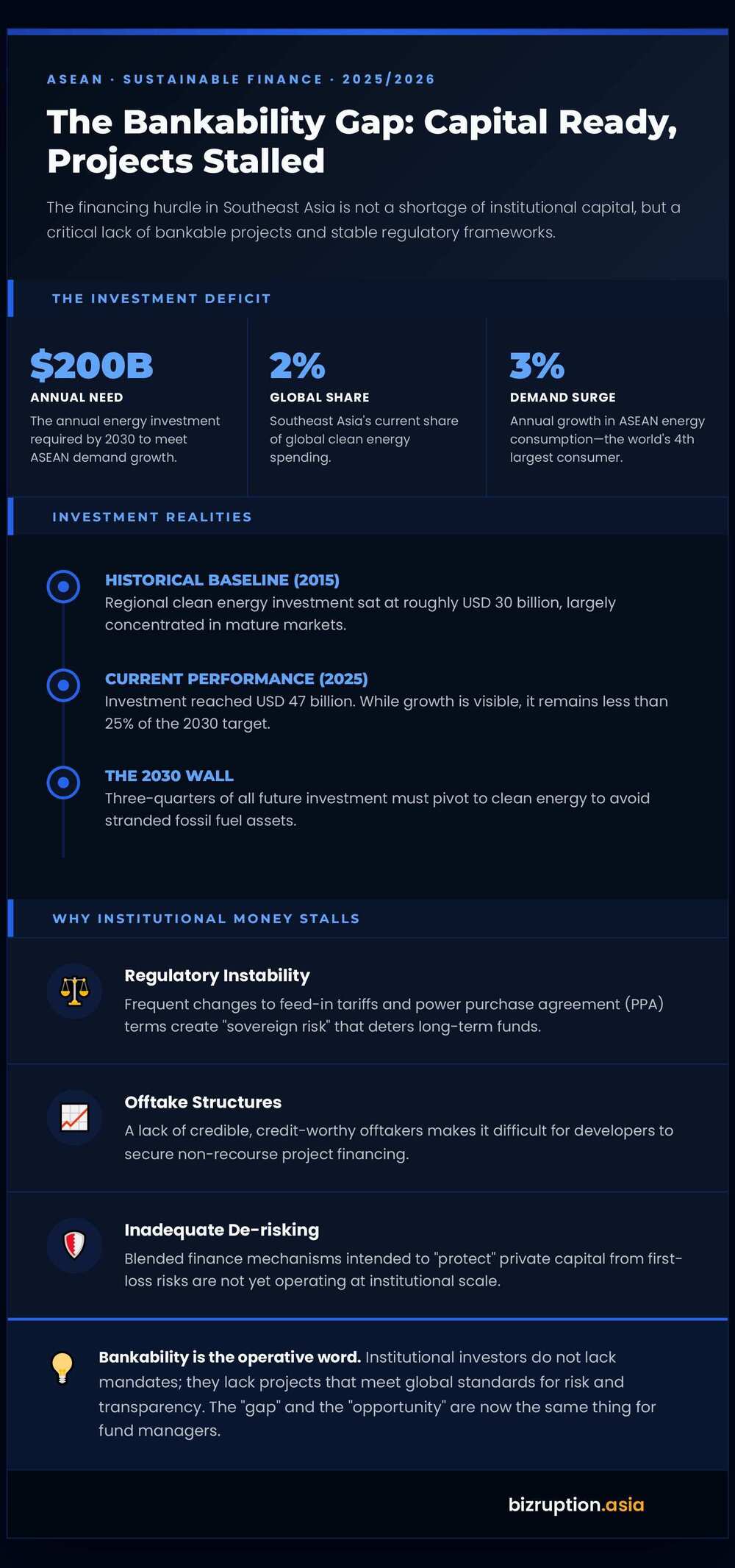
At the Energy Transition Meeting in ASEAN on 26 May 2025, Malaysia’s Deputy Prime Minister Fadillah Yusof put the problem plainly: “ASEAN is now the world’s fourth-largest energy consumer, with demand rising at 3% annually.”
The region needs at least USD 200 billion in annual energy investment by 2030, three-quarters of it in clean energy, per the IEA and Imperial College London. Clean energy investment in Southeast Asia reached USD 47 billion in 2025, up from USD 30 billion in 2015, per the IEA’s World Energy Investment 2025 report.
Progress, but still less than a quarter of what is needed. Almost all remaining investment continues to flow to fossil fuels. For the full picture, see the companion piece: ASEAN Bets Billions on AI After Missing Its Clean Energy Targets.
The Financing Gap Is Not a Shortage of Capital, It Is a Shortage of Bankable Projects
Institutional money is not avoiding ASEAN. Southeast Asia’s clean energy spending represents only 2% of global totals, per the IEA – not because fund managers lack mandates, but because the projects, offtake structures and regulatory frameworks required to deploy at scale do not exist in sufficient volume.
The ASEAN Centre for Energy’s 2025 report identifies three structural barriers: high perceived risk, a fragmented market across ten divergent jurisdictions, and the absence of a coordinated regional pipeline of investment-ready projects.
The cost of debt compounds this directly. Onshore wind across ASEAN carries a nominal cost of 9%-12%, and utility-scale solar 8%-11%. Equivalent projects in developed markets finance at 4%-6%. That 300 to 600 basis point spread is the price of regulatory, political and currency risk.
Until those risks are structurally reduced, available capital and deployed capital will not converge.
Hyperscalers Are Building on the Wrong Side of the Ledger
The USD 1 billion commitments from Google in Thailand, Microsoft and Amazon across Malaysia, Indonesia and the Philippines dominate energy headlines. They should not be confused with supply-side infrastructure spending.
Every dollar deployed in a data centre campus funds energy consumption – it does not fund generation, transmission or storage. Each new hyperscaler facility adds load to a grid that already lacks the clean supply to serve it, widening the financing requirement rather than meeting it.
ASEAN’s power grid alone requires an estimated USD 800 billion in generation and transmission by 2045, per the World Bank’s ASEAN Power Grid Financing Initiative.
JETP: Committed Capital That Has Not Yet Moved
The Just Energy Transition Partnerships for Indonesia and Vietnam are the most substantial concessional mechanism in play.
Indonesia’s JETP carries total commitments of USD 21.4 billion. Financing approvals reached USD 3.1 billion as of December 2025. Total disbursements – combining JETP and AZEC – stood at USD 3.5 billion by February 2026, according to Coordinating Minister Airlangga Hartarto.
The structural constraint is visible in those ratios: JETP financing runs 96%-97% debt and only 3%-4% grants, per the ASEAN Centre for Energy. Sovereigns carrying commercial-rate debt to fund transition infrastructure, while simultaneously managing fiscal ceilings and a Hormuz-driven cost surge, face a compounding squeeze.
The Cirebon-1 coal plant retirement in Indonesia – the first intended live test of JETP’s coal phase-out – stalled over legal uncertainty, community opposition and official liability concerns, revealed IISD’s September 2025 analysis.
The lesson is not that the mechanism cannot work. It is that the distance between pledged finance and deployed finance is where most of the USD 170 billion gap actually lives.
Where the Gap Closes and When
Blended finance had reached USD 19.75 billion across 99 ASEAN transactions as of the most recent Convergence dataset – a 2023 baseline that understates current deployment but signals the architecture is functional. The velocity has not yet matched the shortfall.
The ASEAN Taxonomy and Transition Finance Guidance give allocators definitional clarity to move. Vietnam’s green bond market, flagged by Climateworks Centre as integral to its JETP, remains underdeveloped.
For fund managers, infrastructure investors and corporate treasurers, the operative question is not whether the opportunity is real. It is whether the specific project, jurisdiction and offtake structure has been prepared to institutional standard. Most have not.
The managers building bankable pipelines now are positioned to deploy when the window opens. In ASEAN’s energy transition, the window and the gap are the same thing.
References:
- Financing Clean Energy in Southeast Asia – IEA and Imperial College London
- ASEAN Energy Investment 2025 – ASEAN Centre for Energy
- How Can ASEAN Close Its Energy Investment Gap? – ASEAN Centre for Energy
- Southeast Asia – World Energy Investment 2025 – IEA
- What Happened at the Energy Transition Meeting in ASEAN – World Economic Forum
- ASEAN Power Grid Financing Initiative – World Bank
- JETP Indonesia Progress – Energy Transition Indonesia / sipet.org
- Indonesia Disburses USD 3.5 Billion from JETP and AZEC – VietnamPlus
- Is JETP Making Progress in ASEAN Energy Transition? – ASEAN Centre for Energy
- De-risking Just Energy Transition Partnerships – IISD
- Realizing the Potential of JETP in the Current Geopolitical Environment – Columbia CGEP
- Progress on Just Energy Transitions in Vietnam and Indonesia – Climateworks Centre
- Bridging the Investment Gap – ASEAN Climate Change and Energy Project
- Accelerating Clean Energy Investment in ASEAN: Policy Options – ASEAN Centre for Energy