Foreign Investors Exit Thai Assets at Fastest Pace Since 2024
16 April 2026
Editor’s View: Foreign investors dumping $823 million in Thai equities and $705 million in bonds during March – the largest combined outflow since October 2024 – exposes Thailand’s acute vulnerability to the Iran war energy shock. Public debt at 66% of GDP leaves no room for subsidies, deflation has turned into 3.5% inflation projections, and the central bank is paralysed between recovery support and price control. The baht slid 2.8% since late February. Thailand’s deeper exposure runs beyond fuel – over half of power generation comes from gas, with LNG imports rising. Portfolio managers warn markets haven’t priced in the full growth impact. Political stability under PM Anutin briefly brightened the outlook, but oil near $100 per barrel kills it.
Full article here: Foreign investors exit Thai assets at fastest pace since 2024 as oil shock exposes economic vulnerabilities
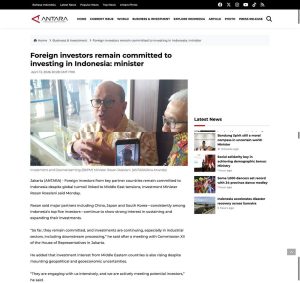
Foreign Investors Remain Committed to Indonesia Despite Global Turmoil
13 April 2026
Editor’s View: Investment Minister Rosan Roeslani reporting sustained commitment from China, Japan and South Korea – consistently among Indonesia’s top five investors – signals confidence in political stability and execution. President Prabowo’s Japan visit secured $23.6 billion in commitments; South Korea followed with $10.2 billion in business-to-business MOUs. Middle Eastern interest is rising despite geopolitical uncertainty. Domestic registrations surged: 1.8 million from MSMEs and local investors in five months. First-quarter 2026 investment realisation expected at Rp 497 trillion ($28.9 billion), up 7% year-on-year. The momentum reflects Indonesia’s advantage: national stability, rising domestic participation and sustained foreign interest amid external pressures. Commitment is one thing; execution and delivery remain the test.
Full article here: Foreign investors remain committed to investing in Indonesia: minister
Malaysia Well-Positioned to Capture Tech Relocation Amid West Asia Tensions
16 April 2026
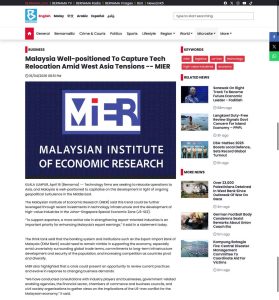
Editor’s View: MIER identifying technology relocation opportunities as firms seek to exit Middle East exposure makes strategic sense – Malaysia’s recent investments in tech infrastructure and the Johor–Singapore Special Economic Zone provide the foundation. The think tank warns logistics costs and input prices will rise, affecting business performance over two to three months, particularly SMEs. Prolonged conflict increases insolvency risk. MIER proposes temporarily reducing SST to 5% for two years (excluding liquor, cigarettes, gaming), gradually reducing RON95 subsidies whilst reallocating savings to diesel subsidies for businesses, and cutting stamp duties for business restructuring. The recommendations are tactical. Malaysia’s advantage is timing and infrastructure – seize the relocation wave or watch it pass.
Full article here: Malaysia well-positioned to capture tech relocation amid West Asia tensions – MIER
Japan Pledges $10 Billion Energy Support to Southeast Asia
16 April 2026
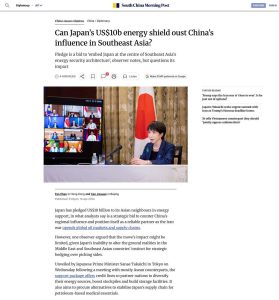
Editor’s View: Japanese PM Sanae Takaichi unveiling $10 billion in energy support at the Asia Zero-Emission Community forum – attended by Thailand, Vietnam, Philippines and Malaysia leaders – positions Japan as a reliable energy partner amid the Iran war crisis. The package offers credit lines to diversify energy sources, boost stockpiles, and build storage facilities, covering the equivalent of 1.2 billion barrels of oil, matching a full year of ASEAN crude imports. Analysts call it a strategic bid to counter China’s regional influence and embed Japan at the centre of Southeast Asia’s energy security architecture. However, one observer notes limited impact given Japan’s inability to alter Middle East realities and ASEAN’s instinct for strategic hedging over picking sides. Timing matters more than pledges.
Full article here: Can Japan’s US$10b energy shield oust China’s influence in Southeast Asia?
Vietnam and China Strengthen Strategic Technology Cooperation
17 April 2026
Editor’s View: Vietnamese Minister of Science and Technology Vu Hai Quan meeting Chinese counterparts during General Secretary To Lam’s state visit delivered institutional cooperation beyond rhetoric. Focus areas: joint research, government-level cooperation mechanism for strategic technologies, mutual recognition of scientific evaluation, and joint laboratories linked to postgraduate training. The model – joint research centres conducting research in key laboratories whilst participating in postgraduate training – enables technology transfer with workforce development. Human resource training follows a project-based model in AI, energy, new materials and smart cities. China handles core technology training; Vietnam manages testing and application. The shift from technology transfer to joint R&D of core technologies is strategic. Execution and commercialisation determine success.
Full article here: Vietnam and China to boost joint research and high-tech training