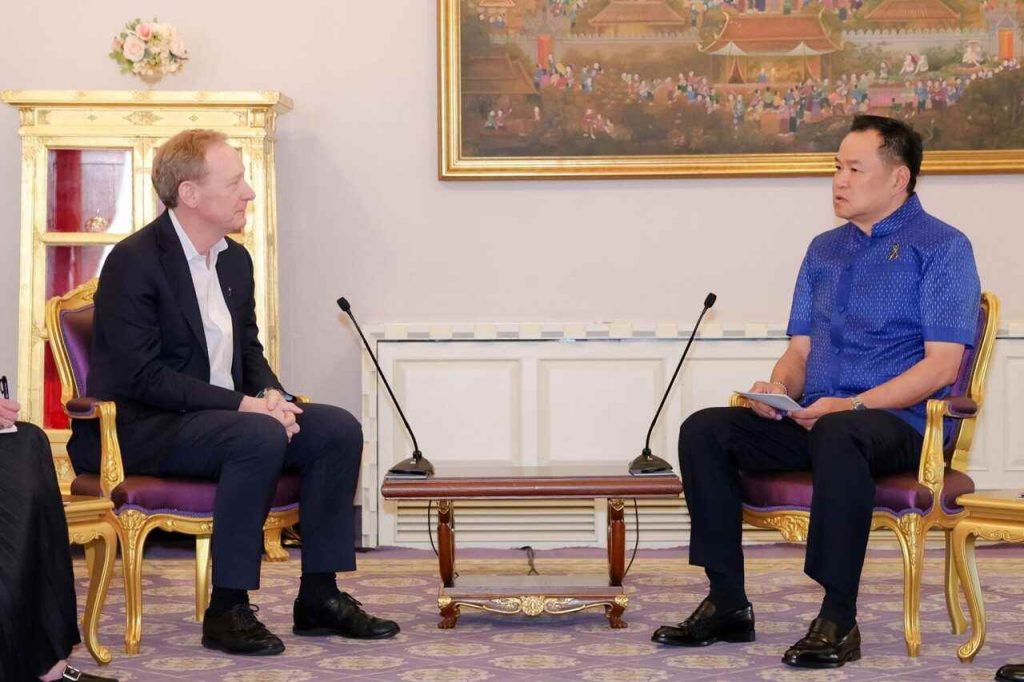
On 31 March 2026, Microsoft Vice Chair Brad Smith stood at Government House in Bangkok, announced more than USD 1 billion in cloud and AI infrastructure investment over 2026-2028, and left Thailand looking like a regional technology hub in the making.
The commitment funds a sovereign cloud region built to Microsoft’s global engineering standards, a 150,000-worker AI certification programme through the Ministry of Labour and direct collaboration with Thailand’s Office of the Council of State on AI governance tied to the country’s OECD accession bid.
Prime Minister Anutin Charnvirakul called it “a clear expression of confidence in Thailand’s future.”
The next morning, Thailand’s Joint Standing Committee on Commerce, Industry and Banking (JSCCIB) cut its 2026 GDP growth forecast to 1.2%-1.6% from 1.6%-2.0%, revised inflation upward to 2%-3% from a prior projection of 0.2%-0.7% and named stagflation – slowing growth alongside rising prices – as the operative risk.
The JSCCIB is the combined voice of Thailand’s chambers of commerce, industry federation and banking association. When it uses the word stagflation, fund managers and CFOs with Thai exposure listen.
Three Institutions, One Diagnosis
The JSCCIB did not manufacture a crisis. It confirmed one already visible in institutional forecasts. The IMF closed its 2025 Article IV Consultation with Thailand in February 2026 projecting 1.6% GDP growth and flagging risks as “elevated and tilted to the downside” – and that projection preceded the Hormuz energy shock by two weeks.
The Bank of Thailand’s Monetary Policy Committee, in its December 2025 decision, had already cut its own forecast to 1.5%, noted six consecutive quarters of loan contraction and reduced the policy rate for the sixth time since October 2024, bringing it to 1.00%. Neither institution was describing a short-term cyclical dip. Both were describing structural underperformance.
The OECD’s December 2025 Economic Survey of Thailand put a number on it: between 2015 and 2023, Thailand accumulated foreign direct investment equal to 11% of annual GDP. Malaysia accumulated 25%. Vietnam accumulated 42%.
Those gaps do not open in a single bad year. They accumulate across a decade of insufficient reform, weak competition policy and a regulatory environment that discourages the high-productivity investment Thailand needs.
The Hormuz closure has compressed every margin the economy had left. Around 60% of Thailand’s crude oil imports originate in the Middle East, with roughly 0.3 million barrels per day transiting the Strait of Hormuz, per Krungsri Bank data.
By 22 March, the Oil Fuel Fund – the state buffer used to hold domestic fuel prices below market rates – had accumulated a deficit of THB 28.1 billion, with the government subsidising diesel at THB 26.99 per litre daily. The government has since prepared a THB 40 billion borrowing facility to keep the Fund alive.
The policy trap is now explicit. With inflation projected at 2%-3%, the Bank of Thailand cannot cut rates without making it worse. It cannot raise rates without crushing an economy already growing below 1.5%. At 1.00%, the rate floor is in sight.
What Thai CEOs Are Actually Saying
PwC surveyed 59 Thai chief executives for its 29th Global CEO Survey, published 30 March 2026 – one day before the Microsoft announcement. Only 24% expressed strong confidence in their organisations’ revenue growth over the next 12 months, against a global average of 30%. Only 34% expect the domestic economy to improve this year; globally, 55% of CEOs do. PwC Thailand CEO Pisit Thangtanagul was direct: “Confidence among Thai CEOs has fallen to its lowest level in three years, driven not only by a slowing economy but by increasingly complex and overlapping risks.”
On AI specifically: one-third of Thai CEOs reported revenue increases from AI deployments over the past year. Only 18% achieved both revenue growth and cost reduction simultaneously. The gap between installing AI tools and extracting economic value from them – the gap Microsoft’s infrastructure is designed to close – remains wide in the market that infrastructure is being built to serve.
The Ecosystem Gap Microsoft Cannot Buy
Microsoft is arriving into an active buildout. Google launched a Bangkok cloud region in January 2026, projecting USD 40 billion in economic value to Thailand over five years. Gartner forecasts Thai IT spending will reach THB 1.1 trillion in 2026, up 8.4% year-on-year, with data centre systems growing 27.9%. The infrastructure race in Thailand is real.
The talent pipeline is not keeping pace. Microsoft has upskilled two million Thais in AI over two years – a number the company cites as evidence of momentum. Thailand has fewer than four million investment account holders total, approximately 6% of the population, against South Korea’s retail investor participation rate of more than 40%.
The AI-literate professional base that a USD 1 billion cloud region needs to run at productive capacity – the engineers, data architects and enterprise AI managers who translate infrastructure into output – does not yet exist at industrial scale in Thailand.
The OECD named the constraint clearly: Thailand’s FDI incentives have not delivered high-productivity outcomes because competition is weak, knowledge transfer between foreign and domestic firms is limited, and barriers to entry for new firms remain high. Infrastructure investment does not fix any of those things.
One Commitment, Two Timeframes
Microsoft’s USD 1 billion is a decade-long strategic position on Thailand’s role in the regional digital economy. Brad Smith framed the investment in geopolitical terms at a US Senate hearing four days earlier – Southeast Asia expansion as part of America’s technology competition with China, not purely a commercial calculation.
That rationale holds regardless of whether Thailand’s GDP grows 1.2% or 1.6% this year.
The stagflation diagnosis operates on a different clock. Thai equity valuations, corporate earnings forecasts and government fiscal space are all being reset in real time. The policy rate is at its floor. The Oil Fuel Fund is burning through reserves. The JSCCIB has now cut its growth forecast twice in 2026.
Cloud servers and an exhausted central bank are not contradictions. They are Thailand in April 2026 – a country receiving the infrastructure of a future it has not yet built the conditions to inhabit. The investors who get Thailand right this year are the ones who understand which clock they are trading against.
The Productivity Gap
FDI accumulation 2015-2023 vs. peers and what Microsoft’s USD 1B does (and doesn’t) fix.
“The gap is not a forecasting problem. It is a structural one – accumulated across a decade of insufficient reform, weak competition policy and a regulatory environment that discourages high-productivity investment.”
THE PRODUCTIVITY GAP
Between 2015 and 2023, Thailand accumulated FDI equal to 11% of annual GDP. Malaysia accumulated 25%. Vietnam accumulated 42%. The gap is not a forecasting problem; it is a structural one, documented by the OECD in December 2025. Microsoft’s USD 1 billion is the largest single publicly announced technology investment in Thailand’s history. The question it raises is whether this investment accelerates the structural reform needed to close that gap, or becomes another line of foreign-owned infrastructure in an economy that has yet to build the domestic capacity to fully extract value from it.
References:
-
- Microsoft Deepens Thailand Partnership with more than US$1 billion Investment – Microsoft News Asia
- Thai Business Group Cuts 2026 GDP Growth Forecast to 1.2%–1.6% – Bangkok Post
- Business Leaders Slash Thai Growth Forecast – Bangkok Post
- IMF Executive Board Concludes 2025 Article IV Consultation with Thailand – IMF
- Monetary Policy Committee’s Decision 6/2025 – Bank of Thailand
- OECD Economic Surveys: Thailand 2025 – OECD
- PwC Thailand’s 29th Global CEO Survey – PwC Thailand
- Thailand’s Brittle Defense Against Oil Shocks – The Diplomat
- Microsoft Plans USD 1 Billion Investment in Thailand – Bangkok Post
Thai CEO Sentiment: Key Findings
| Metric | Finding |
|---|---|
| Confidence & Outlook | |
| CEOs surveyed | 59 Thai chief executives |
| Strong revenue confidence (next 12 months) | 24% – vs. 30% global average |
| Expect domestic economy to improve in 2026 | 34% – vs. 55% globally |
| CEO confidence level | Lowest in three years |
| AI Adoption & Returns | |
| Reported revenue increase from AI (past year) | 1 in 3 Thai CEOs |
| Achieved both revenue growth & cost reduction via AI | 18% only |
| Value extraction gap | Wide – tools installed, economic returns limited |
| Survey Context | |
| Survey published | 30 March 2026 |
| Microsoft USD 1B announcement | 31 March 2026 – one day later |
| JSCCIB stagflation declaration | 1 April 2026 – GDP cut to 1.2%–1.6% |